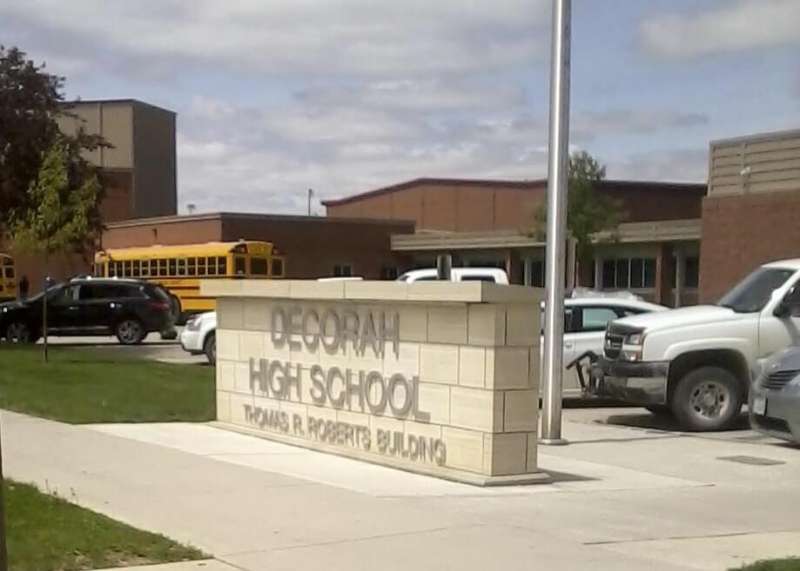
Just a few weeks ago U.S. News and World Report ranked Decorah High School as the 4th best in Iowa, and in the top 3% of schools nationally. However, many voters and school district administrators in Northeast Iowa worry if local children will enjoy the same quality of education after this year’s contentious school funding debate in the Iowa Legislature.
Darrel Branhagen, the freshmen State Representative from the area, has stuck with other House Republicans in their proposal to keep the funding increase to only 1.25%. Education advocates have urged at least a 4% increase to keep up with inflation and maintain the quality of Iowa schools. The low funding level has many school districts worried about how to make ends meet the next few years.
“We’ll have three or four positions that won’t be filled,” says Mike Haluska, the superintendent for the Decorah School District. While that could mean larger class sizes, the district also plans to postpone program improvements. “We were going to do a K-12 revision of our math program … We’re not going to be able to do those curriculum kinds of things we hoped to.”
Even a potential deal rumored at the Capitol to add a one-time funding increase for next year’s budget likely won’t be enough. “At the levels they’re talking about right now, even at 2.625%, that’s just not going to get it done,” Haluska says. “You’re not going to move your education program forward.”
A recent survey of school district administrators highlighted the consequences of the lower funding amount, pointing out a number of fewer opportunities children in Northeast Iowa schools will have. The Howard-Winnishiek district said it’s laying off nine staff and that class sizes will increase by six to eight students. North Winnishiek predicts they’ll have to raise property taxes to bring in an additional $80,000 to keep their budget guarantee and will also remove a basketball coach.
“We’re trying to maintain the status quo,” says Dwayne Willhite, the superintendent of the North Fayette and Valley districts. He mentions his districts are a bit unique thanks to some extra incentive money they obtained recently, but says future problems may be looming. “There’s a couple places where it would be nice to have more, but we’ve been getting by without it for several years now, so we’re kind of used to getting by with less. Next year is going to be very difficult – we’ll probably be offering early retirement settlements … We’ll probably have some spots that go unfilled.”
Also at issue is just how long it’s taking for a budget to get finalized. With House Republicans publicly refusing to budge for months, the Legislature has gone well past the date it’s supposed to produce a budget so schools can start planning.
“I think the Legislature knowingly is violating the law in not getting the budget in the hands of the school boards so they can prepare their budget,” says Lyle Otte, who lives in the Decorah area. “I think that’s just criminal. They should be obeying the law.”
“We have a whole state full of school districts who can’t plan because they’re uncertain of funding,” agrees Peter Olafsen, a retired teacher in Winnishiek County. “I have been extremely frustrated. It seems like we want to do things on the cheap. It seems like while it appears there is ample funding in what appears to be a surplus, we don’t want to fund public education adequately.”
“Frustrating” is the most common word uttered by those concerned with Northeast Iowa’s public education. Many are beginning to wonder where the actual priorities of Iowa’s elected leaders are with the education stalemate.
“The level of funding seems to be a polar opposite to statements made by the Governor when reelected that he wants to make Iowa number one again in education,” says Haluska. “When you look at what other states have done, the spending levels in Iowa simply don’t match the desire to move back into the elite in the country in terms of educational attainment.”
“It’s sad that they talk about – especially the Governor – about wanting to move us toward world-class schools, while at the same time they’re claiming the economy has gone bad in Iowa,” says Willhite. “And there is a revenue excess coming into the state budget, but they’re not recognizing that all of it’s there. Part of that is they’re back-filling the property tax cut. In my view, the legislators have placed property tax relief on a higher pedestal than education.”
Others wonder whether Darrel Branhagen is really listening to the local concerns. “He’s pretty much going with the Republican Party,” says Otte. “They can afford it.”
“I don’t think he’s been receptive,” Haluska says of the new state representative. “As is the case across the board with the Republican House, they seem to have taken the stance that it’s 1.25% and not veering from that in any way. It’s almost like it’s not a matter for debate. That really, for me, has become one of the real frustrations.” Haluska notes that it hasn’t always been this way during his 26 years as superintendent. He mentions that Chuck Gipp, the former Leader in the House from the Decorah area, was able to come to consensus with Democratic Governor Tom Vilsack on several areas.
“When the Republican Governor proposes a budget that’s $166 million higher than what the House did – I don’t think anyone would brandish Terry Branstad as a liberal,” Haluska argues. “So I’m assuming he’s putting out a relatively conservative budget, and yet it’s $166 million more than the House? You mean to tell me they can’t find the extra 70-some million dollars it would have taken to move that to 4%? I just find that awfully hard to believe, if that was a priority.”
Willhite says that Branhagen has been “very good and open and talking with us about the issues.” Still, he notes that “he talked to us about more of a business model for education… that’s not really how education falls together.”
“I really feel bad for the teachers who take the brunt of criticism,” adds Willhite. “As they talk about good education, and yet fail to fund education adequately, they’re really dipping into the number of teachers we can have. And the fewer teachers we have the more work everyone else has to do. It’s getting pretty difficult to find good teachers these days.”
As the legislative session drags on, many at the Capitol and around the state eagerly watch to see what type of deal gets done on education. A recent rumor suggests Republicans may offer $55 million more in one-time spending for the upcoming year (which would get it overall to a 2.6% increase), but stick to the 1.25% for the following year. That could set up yet another contentious debate next session.
“It’s really been frustrating,” Haluska says of the long-lasting stalemate in the education debate. “If you look at any other sector of government, if they want information on something regarding the medical profession, they turn to the doctors. If they want something from the legal profession, they turn to the attorneys. Yet when they want something from education, they immediately turn away from the educators as though they’re going to give them some sort of biased view. That seems a little bit irrational to me. People don’t go into education for themselves – they aren’t in it to get rich. They want to help kids. We all want to help kids. We just aren’t going to be able to do that. We’re not going to be able to move our programs forward with that kind of funding we’re looking at.”
by Pat Rynard
Posted 5/20/15