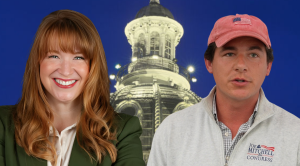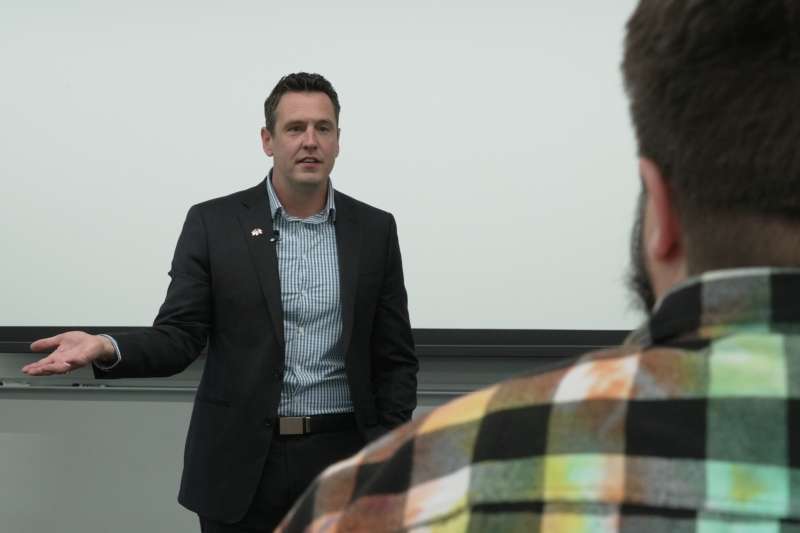
Zach Lahn stood in front of excited supporters Tuesday night and declared Iowa doesn’t belong to “the political class” or “lobbyists, special interests and corporate giants.”
“I will take on the big ag cartels. I will break up their monopolies, and I will get Iowa farmers a fair deal,” Lahn said Tuesday night, the Associated Press reported.
Iowa Republicans liked the message enough or didn’t like Trump-endorsed Randy Feenstra enough to make Lahn their nominee for governor. But there’s a problem at the center of his outsider narrative.
While his campaign has been spinning him as the governor race’s clear-eyed, anti-establishment candidate, available reporting documents Lahn’s long history in politics during which he built skills and contacts that he’s relying on in his bid to help Republicans keep the governor’s mansion this November.
From conservative student activist to Republican Congressional staffer
Coverage of Lahn has identified him as a political outsider. One report from Iowa State Daily, a student newspaper, claimed “Lahn has never been involved in government before.” He bragged on X that he’s the only candidate in the race without a .gov email. But his Legistorm profile is a paper trail of his early political career going all the way back to when he was finishing up college.
The earliest appearance of Zach Lahn in the political press dates back to 2009 when President Barack Obama visited Grand Junction, Colorado for a town hall. ABC News’ Political Punch blog described a 23-year-old Lahn who, after shouting out a few times during the event’s Q&A segment, stood up demanding “an Oxford-style debate.”
“I think this is good,” Obama said. “You know, this is good. You know, I like that. You got to have a little chutzpah, you know.”
A Colorado political news website wrote, “It also takes some ‘chutzpah’ to fail to disclose to either the President or to reporters interviewing you afterward that you’re a staffer for one of the hardest-right Republicans in the Colorado Senate.” According to the report, he was working for Greg Brophy, who in 2008 infamously offered an amendment to anti-discrimination legislation that would include LGBTQ people to instead protect short people.
In 2010, Lahn got involved in Republican US Rep. Cory Gardner of Colorado’s election campaign. According to Legistorm, a database used to track government officials and staff, he followed Gardner and worked as a staff assistant. In 2011, he started managing now-US Sen. Steve Daines of Montana’s first campaign, and by 2013, he was Daines’ congressional state director.
In 2013, Lahn returned for a brief time to Iowa. Republican David Young—who himself was chief-of-staff to US Sen. Chuck Grassley’s office and is currently in the legislature—hired Lahn to manage his congressional campaign. And in 2014, Lahn signed on to work for Matt Schultz’s congressional campaign.
Lahn’s big break: Stop Medicaid expansion in Montana
After some years on the campaign trail, he got his big break with Americans for Prosperity.
AFP is the flagship political advocacy group of the Koch Industries network and is considered one of the most powerful and well-funded political networks in the country. It’s spent decades and hundreds of millions of dollars pushing to reduce regulations on pollutants as part of a mission framed as a push for small government. For example, AFP was among the groups that pushed the Supreme Court to curb regulatory power over carbon emissions. Critics note AFP just so happens to benefit Koch Industries, one of the country’s largest industrial polluters, considerably.
The political-arm organized local chapters that have worked to block renewable energy standards, clean car rules, and carbon pricing at the state level. But when Lahn came on in 2014 as state director, he helped lead AFP Montana’s push to block Medicaid expansion in the 2015 legislative session. In mailers, telephone call campaigns, and local events, AFP pressured Republican legislators to dig their heels in and for those who faulted: one Republican state legislator had his face superimposed over a picture of President Barack Obama on a poster, the Montana Standard reported.
Lahn’s effort ultimately failed. The Montana House passed legislation to expand Medicaid to 75,000 people.
“We are deeply disappointed in the legislature’s decision tonight to expand Medicaid. This decision stands directly against the voices of millions of Montanans who have made it clear that they do not want more Obamacare,” Lahn wrote in a statement.
Only, Montana’s estimated population in 2014 was 1.02 million; not millions.
Montana Governor Steve Bullock wrote on the app then known as Twitter, “Yesterday, a “grassroots” organization talked about the things #MillionsOfMontanans did. What else have #MillionsOfMontanans done?”
The Great Falls Tribune reported Lahn’s response: “Two mistakes were made yesterday. One was in our press release, the other was on the house floor with the passage of Medicaid expansion.The latter mistake will have a devastating impact on state budget and the lives of Montanans who have made it known that they reject Obamacare. Our organization and our 14,000 Montana activists will be holding lawmakers accountable for that mistake in years to come.”
The organization continues in Montana, but Lahn left the group shortly after.
Lahn heads to Kansas to found a Koch-funded private school
Lahn moved to Wichita, Kansas a few years later. There he co-founded a private school called Wonder. The pre-kindergarten through 12th-grade school opened in 2018 on the campus of Wichita State University. Tuition was $10,000 a year when it started, KSHB reported.
“We believe that we need to have an understanding of freedom and why we can have these discussions and debates. But no, there’s not any sort of politically driven or any other influence,” Lahn told The Wichita Eagle when asked about his political background.
Wonder did not seek accreditation through the Kansas Department of Education, meaning it was not required to follow state regulations, administer state tests, or hire licensed teachers. It instead grouped students into multi-age studios with “guides” and “coaches” instead of teachers, and no traditional grades, report cards, or homework.
The private school project was financed by Chase Koch—son of billionaire Charles Koch—and Chase Koch’s wife Annie Koch. During the years that followed, Annie Koch and Lahn divorced their spouses and married each other.
Lahn’s Kansas-Iowa commute
As early as 2014, Lahn owned property in Iowa. That’s when he and his then-wife purchased property in Belle Plaine, Iowa. But as recently as 2022, he claimed residency to vote in Kansas.
A Kansas Reflector analysis of voter registration records showed Lahn only barely became eligible to run in Iowa. He participated in three Kansas elections:
- November 2018 – voted with a provisional ballot in a general election
- November 2020 – voted in-person in a general election in Sedgwick County
- August 2022 – voted with an advance ballot in a primary election (essentially Kansas’ name for early voting)
Iowa requires governor candidates to have resided in the state for at least two years prior to their election date. On October 17, 2024, Lahn registered to vote in Iowa, just in time to meet the requirement. That same year, his wife Annie Lahn purchased a home near Wichita and declared on a mortgage document that it was her primary residence, not the house in Belle Plaine. One year later, the couple sold the Wichita home to an LLC for $1.
During this year’s primary, a Des Moines Register report found that Lahn’s personal plane spent 75 nights in Wichita compared to just 51 nights at his property in Belle Plaine. Lahn said his trips to Kansas were to spend time with his children.
“But if I’m elected governor, it would be a different arrangement, and we’d work it out. Because, you know, we’d be in Iowa as much as humanly possible,” Lahn promised.
Lahn won Tuesday’s primary by less than one percentage point. Now he has five months to convince Iowans that the outsider story holds.