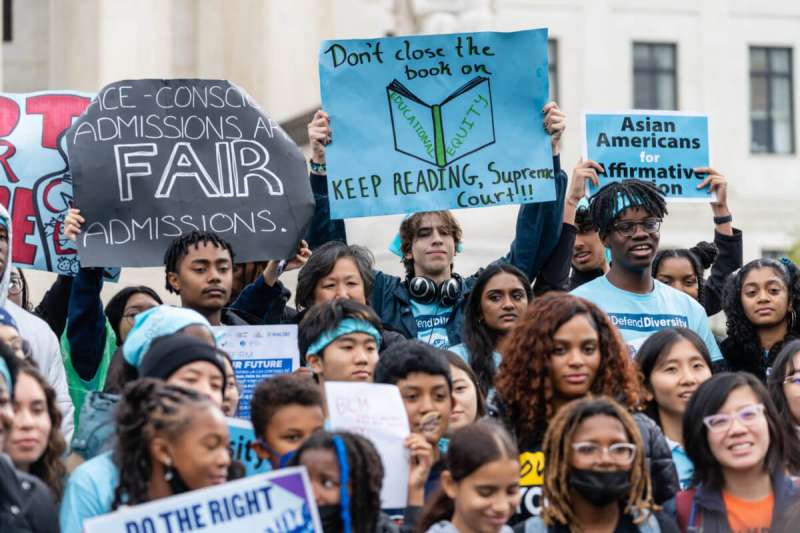
The US Supreme Court on Thursday struck down affirmative action in college admissions, ruling that consideration of race during the admissions process is unconstitutional.
In two separate decisions, the Court’s conservative judges ruled that race-conscious admissions programs at the University of North Carolina (UNC) and Harvard were illegal, even as legacy-based admissions that benefit wealthy, white, and well-connected students continue.
The vote was 6-3 in the North Carolina case and 6-2 in the Harvard case, with Justice Ketanji Brown Jackson recusing herself from the Harvard case, since she’d previously been a member of an advisory governing board at the university.
“The student must be treated based on his or her experiences as an individual—not on the basis of race,” Chief Justice John Roberts wrote for the majority.
The Court’s decision reverses decades of precedent. In 1978, the Court ruled that affirmative action was lawful, which it later upheld in 2003 and 2016. But now, with a staunch right-wing majority, the Court has once again reversed decades of established precedent, just as it did in last year’s Dobbs v. Jackson Women’s Health Organization, which overturned 1973’s Roe v. Wade ruling.
Both cases—Students for Fair Admissions v. President & Fellows of Harvard College and Students for Fair Admissions v. University of North Carolina—were filed by a right-wing activist group.
In the UNC case, Students for Fair Admissions argued that the universities discriminated against white and Asian applicants by giving preference to Black, Latino, and Native American students. Harvard, meanwhile, was accused of discriminating against Asian American students by using subjective standards to limit the number accepted.
The decision will force universities and colleges to revamp their admissions practices and find other ways to try and ensure diverse student bodies. The impacts could be significant for Black, Latino, and Native American students, who have historically been left out of higher education in America and faced systemic barriers in the education system, including exclusion, segregation, and underfunding.
Conservatives have argued for decades that affirmative action hurts white and Asian-American students. However, contrary to what critics have said, affirmative action did not automatically grant students of color admission to universities or colleges. Instead, it allowed their race and ethnicity to be considered as part of a broader evaluation of their application, as a way to ensure that historically disadvantaged populations were given a more fair chance at admission.
The impact of affirmative action has been significant. Over the past four decades, college enrollment and completion rates have risen among students of color. But there is still work to be done: Black and Latino students continue to remain underrepresented at selective universities and colleges and at many states’ flagship public universities.
The loss of affirmative action could make things worse, with one study finding that the likelihood of admission to highly selective public colleges could decline by 23%.
The experiences of the University of Michigan and the University of California, which were forced to stop using affirmative action in admissions 15 years ago, are also instructive. Since the bans went into effect, both school systems have prioritized outreach and invested significant financial resources in order to maintain diverse student bodies. But as both universities admitted in amicus briefs filed with the Court in the UNC and Harvard cases, those pricey efforts have completely failed.
In 2022, the freshman class at the University of California, Berkeley included only 241 Black students and 121 Native American students out of 6,750 total incoming students. In contrast, there were over 2,000 white students and 3,514 Asian students.
A year earlier, at the University of Michigan’s main campus in Ann Arbor, only 4% of more than 32,000 undergraduate students were Black, a decline from 7% in 2006, back when affirmative action was in use. That decline came amid an increase in Michigan’s college-age Black population. In contrast, 58% of students at the university were white and 19% were Asian.
Seven other states also prohibit consideration of race in admissions to their public colleges and universities: Arizona, Florida, Georgia, Nebraska, New Hampshire, Oklahoma, and Washington.
Despite the Court’s ban on considering race in the admissions process, Justice Roberts did note that universities could consider applicants’ discussion of their personal race-based experiences in admissions essays.
“Nothing in this opinion should be construed as prohibiting universities from considering an applicant’s discussion of how race affected his or her life, be it through discrimination, inspiration or otherwise,” Roberts wrote, noting that this was permissible as long as students are “treated based on his or her experiences as an individual—not on the basis of race.”
However, he also warned that his (bizarre and confusing) carveout did not mean application essays could be used as a workaround to the ban on affirmative action.
“Universities may not simply establish through the application essays or other means the regime we hold unlawful today,” he wrote, underscoring, “What cannot be done directly cannot be done indirectly.”
In a dissent to the conservative decision, Justice Sonia Sotomayor—who has previously said affirmative action opened the door for her to attend Princeton University and Yale Law School—wrote that Thursday’s ruling “rolls back decades of precedent and momentous progress.”
“Today, the Court concludes that indifference to race is the only constitutionally permissible means to achieve racial equality in college admissions,” Sotomayor wrote. “Ignoring race will not equalize a society that is racially unequal. What was true in the 1860s, and again in 1954, is true today: Equality requires acknowledgment of inequality.”
In a separate dissent, Jackson—the Court’s first Black female justice—called the decision “a tragedy for us all.”
“With let-them-eat-cake obliviousness, today, the majority pulls that ripcord and announces ‘colorblindness’ for all by legal fiat,” Jackson wrote. “But deeming race irrelevant in law does not make it so in life. And having so detached itself from this country’s actual past and present experiences, the Court has now been lured into interfering with the crucial work that UNC and other institutions of higher learning are doing to solve America’s real-world problems.
“It is that inequality that admissions programs such as UNC’s help to address, to the benefit of us all. Because the majority’s judgment stunts that progress without any basis in law, history, logic, or justice, I dissent,” she added.
President Joe Biden also criticized the ruling, calling it a “severe disappointment” and pointing out that discrimination still exists in America.
“I strongly, strongly disagree with the court’s decision,” Biden said in a speech at the White House. “We cannot let this decision be the last word…We need a new path forward, a path consistent with the law that protects diversity and expands opportunity.”
Biden urged colleges not to “abandon their commitment to ensure student bodies of diverse backgrounds that reflect all of America” and suggested a new standard for them to consider: a measure of the adversity a student has overcome, including a lack of financial means, where they grew up, and where they went to high school.
But “students first need to be qualified applicants,” he added, just as they had to be under affirmative action.
Biden also said he was directing the US Department of Education to find ways to study which practices help build diverse student bodies, and which practices hold that effort back, specifically calling out legacy admissions as a program that “expand[s] privilege instead of opportunity.”
The Court’s decision was also met with criticism from racial justice advocates.
“In a society still scarred by the wounds of racial disparities, the Supreme Court has displayed a willful ignorance of our reality,” the NAACP said in a statement.
The court’s ruling could also prove unpopular with the public. A May poll of 1,680 American adults by the Associated Press-NORC Center for Public Affairs Research found that 63% believe that the Supreme Court should not prohibit colleges and universities from considering race during admissions.
In a footnote, Roberts also exempted military academies from the ruling, because of “the potentially distinct interests” they present.
by Keya Vakil
06/29/23