Chris Petersen started raising pigs in 11th grade because he wanted a better car. He married the girl he was trying to impress, and the two of them built a farm together outside Clear Lake. His Iowa farm spanned 400 acres and reared 2,500 hogs a year. A family operation they proudly ran themselves.
Then in 1998, hog prices collapsed. Petersen and thousands of other independent Iowa hog farmers went bankrupt. When the dust settled, he said, farmers like him faced a choice. The industry was pushing producers like him to sign on as a contractor raising hogs someone else owned, or to get out of the business entirely.
“Our American dream was over,” he said. “They’d done it to us, along with tens of thousands of other independent pig farmers.”
In 1935, the number of farms in the US reached an all-time high of 6.8 million. By 1990 that number had dwindled to 2.1 million farms. And farm bankruptcies are climbing again—they rose 46% in 2025 compared with the year before, according to the American Farm Bureau Federation.
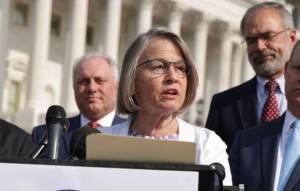
Petersen was one of five Iowa farmers and agriculture advocates who gathered at a barn near Elkhart on Wednesday for a press conference arguing that a policy being slipped into the Farm Bill would do to the survivors what the 1990s did to him.
The Save Our Bacon Act, a signature act for US Rep. Ashley Hinson, would block states from enforcing conditions on livestock products sold across their borders. Its main target is California’s Proposition 12, which requires that pork sold in the state come from hogs given at least 24 square feet of usable space—effectively banning the sale of pork from hogs raised in gestation crates. Those are narrow metal enclosures that confine sows for most of their lives. It was overwhelmingly popular, passing with 63% approval from California’s electorate. The US Supreme Court upheld Prop 12 in 2023. Three other states have adopted similar rules.
According to USDA data, roughly 27% of U.S. pork producers have already spent money to become Prop 12-compliant. If Hinson’s Save Our Bacon Act becomes law, there’s concern about wasted investment. Aaron Lehman, president of the Iowa Farmers Union, said there are other policies to help producers in Iowa without going back on this investment: country-of-origin labeling, antitrust enforcement for meatpackers, and greater investment in regional meat processing.
“We know how to make meaningful changes to help Iowa livestock farmers,” Lehman said. “We just need the political will to demand that they be put in place. The Save Our Bacon Act won’t get it done.”
As she’s pushing the act in Congress, Hinson is also running for US Senate. Her Democratic opponent Josh Turek has also said he opposes the bill.
“This bill protects giant foreign corporations and hurts Iowa’s local pork producers all so the billionaire CEO of Smithfield can rake in more profits,” Turek wrote on X. “Ashley Hinson once again putting billionaires over rural Iowans.”
A spokesperson from Hinson’s campaign said Turek’s opposition to the bill amounts to backing “Prop 12 regulations on Iowa farmers,” which the spokesperson called “disqualifying,” and that “Ashley Hinson has listened to [farmers] and led the fight against anti-ag activists trying to tell Iowa farmers how to raise their livestock.”
The campaign added that the bill’s scope “stops at the farm gate” and “would have no effect on movement, harvesting, or processing of livestock,” arguing it gives farmers and consumers a choice—since without it, the campaign said, producers are forced to comply with California’s standard if they want access to that market.
The campaign pointed to a study by North Dakota State University economist Sandro Steinbach, which it said argued that Prop 12 compliance is driving up grocery prices. But Steinbach told The American Prospect that USDA data shows the wholesale price increase from Prop 12 has actually been modest—about 4 cents per pound—and that the larger jump in retail prices mostly reflects retailers “exploiting a perceived opportunity” to raise prices once they had something to point to, not the cost of compliance itself. Brent Hershey, a Prop 12-certified farmer in Pennsylvania, told Sentient Media his own compliance costs worked out to about $4 per pig raised — roughly a 1% increase in operating costs — after his herd’s health and conception rates actually improved.
The SOB Act has the backing of the Iowa Pork Producers Association, Iowa Farm Bureau Federation, and national agriculture groups. Farm Bureau’s political action committee has endorsed Hinson in her Senate bid. The National Pork Producers Council, the industry’s largest trade group, has been the loudest voice pushing for the bill.
“It’s not very often you get 100 percent of your policy asks included in a bill approved by Congress,” NPPC president Rob Brenneman wrote on LinkedIn.
But farmers at Wednesday’s press conference, organized by the advocacy group Farm Action Fund, argued the bill protects the largest meatpackers, not farmers. Lehman said four companies control the large majority of the country’s beef, pork, and poultry processing, and that farmers now receive less than 15 cents of every food dollar Americans spend.
That consolidation has drawn its own scrutiny. The Justice Department settled price-fixing claims in May against Agri Stats, a data-sharing company that helped major meatpackers, including Smithfield, coordinate pricing for years.
An analysis from Harvard Law School’s animal law program identified 13 Iowa laws the Save Our Bacon Act could affect. Most are the kind of import rules John Gilbert, a Hardin County farmer, warned about from the podium Wednesday: requirements that livestock entering Iowa test negative for diseases like brucellosis, tuberculosis, and pseudorabies before crossing the border. Gilbert said losing those protections could open the door to diseases like African swine fever.
“It’s telling people you don’t have a right to a choice at the cash register,” he said.
Hinson is right that the bill stops its regulation on states at the “farm gate.” The bill defines “production” narrowly as the “raising (including breeding)” of livestock and specifically states that production “does not include the movement, harvesting, or further processing” of livestock. Because the bill only bars states from regulating “production,” that carve-out suggests Iowa’s border health checks and disease-testing rules, the ones Gilbert cited, could survive a legal challenge, since they govern the movement of animals across state lines rather than how those animals were raised. The bill hasn’t been enacted and the analysis flags “movement” as one of several undefined terms that would require judicial interpretation:
“The scope of ‘movement,’ for example, would have significant consequences for the ability of states to control the spread of pests (such as New World screwworm) and diseases (such as avian influenza) affecting livestock entering and within their borders,” the authors of the Harvard analysis wrote.
Iowa Code section 579B.3 regulates the production contracts binding farmers to the companies whose hogs they raise. Unlike the import rules, a law regulating the terms of livestock production contracts falls squarely within what the bill itself defines as “production,” making it arguably a clearer target.
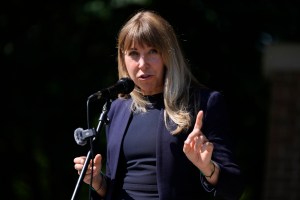
Tony Thompson, a farmer and Iowa Senate candidate, argued the bill would punish farmers for innovating instead of rewarding them.
“Small family farms aren’t going to win a race against multinational, vertically integrated corporations on producing the cheapest pound of protein. And frankly, I don’t want them to — because when lowest cost becomes the only goal, everything else starts to look like a cost to be eliminated,” Thompson said. “Good stewardship is a cost. Good animal husbandry is a cost. The farmer becomes a cost. It’s a race to the bottom.”
For Petersen, the fight isn’t abstract. It’s the difference between staying independent and going back to being what he called, bluntly, a “chore boy” for someone else’s hogs.
“The industry will not rest until they’ve got 100% of market share,” he said. “This is the game, people — get rid of us.”