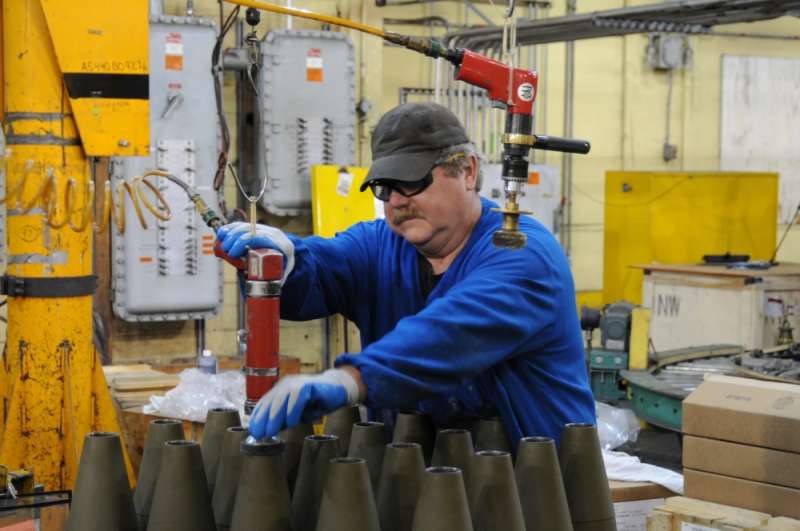
MIDDLETOWN – The US Army plans to detonate 68 barrels of unstable, highly explosive lead azide this Friday, Nov. 20. While a public meeting was held last month, the Army released the first map of where wind could carry lead-containing dust across the region, just five days before the planned detonation.
Army Sustainment Command public affairs specialist Justine Barati, a spokesperson for the Army, acknowledged the plume area is news to many people outside Middletown.
“I understand that it’s shocking to the people that we haven’t told before,” Barati told Iowa Starting Line. “It’s not shocking to the Middletown area because we knew they were in the potential area of impact all along. But to the other areas, yeah, it is shocking. It’s new information.”
The Army has planned two detonations at the plant around noon Friday. The blast, according to Sunday’s advisory, will produce an air plume containing “some lead-containing particles” that will disperse in the air and settle on the ground. The projection in the release shows lead-contaminated dust traveling through a corridor between Iowa City, Cedar Rapids, Clinton, and Davenport, moving as far north as Maquoketa.
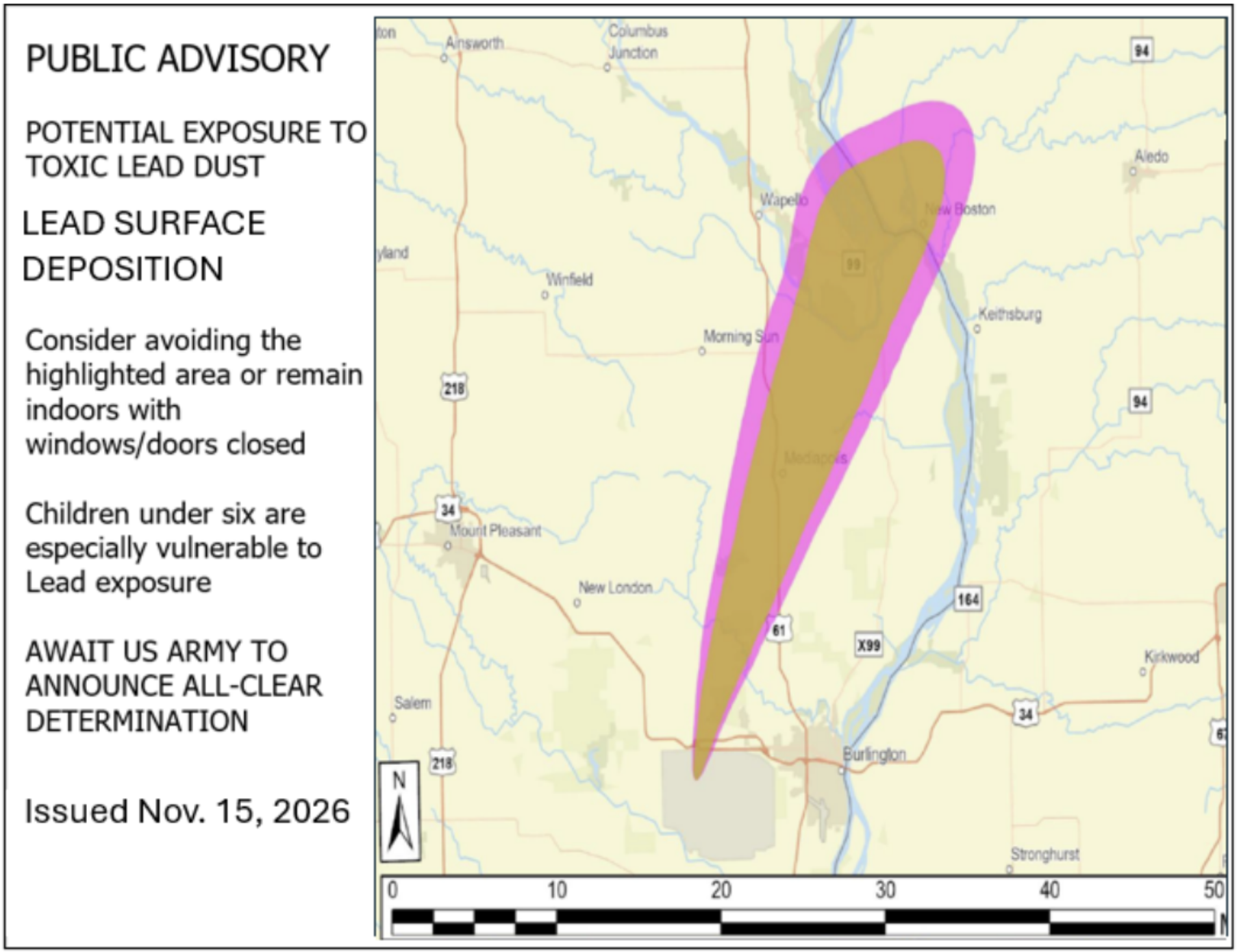
Barati told Iowa Starting Line that Johnson County was included in the first model but that shifting winds could change the projection. The next update is due 48 hours before the blast, according to the advisory.
“Johnson County might not be in it anymore, depending on what the wind predictions are for Friday,” Barati said. “And then when we do the six hour plume, it might have Johnson County back in it again if now they think the wind is gonna go that direction again. … So we’re giving people as much notice as we can. And then we’re talking to them about what they can do if they think they were exposed.”
Barati said the Army gave the public five days notice, meeting the EPA’s requirement.
There is no level of exposure to lead that is known to be without harmful effects, according to the World Health Organization. Exposure is particularly harmful to young children and women of child-bearing age. In infants, children, and fetuses, the National Institute of Environmental Health Sciences says lead exposure impacts brain development, lowering IQ, shortening attention spans, and can cause behavioral or learning difficulties.
“If you think that your house was exposed, what you would need to do is then use a garden hose and rinse off your porch and any kind of children’s play equipment you may have,” Barati said. “Anything that a child could potentially put in their mouth or touch and then put their hand in their mouth … you just have to use a garden hose or wipe it down with a wet washcloth and then launder the washcloth normally.”
The Army’s advisory says to wait until the Army determines the exposure period has ended before cleaning surfaces.
Middletown prepares to leave town
Eric Gerst, Middletown’s former mayor, lives about 5,000 feet from the blast site and said the Army detonates artillery rounds at the plant almost daily. He said it sounds like a large gun going off, but “nothing earth-shattering.” He said that while he is used to the sound, his dog, Jarvis, is not. Jarvis, a mini-golden doodle, gets “awful nervous.”
“I’m going to do what they’re recommending and remove myself from the adjacent area,” Gerst, who’s lived in Middletown for 28 years, said.
At 5 a.m. on Friday, he’ll go to work like any other day. Once he gets a call from his wife, the couple will pick up Jarvis and their youngest daughter, head to Iowa City, and hope to return in the afternoon.
Gerst is one of the 363 people living in Middletown who have been asked to get out of town for the explosion and immediate aftermath. The Army is recommending that residents of the Middletown City Park neighborhood leave from 8 a.m. to 2 p.m. because vibrations could break windows.
Gerst, who said he is not personally worried, said that the Army has said a controlled detonation is the only viable way to deal with the unstable material. “I want it gone,” he said.
Still, Gerst said he understands why people outside of Middletown are alarmed. He got the plume projection Sunday “just like everybody else,” he said, but Middletown residents have “been aware of this for a couple months now,” which gave them time that others didn’t have. While he’s not worried about it, he said he’s not surprised by mounting concerns.
“I empathize with those people,” he said. “I think that there’s reason for concern.”
The Army’s plan to mitigate damage, lead exposure
The Army is detonating the lead azide in place because it has determined the material is too unstable to move. Barati said it has taken measures to limit how much lead leaves the plant. A controlled explosion lets crews wet the soil and use water sprayers above the buried cement bunker containing the explosives. A sand barrier has also been erected around it.
An October community fact sheet distributed by the Army addressed whether the blast would contaminate air, water, or soil and noted that when lead azide is detonated properly, “the intense heat incinerates the explosive material.” It said the Army would work with the EPA to monitor air for lead contamination, but did not mention any risk of a plume or lead dust beyond Middletown.
The Army’s Nov. 15 email says the operation follows strict conditions in an EPA permit issued under the Resource Conservation and Recovery Act. The Army and EPA did not immediately make the permit available for review. The email lists earthworks, soil wetting, and air sampling as permit requirements. Environmental sampling took place before the blast and sampling of the blast area will follow.
There is no publicly available report on the lead azide or the decision to detonate it. Barati listed more than 25 agencies and offices that she said assessed the material, including the ATF, EPA, and the Army Corps of Engineers, but said she could not provide a report or any publicly releasable document.
Business Insider reported in October that the decision was approved by former US Army Sec. Dan Driscoll, who resigned following reported clashes with US Sec. of Defense Pete Hegseth.
The Army now calls it an ‘emergency’
Barati described the detonation as an “emergency operation.” Asked for a report from the experts the Army says assessed the material, she said none exists yet, and that the process has been “happening quickly.”
“None of that has happened yet because this is an emergency,” she said. If the Army did nothing, she added “something could happen which could cause it to detonate on its own.”
The problem was discovered in March during a routine semi-annual inspection of lead azide that has been stored in two earth-covered magazines at the Iowa Army Ammunition Plant for roughly 20 years. She said a survey in March found that the ethanol and water bath used to keep the lead azide from exploding had evaporated, leaving extremely volatile crystals of the compound around it.
The Des Moines Register reported in March that the plant was shut down for a “proactive safety review.” A March 19 Army release named lead azide as the concern but did not explain why. The release said the Army would carry out a multistep plan to neutralize and dispose of the lead azide. The Army said the plant would reopen March 30 with the volatile lead azide still in storage underground.
“There is no immediate danger to the public. The safety of our people and our neighbors is non‑negotiable,” Lt. Col. Daniel Nosse, commander of the plant, said in a March 19 release.
Eight months later, Barati told Iowa Starting Line the Army is worried the material could detonate at any time. The Army’s October fact sheet described a “deliberate, controlled disposal” and said “advanced explosive and scientific modeling is complete.”
Asked Tuesday whether five days is enough notice for those in the plume’s likely path, Barati said, “We are all welcome to have our own opinion. This is what the permit says that we are to do.”