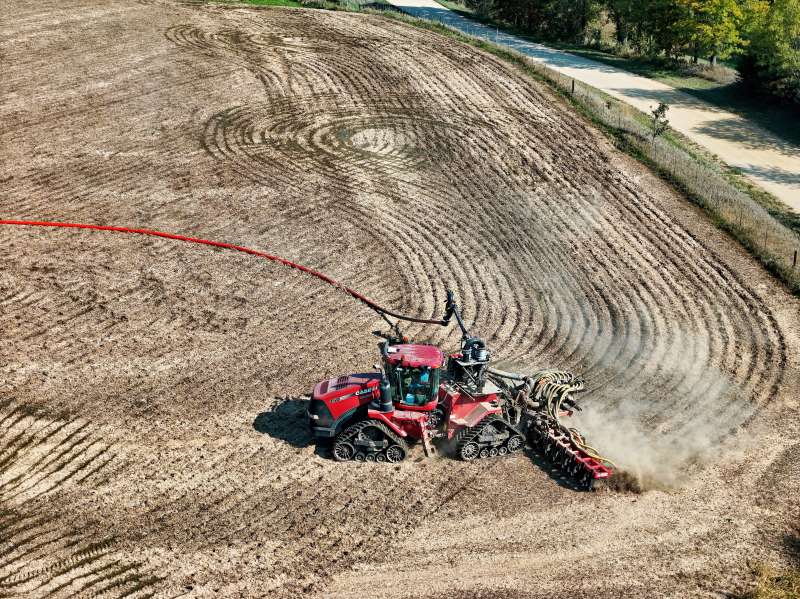
On a busy harvest day, Aaron Lehman’s Iowa farm can burn through 400 gallons of diesel. This fall, that fuel is costing him about $1,000 more per day than it did last year.
“That’s just a cost that you cannot adjust around and make up for in other ways,” said Lehman, a fifth-generation farmer whose family has worked the same ground between Ames and Des Moines for about 150 years. “And we are by no means a big farm.”
Lehman’s family grows corn, soybeans, oats, and hay. He is also president of the Iowa Farmers Union, which represents mostly small and medium-sized commodity farmers. Members across the state are telling him the same thing, he said: they’re struggling.
Why are Iowa farmers struggling?
The pressure has been building for years. A report from Iowa State University, the Iowa Farm Bureau Federation, and the Iowa Bankers Association found that Iowa net farm income fell 53% from 2022 to 2024, while the cost of producing corn and soybeans has risen more than a third since 2021. Lehman said decisions made in Washington have turned that hard stretch into something worse.
Tariffs came first. When President Donald Trump raised tariffs on China, Beijing retaliated by halting purchases of American farm products, cutting Iowa soybean exporters off from their biggest buyer. A later deal brought China back, but the Iowa Soybean Association noted that the first year’s promised purchases still amounted to less than half of a normal year’s sales.
Then came the war with Iran. Lehman said fertilizer prices had crept up for a decade because only a few companies supply nearly all of it. The war, he said, brought “huge, dramatic increases” on top of that.
No one he talks to expects prices to fall when the fighting ends.
“Farmers just have so many things we have to deal with,” Lehman said, “but these are bad decisions without a plan to get out of them and stop the harm that they’re causing farmers.”
The strain doesn’t stay in the field. Lehman said household costs, especially healthcare, are “going through the roof” for farm families just as their margins collapse. And when farm income drops, small towns feel it.
“We’re spending less money on machinery and supporting our Main Street businesses less, and people are going without healthcare in some cases, and bankruptcies are going up,” he said.
The broader numbers point the same way. Creighton University’s Rural Mainstreet Index, a monthly survey of rural bank CEOs, has had Iowa below growth neutral for most of 2026, most recently at 46.2 in August.
Lehman also pointed to a disconnect that frustrates farmers. The lower prices they receive haven’t translated into lower prices at the grocery store. He blames consolidation among the companies between farmers and shoppers, and he wants stronger antitrust enforcement.
“We farm because we want to grow things for people to eat,” he said.
His deeper worry is who comes next. He said he is constantly amazed by young people who want to farm and improve their communities, but the current economics are shutting them out.
“The real danger long term is that we’re missing out on the opportunity of some great people who would make great farmers and great members of our rural communities who aren’t seeing the opportunity,” he said.
Lehman said the tariff and war decisions came from the White House. What has surprised his members more is the silence closer to home.
“They have not heard their Iowa decision-makers, their members of Congress, their governor, their Iowa secretary of agriculture stand up and say, ‘This is wrong,’” he said. Real pushback came only months later, he said, after the damage was done.
What has Ashley Hinson done to help?
Iowa’s congressional delegation includes US Rep. Ashley Hinson, who’s also the Republican nominee for US Senate. She faces Democrat Josh Turek on Nov. 3. Hinson has promised to be Trump’s top ally in the Senate, and she has stood by his tariffs when it counted—for him.
For nearly a year, House Republican leaders used procedural rules to block votes on the emergency powers behind many of Trump’s tariffs. When that effort collapsed in February, Democrats forced a vote to end the tariffs on Canada, Iowa’s largest export market. The measure passed 219-211 with six Republican votes. Hinson voted no, telling Iowa Public Radio she believes Trump will “level the playing field” on trade.
Hinson has also defended a tough posture toward China. She did break with the president over his ground beef import policy, and she has said Congress needs to prioritize a farm bill that addresses rising costs such as fertilizer. Lehman noted that the farm bill is now three years overdue.
Iowa Farmers Union is taking an unusually direct role this fall. Lehman said this is the first time in his 14 years in leadership that the group has endorsed candidates in every federal race in Iowa.
IFU endorsed Turek for US Senate.
The goal, Lehman said, was to send “a clear message that we’re on the wrong path and we need to have a correction” toward farmer-centered policy.
Farmers are listening, Lehman added, and are trying to figure out what a better path looks like.
“These really have been policy failures,” he said. “It’s extremely frustrating when we have a policy failure that has really let us down when we need the help now more than ever.”