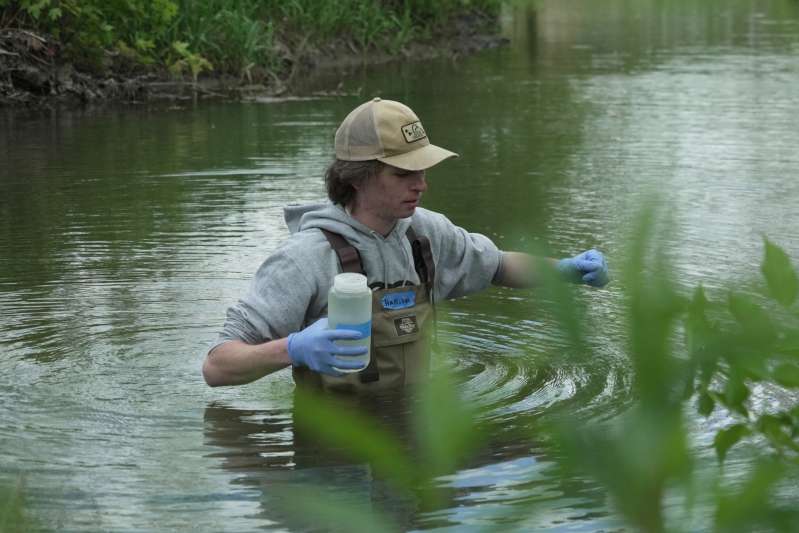
Tamara Krug leaves a wide strip of grass between her crops and the creeks that wind past her fields in western Linn County. She and her husband farm corn and soybeans next to three of them: Mill Creek, Morgan Valley Creek, and Prairie Creek. The grass costs her a couple of acres per field. It also keeps fertilizer in the ground she planted, not in the water her neighbors drink.
“What’s a couple of acres when it comes to saving the water?” Krug said.
Not every farmer sees it that way. Krug estimates about a third of the farmers around her don’t leave a buffer along the creeks, and Iowa doesn’t make them. The Iowa Legislature, majority Republican for nearly a decade, has passed no new regulations to shore up water quality, relying instead on the voluntary Nutrient Reduction Strategy.
“I think you should be required to be so far off a waterway. Period,” Krug said.
That hands-off approach is getting harder to defend. In 2026, Iowa had the second-highest rate of new cancer cases in the country and was one of only three states with a rising rate. The Iowa Cancer Registry’s 2026 report projects about 21,700 Iowans will be diagnosed with invasive cancer this year and 6,400 will die from it, both up from last year.
What the research says about nitrate
Cancer has many causes, and nitrate in drinking water is one researchers have studied for decades. Nitrate comes largely from farm fertilizer and manure that washes off fields into rivers and groundwater.
A long-running study of Iowa women published in Environmental Health Perspectives found a link between nitrate and bladder cancer. Researchers followed 34,708 postmenopausal women in Iowa from 1986 to 2010 and tracked how many years their public water supplies exceeded 5 mg/L of nitrate, half the federal limit. They found that long-term ingestion of elevated nitrate in drinking water was associated with an increased risk of bladder cancer.
A national study in Denmark points the same direction. Researchers calculated nitrate exposure for 2.7 million adults and found statistically significant increases in colorectal cancer risk at levels far below that country’s drinking water standard. The levels tied to higher risk were also well under what U.S. law allows.
Those findings matter in Cedar Rapids. The city has no treatment process to remove nitrate, so the amount in its tap water largely depends on how much is in the Cedar River. In 2024, the Northwest treatment plant, which supplies about a third of the city’s drinking water, put out water above 8 parts per million nitrate for most of a two-month stretch. A University of Northern Iowa researcher who tested tap water along the Cedar River this year concluded that all of Cedar Rapids is drinking water with unhealthy levels of nitrate, even though no sample broke the federal limit.
Accountability: How state leaders have responded
In 2023, the Legislature slashed $500,000 in funding for the Iowa Nutrient Research Center, the same amount that had historically supported the University of Iowa’s water quality sensor network. Those sensors make up three-quarters of Iowa’s continuous water monitors, and they haven’t received state funding since. The program faced shutting down until Polk County voted to put $200,000 toward keeping it running.
Republican Sen. Dan Zumbach, state senator representing District 34 in eastern Iowa, was the sponsor of that legislation. The bill that cut the funding for the Nutrient Research Center also removed a requirement that the center collaborate with Iowa’s other public universities. Zumbach’s term runs through January 2029.
Republican Congresswoman Ashley Hinson, who currently represents Iowa’s 2nd Congressional District—that’s Cedar Rapids, Dubuque, Mason City, Waverly, Waterloo, and Grinnel—is the Republican nominee for Iowa’s open US Senate seat. In 2023, she voted to overturn the Biden administration’s rule defining which waters receive federal Clean Water Act protections. She also voted no on the PFAS Action Act of 2021, which would have expanded federal requirements to address contamination in water.
At an October Senate debate against Democratic opponent Josh Turek, Hinson did not comment when asked whether farm subsidies should be tied to improved water quality and conservation.
Hinson has taken campaign donations from Bayer PAC—Bayer is the owner of Monsanto and Roundup—and CropLife America PAC, which represents the pesticide industry.
Republican Congresswoman Marianette Miller-Meeks, who represents Iowa’s 1st Congressional District, is running for re-election this November against Democrat Christina Bohannan. Like Hinson, she voted against the PFAS Action Act in 2021.
Republican Gov. Kim Reynolds’ efforts to lower Iowa’s cancer rates largely ignore water pollution. She proposed a bill to tax hemp and vaping products and remove foods with added dyes from school lunches as part of her plan. Meanwhile, a state-commissioned report released in September found that demographics and behavior account for much of Iowa’s excess cancer. But researchers also said counties and cancer types with remaining excess cases may be influenced by factors the analysis didn’t include.
Communications Director Tammie Krausman told Iowa Starting Line that the Iowa Department of Natural Resources’ work is broad. It includes watershed coordinators who work with landowners, lake restoration, monitoring of beaches and rivers, and programs that help communities protect the rivers, lakes, and underground water supplies their drinking water comes from. She did not point to any requirement that farmers cut runoff. Krausman said Iowa State University, not the DNR, measures whether the Nutrient Reduction Strategy is working.
A power plant raises new water worries
For Krug and her neighbors, the water fight now includes a power plant. Alliant Energy wants to build the Morgan Valley Energy Center, a 720-megawatt natural gas plant northwest of Fairfax, and is seeking a decision from the Iowa Utilities Commission by December. Alliant says the plant has no specific customers, but officials have said its location is based at least in part on rising power demand from data centers under construction in southwest Cedar Rapids.
Krug is part of Save Morgan Valley, a group of residents fighting the plant. About 41% of the land she farms sits within a mile of the site. Her 87-year-old father-in-law lives on the farm.
“If they’re allowed to drill a well out there, every farmer in that area is probably in trouble, and so are our crops,” Krug said. Many people in the area still rely on shallow sand point wells, she said, and one neighbor recently paid about $30,000 to drill a new well after theirs went dry.
According to a signed agreement, the City of Cedar Rapids’ Water Division will supply water to the plant through a new line. Krug said residents who asked about a contract were first told there wasn’t one, then learned of a letter of agreement.
Alliant now says its most recent plan for the plant wouldn’t use city water or an onsite well. Instead, a contracted supplier would deliver water to be stored on site, Alliant Senior Communications Specialist Taylor Adams told Iowa Starting Line. That proposal by Alliant still needs approval from the Iowa Utilities Commission and Linn County. Krausman said the DNR has not yet received a water use permit application for the facility.
Krug worries about what happens to the plant’s wastewater, and whether it could end up in her fields or her father-in-law’s well.
Abe Kellison, another core member of Save Morgan Valley, lives in Fairfax about two miles from the site. He said Alliant has told residents the plant would recycle its cooling water, but hasn’t explained what happens to the glycol-based solution once it’s spent.
“What do they do with the wastewater? They haven’t answered those questions,” Kellison said. “What if that wastewater leaches into our groundwater?”
That risk falls hardest on families who can’t afford a home filtration system. “I don’t know that it is [contaminated], but they haven’t told us, so we have to think about these things,” he said.
Adams said the plant’s glycol-based cooling system recycles its water and produces no wastewater. Other wastewater, including water used in summer cooling and to wash equipment, would be collected on site and transported to Cedar Rapids’ wastewater treatment plant or elsewhere for disposal. The plant would also use legally required spill prevention measures, Adams said.
Kellison said he’s heard estimates the plant could use up to 9 million gallons of water a year. Alliant projects about 4.2 million to 9.4 million gallons a year, which the company says is a quarter to a third of what a typical irrigated 18-hole golf course in the Midwest uses. Alliant has also suggested the plant’s design will minimize water use and wastewater discharge.
But both Kellison and Krug said Alliant representatives dodged their questions at public meetings, including a recent planning and zoning meeting.
“They’re trying to plow us over,” Krug said.
Alliant disputes that. Adams said the March meeting was only the start of the public review process. Since then, the company says they have filed applications with regulators, held two additional public meetings, answered questions compiled by Linn County, and posted project details on its website.
Residents will have their next chance to weigh in soon. Linn County Planning and Development Director Charlie Nichols said Alliant’s rezoning request goes back before the county’s Planning and Zoning Commission on Oct. 19, with the Board of Supervisors’ first reading set for Oct. 20.
The county’s review does consider the plant’s water use and wastewater disposal, Nichols said, but county rules don’t require those services to be provided in any particular way. The board can still weigh that information when it votes. Nichols said Alliant and the county have completed a host community agreement. All documents related to the case are posted on the county’s Morgan Valley Energy Center webpage.
Iowa Starting Line reached out to the City of Cedar Rapids, to Gov. Kim Reynolds’ office, and to Rep. Tom Gerhold, R-Atkins, whose district includes the proposed plant site, for comment, but did not hear back as of the time of publication.
‘Look at the health of the people’
Kellison said the people he’s spoken with in office acknowledge Iowa’s water quality problem but won’t take a stand before the midterms. He wants to know why the state keeps approving projects one at a time without weighing the collective toll on water, air, and health that’s already here.
“We are the second-highest cancer incidence state in the country. Why are we adding to that?” Kellison said. “Why are we not looking at enacting legislation that will penalize polluters?”
Krug has a message for state lawmakers too.
“You’re looking at the dollars that these businesses may bring in. You’re not looking at the health of our people,” she said. “Maybe we are consuming water that’s giving us cancer. You need to spend more time looking at the health of the people.”
READ MORE: Clean water advocates announce demands for Iowa rivers, streams