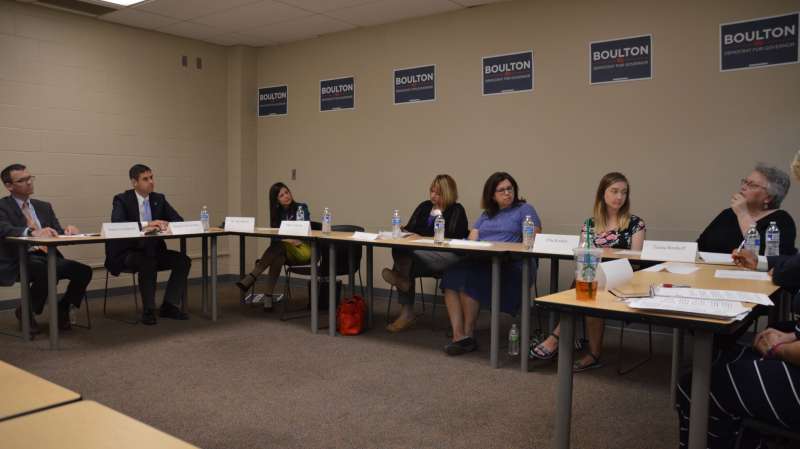
The drastic budget cuts to mental healthcare programs implemented by Governor Kim Reynolds and her predecessor look awfully bad on paper. But what are some of the real-life impacts that actual Iowans are seeing in their day-to-day lives? That’s something State Senator Nate Boulton sought to find out and highlight this week with a roundtable discussion aimed at uncovering the fallout of Reynolds’ actions.
“We’re at a time where Iowa’s revenue is stable and growing, and yet we’re seeing round after round of budget cuts,” Boulton said. “These problems don’t go away by cutting services. The problems still exist and must be dealt with at some point … This budget crisis does affect lives in our state. This budget crisis is holding our state back and creating long-term problems.”
The event was intended to focus on all aspects of Iowa’s budget cuts, but mental health concerns continually drove the discussion.
“They had to cut down on the number of school counselors in the last couple of years,” noted Ellie Konfrst, a senior at Roosevelt High School, when talking about low education funding. “There are two of them that deal with thousands of kids. When students have to go to the counselors for things like mental health issues or things like problems at home, they don’t have as much access to those people because they don’t have as much time in the day.”
Teresa Bomhoff, who has two adult children with mental health issues and is the president of National Alliance on Mental Illness for the greater Des Moines region, warned about the difficulties of keeping good mental health workers in the system.
“A behavior healthcare worker starts working for less wages than the regular medical profession,” Bomhoff explained. “It’s very easy if someone gets burned out or they need more money to support their family, that they will move to the regular medical field instead of staying in mental health. That’s a huge problem.”
Proposals by legislative Republicans this past year would drain even more funds from mental health services, in addition to actual programs cut.
“We’ve gone since the 1996 frozen levy, we were generating $218 million in property taxes,” Bomhoff said of mental health funds that impact Broadlawns Medical Center in Des Moines. “After mental health redesign with the state taking over, the number of dollars generated by property taxes went down to $145 million. With Senate File 504 it’ll go down to $114 million.”
Individual programs were completely eliminated this year by Reynolds and Republicans, including services that test school children for mental health issues.
“For example, audiological services for kids,” said Prakash Kopparapu, a West Des Moines businessman with a child on the autism spectrum. “$156,482. 100% cut. What that does, is if a teacher says this student is not listening properly in class, they’ll use an audio screening or a hearing screening. From 2018, you don’t have that anymore … We are 49th in the country [for mental health care]. How much more are we going to cut? Are we going to add more states to get lower?”
In addition to the specific cuts, the Medicaid privatization unilaterally enacted by Terry Branstad and Reynolds has slowed down services and care.
“I wrote a prescription for a patient to get a very needed medication for their illness, and it took Medicaid a really long time to approve it, and in the meantime she ended up in the emergency room and admitted to the hospital,” said Dr. Amy Shriver, a pediatrician. “That could have been prevented without that delay. These delays are costing us more money than they’re saving us.”
Boulton is looking at hosting more round-table discussions to connect Iowa’s budget issues with actual impacts on Iowans.
by Pat Rynard
Posted 7/11/17