Amie here. There are things we Iowans can do to cut our cancer risk ourselves—we can decide to put on sunscreen more often, drink less, exercise more, and not smoke tobacco.
But not everything is a personal decision. If we want cleaner water, less air pollution, and to keep our public buildings mitigated from radon, that takes collective decisions.
That’s what Zachary Oren Smith‘s letter is about this week: Policy changes Iowa’s elected officials could make to reverse Iowa’s fast-growing cancer rates.
Whether they ultimately decide to make them will depend largely on whether they’re getting pressure from voters. (Scroll to the end to look up your legislators and put that pressure on!)
Encouragingly, at least right now, cancer is a bipartisan issue. Some Republicans have been working with Democrats to try and pass bills that would mitigate our risk—like Rep. Hanz Wilz of Ottumwa, who says he’ll bring back a bill next year that would require radon-resistant construction in new homes.
If you could wave a magic wand and pass one bill related to reducing our cancer risk, what would it be? Reply and tell me.
Did someone forward this email to you? Subscribe to the rest of our Cancer in Iowa series here, and share your cancer story with us here.
|
|
|
What could policymakers do to reduce Iowa’s cancer risk?
|
(Francesca Daly/Iowa Starting Line)
|
By Zachary Oren Smith
Joe Schroeder desperately wants to grow oak trees. When the 2020 derecho swept through Mechanicsville, it took a lot of trees with it. As he and his German shepherd Hondo walk his 234 acres of land, he can tell you where great oaks used to shade. And he can pull the branches of white oak saplings where they peek out of the brush.
Oaks take decades to mature—30, 40, even 100 years. And in 2018, Schroeder learned he had kidney cancer. He still has checkups with a doctor about it.
Schroeder’s dad died of cancer at 72. His neighbors, a husband and wife, were both diagnosed with kidney cancer. He learned their son was diagnosed with bladder cancer. The guy who repairs tires in town: cancer. Some of the men who worked for him: cancer. In town, out of town—it’s the same story. People are getting sick.
“I read all about the new procedures they’re doing (at the University of Iowa). New studies. But nobody wants to address what the problem is, you know?” he said. “What about dealing with the cause instead of going through all these procedures?”
Iowa has the second-highest cancer rate in the nation, and unlike most states, our rate is climbing instead of falling. As part of The Hot Spot, Iowa Starting Line’s investigation into our cancer crisis, we’ve been looking at the causes and potential solutions.
It’s true that personal health and habits drive up our risk of cancer, but they do not tell the full story. To take on Iowa’s cancer crisis, the government will need to take action.
We assembled a list of ideas to get the ball rolling for policymakers. Each comes with setbacks, but they’re a place to start as we try to make a real dent in our cancer rates. Each cancer is linked to a different mix of factors, so we focused on tackling Iowa’s top three most common cancers, according to the 2025 Iowa Cancer Registry.
|
Breast Cancer
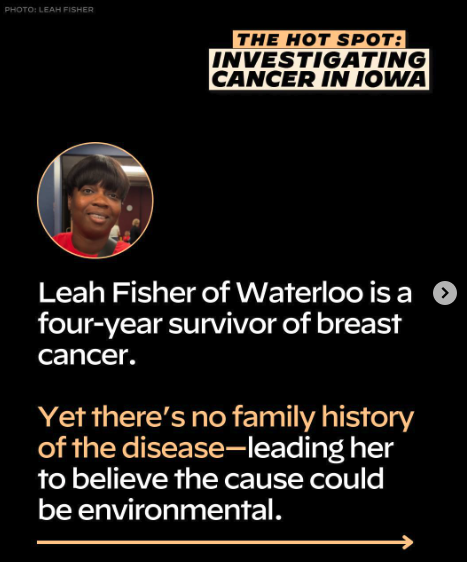
Research shows that most women who develop breast cancer have no family history of the disease, suggesting environmental factors play a significant role.
The NIEHS Sister Study, which looked at 50,000 sisters of women with breast cancer in the United States, reviewed lifestyle and environmental exposures and found that air pollution, particularly lead, mercury, and cadmium levels, was tied to a greater chance of developing postmenopausal breast cancer.
Nitrogen dioxide exposure, which is associated with traffic-related pollution, was also associated with increased breast cancer risk. Women who used hair straighteners and dye were 9% more likely than women who did not to develop breast cancer. Burning wood or natural gas indoors at least once a week was associated with a modest increase in breast cancer risk.
Most of these issues are associated with urban areas, which are also correlated with higher rates of breast cancer in Iowa Cancer Registry data.
Here are some places regulation could start:
- Limit or label endocrine-disrupting chemicals in consumer products;
- Prioritize development that doesn’t rely on cars as a primary means of transportation;
-
Fund projects that enhance air quality monitoring, particularly for fine particulate matter.
|
Prostate cancer
Each year, Iowa farmers use a tremendous amount of pesticides and commercial fertilizer. Research has linked pesticide exposure to the disproportionate rate of prostate cancer among farmers. And exposure to nitrate in drinking water is a risk factor in many of the same high-incidence cancers that make Iowa’s cancer rates high.
Yet Iowa has taken virtually no regulatory action. The Iowa Legislature, dominated by Republicans for nearly a decade, has passed no new regulations to try and shore up water quality, content with the limited impact of a voluntary Nutrient Reduction Strategy program.
While Iowa lawmakers have not shown the political will to meaningfully improve water quality, there are many conservation choices that both keep fields productive and reduce farm runoff:
-
Mandate buffer strips along waterways to slow the runoff into the streams;
- Limit fertilizer application during vulnerable weather periods to avoid heavy rains flushing chemicals from the field;
- Require proper manure storage and application timing;
-
Limit pesticide use near schools and residential areas;
- End moves to defund the state’s water quality monitoring system;
-
Increase financial penalties for agricultural operations that exceed pollution thresholds.
|
Lung cancer
To state the obvious, one of the leading causes of lung cancer continues to be smoking tobacco. The good news is we already have some well-tested means of reducing smoking rates.
Between 1963 and 2006, the number of packs smoked per capita in the United States was cut in half, in large part due to anti-tobacco campaigns that began in the 80s. These aggressive media campaigns publicly confronted the tobacco industry’s deceptive practices.
Another tool is taxation. Peer-reviewed studies show that increasing tobacco excise taxes is an effective way to reduce tobacco use. And Iowa hasn’t adjusted its tobacco tax since 2007. The state also does not have an excise tax on vapes, e-cigarettes, and other similar products.
Any serious effort to reduce lung cancer rates in the state of Iowa also needs to address radon as a major cause. Radon causes about 21,000 lung cancer deaths in the US each year and is the second-leading cause of lung cancer after cigarette smoking.
In Iowa, this isn’t just a statistic—70% of Iowa homes have elevated radon levels. Every single county in Iowa has the highest radon risk level.
Here are some ideas the Legislature could pursue next session:
-
Require landlords to allow tenants to test for radon and break leases if levels are dangerous. According to data from the American Community Survey, about 28% of Iowa’s housing units are rented. Yet most have no idea if they’re being exposed to radon;
-
Require new homes to include passive radon mitigation systems during construction;
- Fund radon testing. In 2025, the Iowa Legislature set aside $20,000 for the Iowa Department of Health and Human Services to pay for radon testing kits. According to State Rep. Austin Baeth, a physician who represents part of Des Moines, demand for the kits exhausted their availability. The Legislature could increase its allocation of free tests.
Concerned about Iowa’s rising cancer rates and want to do something about it? Consider forwarding this story to your state lawmaker. You can look up their email address here.
|
|
|
Across the country, the future of local news is uncertain. But here at Iowa Starting Line, we’re staying focused—on you.
Our goal for our fall fundraising campaign is to raise $2,000 by Sept. 30 to keep this kind of coverage strong in Iowa.
If you’ve ever read one of our stories and thought, “I wouldn’t have known this otherwise,” we hope you’ll consider supporting our work.
|
|
|
Missed a story in this series? Here’s where you can find them all:
|
|
|
Would you recommend this newsletter to your friends and family?
|
|
|
Do you want to support Iowa Starting Line’s mission while showcasing your products or services to an engaged audience of 21,000+ subscribers?
Email advertise@couriernewsroom.com for more information.
|
Thanks for reading. This newsletter was written by Amie Rivers with reporting by Zachary Oren Smith. It was edited by Paula Solis.
Iowa Starting Line is free for everyone. Your support makes our work possible.
|
|
|
You are receiving this email because you opted in via our website.
Our mailing address is:
Iowa Starting Line
c/o COURIER Newsroom
101 Avenue of the Americas
8th and 9th Floors
New York, NY 10013
Want to change how you receive these emails?
You can update your preferences or from this list.
|
|
|
|