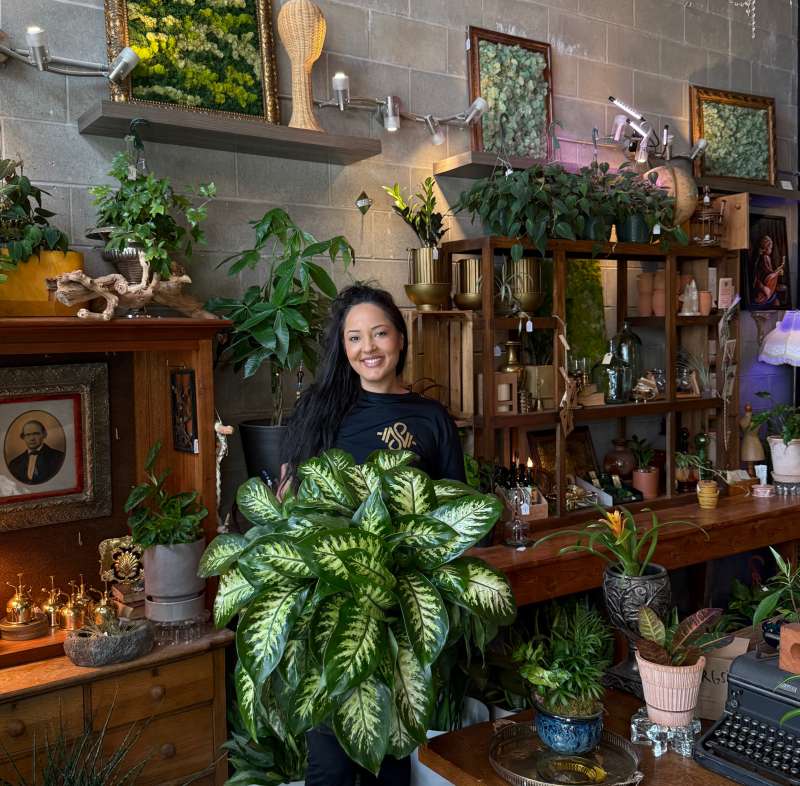
Among the plants and vintage that are the staples of Petals and Moss, there’s a bit more festive greenery in this Black woman-owned plant shop right now.
“We always get compliments on the overall vibe of the place, any season,” Shawntel Noel, owner of Petals and Moss said. “For the holidays, we do a little extra decorating and incorporate a little more holiday decor among our plants and our vintage, but the plants and the vintage stay at the forefront of what we’re offering.”
On Friday nights between Thanksgiving and Christmas, Des Moines’ Historic East Village stays up late. During the annual Holiday Promenade, local shops stay open for holiday shopping and specials. Shoppers who can’t make it during the workday finally get a chance to browse.
What they don’t always see is how few shops like hers exist. Noel runs one of the few Black women-owned plant shops in Iowa, and she said that’s part of why she opened it.
“Not seeing any type of representation kind of in the plant world, especially among Black folks,” Noel said. “Just kind of being an example, showing younger generations, being able to be that person to either mentor, be someone to look up to, whereas growing up, I didn’t really have that.”
She said Black-owned businesses in Iowa can be hard to find unless shoppers go looking for them.
“Most plant shops and things, you don’t see people like us,” she said. “Being a minority doesn’t mean we don’t have an interest in it.”
Noel built Petals and Moss with little outside help, in a state where Black business owners have long had a harder time getting loans and grants. Now that path is narrowing further. Iowa has removed women and minorities from its state contracting goals. Meanwhile, major companies have scaled back programs meant to open doors for business owners like her. During the holiday season that she said carries her business through the winter, community support is critical.
Building Petals and Moss on her own
“There’s also a lot of barriers in the way of getting funding and that sort of thing for Black-owned businesses,” Noel said. She said working in banking showed her up close how hard it can be for Black business owners to get funding.
“I kind of got exposure in the real world to that.”
She said grants for for-profit businesses are limited, and the competition for them is stiff. In place of formal programs, she found support in the East Village, where she said most of her fellow business owners are women.
“Everybody’s supporting everybody,” Noel said. “They do a good job of uplifting us and steering customers in our direction with intentionality.”
She said Black business owners in Iowa need more of that, including gatherings where they can share advice and lift each other up. Some of the support that did exist for owners like Noel is changing, as Iowa lawmakers rewrote how the state supports women- and minority-owned businesses.
How Iowa’s new law changes support for Black- and women-owned businesses
This year, Iowa lawmakers passed H.F. 2711, the “Elimination of State and Local Policies and Programs with Affirmative Action, Race, Minority, or Gender Requirements.”
Alexson Calahan, director of the Iowa chapter of the National Association of Women Business Owners (NAWBO), said the state’s contract compliance policy used to name women-owned businesses among the suppliers it sought to use. Now H.F. 2711 directs the state to promote Iowa-based businesses more broadly. Iowa law still sets separate procurement goals for certified Targeted Small Businesses, she said.
“For a small business, one state contract can mean enough steady work to hire another employee or enough experience to bid on a bigger project,” Calahan said.
She said the real impact will depend on what state agencies do next. “Will women-owned businesses hear about bid opportunities in time to pursue them? Will state buyers continue to reach out to those businesses?”
Noel said that thankfully the law hasn’t directly affected Petals and Moss, since the shop doesn’t do much contract work with the state. Decisions like this one, however, still have consequences for business owners like her.
“That puts us at more of a disadvantage when you look at the whole scheme of things,” she said. “Historically, there’s been so many more barriers.”
Iowa’s change follows a national retreat. In January 2025, Trump canceled all federal DEI programs, and Target announced a retreat from its diversity goals, including programs to fund entrepreneurs of color and increase diversity among its suppliers. Ford, Walmart, John Deere, and Harley-Davidson have also publicly rolled back DEI initiatives.
The money gap for Black-owned businesses
In the Federal Reserve’s 2024 Small Business Credit Survey, 35% of Black-owned employer firms that applied for loans, lines of credit, or merchant cash advances got the full amount they sought, compared with 56% of white-owned firms.
“Most working Americans come to business ownership with far less access to wealth, credit, and connections,” said Anisha Steephen, a fellow at the Roosevelt Institute and former senior policy advisor for racial equity at the US Treasury. “Removing efforts to address those differences leaves the advantages in place.”
They said one way lawmakers could address those disparities is by making affordable small business financing available to people who don’t already have wealth. “Banks usually want collateral, like a home or savings, before they’ll lend, and many hardworking people don’t have that or family money to fall back on,” they said. A 2024 survey from National Opinion Research Center (NORC) at the University of Chicago found that 83% of business owners who needed startup money used personal or family savings, assets, or home equity.
Shopping with intention this holiday season
For Petals and Moss, the holidays carry the shop through the cold, slow months ahead, Noel said.
“The holidays are super important for small businesses, and especially for Black-owned businesses, too,” she said. “It’s a great time to shop with intention.”
Calahan said shoppers can keep helping after the holidays end. “If you find a gift you love, tell someone where you bought it,” she said. “Your recommendation can bring the business a new customer long after the holidays.”
Small businesses make up most of Iowa’s economy. The state has 289,962 small businesses, employing 637,557 people, or 46% of Iowa’s employees, according to the U.S. Small Business Administration’s Office of Advocacy. On average, 52.9% of each purchase at local independent businesses recirculates locally, compared with less than 13.6% at chain stores, according to studies by the research firm Civic Economics.
The stakes are even higher for business owners like Noel. Black-owned businesses are a key path to building wealth in Black communities. When Black-owned businesses grow, the paychecks they create reach well beyond the owners. In 2023, about 200,900 Black-owned businesses with employees put 1.9 million people to work and paid $69.8 billion in wages, according to the U.S. Census Bureau.
But there aren’t nearly enough of them. In 2023, Black Americans made up 14.4% of the U.S. population but just 3.4% of business owners with employees, according to Brookings. The Black-owned businesses that do exist often start with less cushion and less money behind them.
When the pandemic hit, Black business owners had the least to fall back on. The number of active Black business owners dropped 41% from February to April 2020, compared with 17% for white business owners, according to a 2021 report by the National Bureau of Economic Research.
Noel said supporting equity takes more than saying so.
“Folks say, yes, I support this, I support that, but intentional support by using your dollars intentionally makes a big impact in our community,” she said.
Noel said supporting Black- and women-owned businesses does more than keep one shop open.
“It helps create more opportunities, strengthens our local economy by putting dollars back into our community,” Noel said. “Helps us build a more inclusive community.”
READ MORE: Skip the bookstore chains and grab holiday gifts at these independent Iowa bookstores