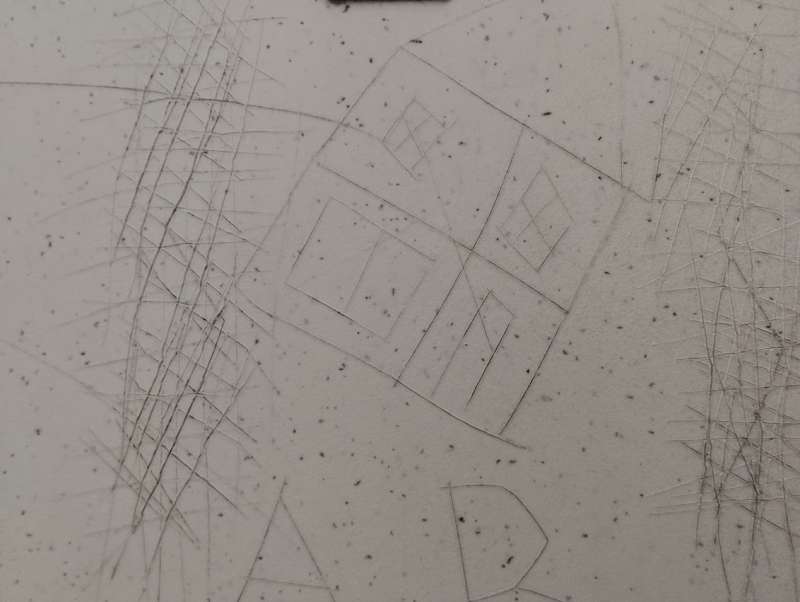
I clocked them as soon as I sat down on the toilet of a rest area bathroom that reeked of too much disinfectant. Violent jagged scratchings, surrounded by the usual graffiti you’d expect in the stall of a lonely rest stop along I-80: dirty limericks, artistic renditions of phalluses, stylized names as calling cards. But that was all noise surrounding those etchings of rudimentary houses, composed of four squares and a triangle roof. The kind of house that, at first glance, could dot the horizon of a child’s drawing.
But these weren’t those. The homes were built to cover up the initial swastika scratched into the wall. Four squares to close up the geometry of hate. A triangle on top, and it becomes another symbol altogether.
It’s a cover-up job that I have a particular, fraught history with.
This happened in December, on a westward route across Iowa to visit my wife’s family in South Dakota for the holidays. Since then, and I don’t mean this lightly, I’ve been obsessed with these strange homes and the reaction that they instilled in me. Or rather, the reaction that they’ve reinstilled in me.
Because here’s the thing: I am close to 100% sure that this was not the work of a single person, or some uber troll that etched a swastika then tried to obfuscate it with a house. No; this was a conversation. Someone else, maybe someone like me, came upon the initial symbol and decided to respond.
Here’s the reason why I’m so sure of this. I didn’t just make out that these homes were initially swastikas. I remembered that they were. I instantly recognized that these were swastikas because, in my youth, I drew my own homes. I remember covering up these symbols of hate in this exact same manner: Four squares, triangle on top. It wasn’t just a scribbling out, or a total covering up, but a finessing. When I sat down on that toilet seat, the sense memory of past encounters came flooding back.
I took a picture and, upon returning to my driver’s seat, showed the houses to my wife. I proceeded to ask her a series of questions I have asked a number of other people since. “Hey, check this out. What do you see? Yeah, but do you see anything else?”
She didn’t, until I pointed them out. And then, after the reveal, another set of questions—ones I’m still trying to properly weigh the ramifications of and still struggle with, half a year later. “But did you ever have to make one of those yourself, growing up? The homes, I mean. Did you ever have to make enough of these that the sight of them, decades later, unearths something you can’t properly define? If so, what do you think it cost you? Peace of mind? A sense of safety? An innocence lost you can never get back, like the opening of Pandora’s box or the passage of time?”
The first time I remember seeing an outright swastika was at Kimberly Park, when I was probably around the same age as my oldest daughter, who is about to turn 5. Kimberly Park was about two houses away from my childhood home. My older cousin Freddy and I would race each other up the stairs to slide down “The Tornado,” which was the park’s pièce de résistance: a big, swirling slide that started in a tube and opened up as you went down the full height of the structure.
It lay in wait at the top, undeniable along the wall facing you as you maneuvered to sit down on the hot metal lip of the slide. A big spider scrawled along the wall that smelled of the ink of the fat sharpie that made it. The ink ran on the different points of the symbol, at the angles and convergences of lines, leading to trails running down the intersections of the swastika. Like it was melting. Or crying.
I asked my older, more world-weary cousin, (a 5-year-old asking a 6-year-old) what the heck was on the metal wall. I don’t remember if Freddy had the technical words to describe the full weight of the symbol. I do remember him saying something along the lines of, “That means that some people don’t want us around. No, not just you and me, but people like us.” We were Mexican, and that symbol meant that they didn’t like that. It was a warning, a declaration of discontent aimed at kids like my cousin and me, to see every time we wanted to barrel down a slide on a park a few houses from home.
There’s something about being exposed to hate symbols that are unequivocally meant for you—meaning me, as a brown kid in a park in my hometown. A hate symbol is never meant for the royal “we.” It is a direct missive, to be intercepted on the paths that the receiver naturally maneuvers through.
I imagine someone lurking in the shadows of the park, noticing these brown kids at play, waiting for the cover of night to send a message that will stay with them for the rest of their lives.
Here’s another thing about being exposed to hate symbols all your life: It becomes a part of your experience. I don’t want to say that you get used to it, but it’s telling that I am 100% certain that I encountered numerous other hate symbols in my life, but can now only recall the ones that stand out.
In his book of essays, “They Can’t Kill Us Until They Kill Us,” Hanif Abdurraqib writes, “The truth is, once you understand that there are people who do not want you to exist, that is a difficult card to remove from the table. There is no liberation, no undoing that knowledge. It is the unyielding door, the one that simply cannot be pushed back against any longer. For many, there are reminders of this every day, every hour.”
For me, those reminders became so commonplace that my memory chunked them like the recalling of school days. You remember the first and last and any other big ones, but the majority are a generic blur of experience. They are a rapid flipping of pages to get to the next core memory.
When it comes to my experience with swastikas, my next core memory was in junior high. I’m thinking it was probably around fifth grade, when we graduated to textbooks with enough heft that our schools thought it wise to reuse the books every year, until the accumulated wear-and-tear ground them to dust.
Here’s something that happened more than a few times: At the start of the school year, our teachers would instruct us to divvy out the textbooks cached at the back of class. The task was to open to the inside cover and write your name under the long list of other names already there, a signifier that this was now “your” book for the year.
Usually it wouldn’t take long to find out if your book was one of “those” books. One of those books peppered with swastikas from days’ passed; swastikas made by those prior students whose names sat above the line you were supposed to add your signature to. Going over the names became this futile exercise in trying to triangulate who in the list of past fifth graders was the most-likely culprit. A game of find-the-Nazi, if you will.
Were the marks from the year before, done by the hands of a sixth grader that you knew to avoid on the playground? Or maybe they were a few years older, an older sibling of a kid in your class that always managed to bump your shoulder passing by in the lunch line? Or—because we’re talking about books that could go back decades—maybe the hate was inked by someone’s parents or grandparents? The same ones you see in the stands at high school football games or get candy from at Halloween?
Either way, the first response to having one of those books was to pass it along and find another textbook to call your own. (For whatever reason, I never recall telling our teachers to have them remove the compromised books. There’s probably something significant in the absence of that memory.) Sometimes though, if your desk was the last in line to have your pick of textbooks, you were left to your fate. This little scramble of getting the right book was just one part of the process.
Honestly, sometimes it was better if you came across a book from some brash punk that spewed their hate right there on the inside cover, who at least gave you the courtesy of knowing what you were dealing with on day one. What was worse was when you were maybe a few weeks into class, after you let your guard down, when the swastikas start appearing in the second or third unit of class. When you were well into the page count is when you had to resort to making houses.
This is the sense memory that the I-80 bathroom shocked to the surface. This is how I knew these houses weren’t just houses. When there was no other way to get rid of these textbooks and the burden they carried within their pages. When I didn’t want to flip to the start of another unit and stare at these symbols festering in the margins of our class’s daily reading. That’s when I’d put pen to paper and close the spokes of hate.
To add the roof was instinctual, a callback to simpler times, before my first encounter with these same markings at Kimberly Park. I don’t know. It’s not like I put a lot of thought into it. Maybe simply converting the swastika into a four-part square wasn’t enough? Maybe it needed to be transformed one step further, into a facade of innocence to rid the symbols of their power over me?
Though I admit now that it didn’t work then, and it doesn’t work now.
I need to make clear that it’s not the swastikas themselves that got me all twisted up. I can honestly say that if I were to have sat down in that rest stop, closed the bathroom stall, and come face-to-face with a brazen display of those symbols, I wouldn’t be thinking much about it six months later.
Don’t get me wrong, I would have been pissed, and shaking my damn head at the things, of course. But it wouldn’t have rattled me. Like many Black and brown people living in this state, living in the Midwest, living in America, living in this second administration, we’ve seen and heard the sentiment that these symbols aim to convey more times than we can count.
No, no, no. It’s the houses that got me.
It’s this act of a second, well-meaning party, not wanting to face the cruelty looking back at them. It’s the act of someone just wanting to cover things up, for a slight reprieve or a slight win or just because they don’t want yet another place claimed by this sentiment. It’s for these reasons and perhaps others I’m not privy to.
But here’s the question that swirls through my mind as I think about a second person taking out their key or pocket knife: Who are we letting off the hook when we cover up these symbols?
When the next person at the stall, like the growing tally of friends and acquaintances that I show these symbols to, doesn’t see these houses for what they actually are?
In short: who are we protecting? Again, reiterating that I don’t think this is a case of a person trying to troll and hide a symbol within a symbol, but of two conflicting parties in conversation.
I imagine the second person leaning forward, and scratching at the grooves of a stall in anger or desperation. I imagine a school-aged child, with a thousand-yard stare, pulling out a pen that will match the ink of the hate before them.
And I imagine telling them to stop and, to borrow from another writer better than myself, I’d tell them when these people show you who they are, believe them the first time.
When this administration, this state, this place that you call home shows you who and what they are, let them. Let them show you the hate they wish to spit at you. And let the spittle run down the wall for others to see, so that they can understand the true nature of the homes they wish upon us.