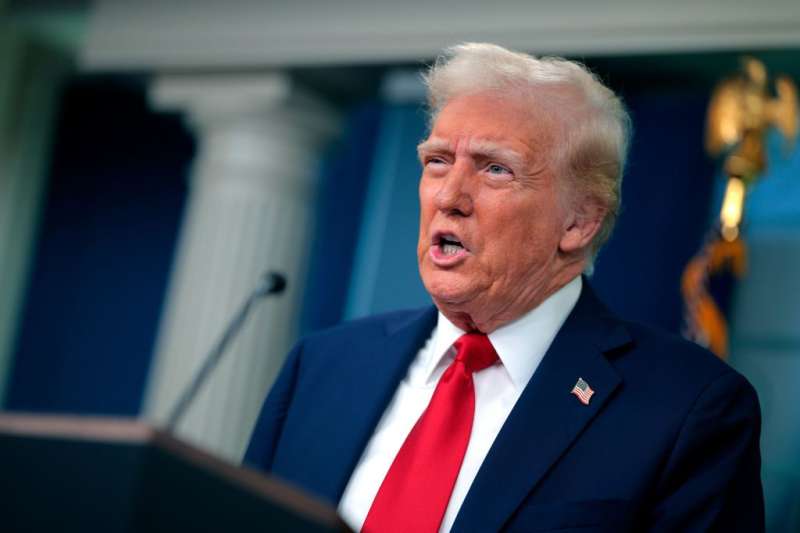
President Donald Trump’s lawyer admitted in court Friday, July 10 there is no evidence that a controversial 2024 Iowa poll was rigged. Yet, they are still asking for a state judge to let them search a veteran pollster’s internal documents to look for proof.
The lawsuit centers on a Des Moines Register/Mediacom Iowa Poll published three days before the 2024 election. Selzer & Co., a polling firm run by founder J. Ann Selzer, founded in 1992, has released polling on the preferences of Iowans. NPR once called Selzer “the most respected pollster in Iowa.”
Although her polls successfully predicted Iowa Sen. Joni Ernst’s 2014 win and former President Barack Obama’s caucus win in 2008, her 2024 poll showing Trump trailing was ultimately wrong. Trump won Iowa by 13 points.
The plaintiffs want to bypass the First Amendment protections for defendants J. Ann Selzer, her polling firm, the Des Moines Register, and its parent company Gannett. They argue the poll constitutes “commercial speech” under the Iowa Consumer Fraud Act because the newspaper is a for-profit enterprise. They also claim the defendants’ behavior amounts to fraudulent misrepresentation and ultimately negligence. However, media law experts argue this theory stretches legal definitions beyond recognition.
“The definition for commercial speech is one of the simplest definitions there is in First Amendment law,” said Brett Johnson, the John Kamp associate professor of media law and policy at the University of Iowa. “Its definition is quite simply a speech that proposes a commercial transaction. So buy my product, buy my service, subscribe to this. That’s what we’re talking about here.”
Johnson warned that treating standard reporting or polling as commercial speech because it is profitable would have massive consequences.
“If a court were to say any speech that is profitable, all of a sudden becomes commercial speech, that would totally throw a wrench into First Amendment doctrine,” Johnson said.
While Trump’s attorney Alan Ostergren initially agreed to an interview for this story, e he later declined, stating by email, “Apologies, I believe I clicked a google-suggested response accidentally. I cannot comment on the litigation.”
Selzer’s attorney, Robert Corn-Revere, argued that the lawsuit is a frivolous attempt to weaponize “fake news” rhetoric. In an interview with Iowa Starting Line, Corn-Revere explained that even if the court accepted the premise that a poll was completely fabricated, it would still not meet the legal threshold of fraud.
“The Supreme Court has said that you can’t simply say something is a lie, and therefore say it’s unprotected,” Corn-Revere said.
He noted that fraud is narrowly defined.
“It’s basically swindling someone for money, where you set back the odometer on a used car, or you tell someone you’re going to sell them the Brooklyn Bridge, and you’re not,” Corn-Revere said. “So the argument in this case, that the poll was made up, ridiculous as that is, is that even if it were true, it’s not defamation, and it’s not fraud, as the law defines it.”
A motion has been made by Corn-Revere to have the case dismissed before the discovery process begins. Under Iowa’s Consumer Fraud Act, plaintiffs do not face the high “particularity” pleading standard required for common-law fraud, allowing them to argue for discovery.
The case was in federal court. Trump dismissed his own federal case and refiled in Polk County on June 30, 2025, one day before a law took effect in Iowa that would have made it more difficult for him to bring a lawsuit. Iowa’s law, the Uniform Public Expression Protection Act, is supposed to prevent lawsuits meant to silence free speech, and it took effect on July 1.
Judge Scott J. Beattie voiced concern over allowing the case to continue to the discovery process. He took the motions under advisement, stating he expects to issue a ruling in several weeks.
Corn-Revere emphasized that the stakes of the case extend far beyond the parties involved in the courtroom.
“This would be a win for the First Amendment, and that extends both to pollsters, to newspapers who publish polls, and it’s a win for the public, because it would mean that the First Amendment fully protects the right to publish polls and the right of people to read them,” Corn-Revere said.