Special Edition: Reporter’s Notebook
|
What one sentence in a 400-word bill means for Iowa’s hog farmers—plus more reader questions.
|
I recently read a bill you could print on two pages. Then I read a 90-page legal analysis explaining how those two pages matter more than they appear.
That’s usually how it goes with the ones that count.
The bill is called the Save Our Bacon Act. It’s US Rep. Ashley Hinson’s signature cause, and it would stop states from putting conditions on livestock products sold across their borders. The bill is shadowboxing—as Iowa Republicans tend to—with California: namely, California’s Proposition 12.
If a hog farmer wants to sell pork in California, Prop 12 requires that pork come from hogs given at least 24 square feet to move around in. Californians passed it with 63% approval. The Supreme Court has upheld it.
But none of that has stopped Hinson from trying to override it from Washington, DC. California is a huge market for pork. And as a primary pork-producing state, well, that hog don’t … root?
|
An article of faith undergirding Hinson’s SOB Act is that it protects Iowa farmers from pesky—if popular—out-of-state regulation that asks more of them.
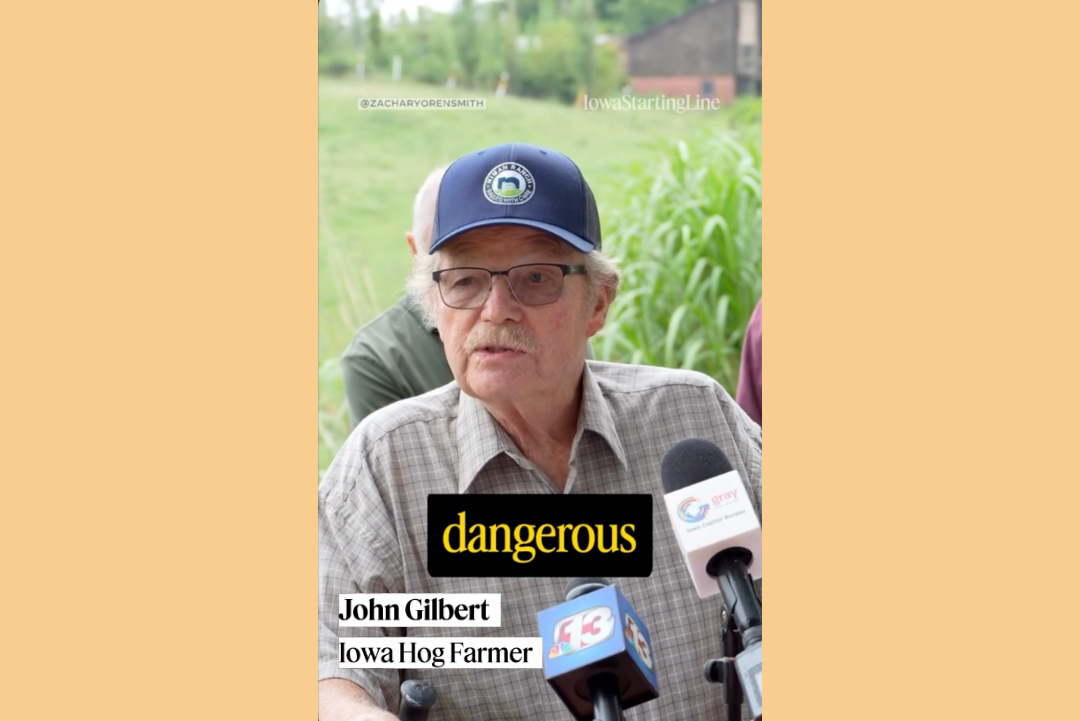
I drove to a barn near Elkhart for a press conference put on by Farm Action Fund; it’s a 501(c)(4) that’s been agitating about the monopolistic Second Gilded Age we seem to find ourselves in.
Just to tease out an example, Tyson, JBS, Cargill, and National Beef control 85% of the US beef packing, 67% of the pork market, and 60% of chicken processing. Economists argue that when the top four firms in a sector exceed 40%, that level of concentration allows for market abuses.
40%.
The problem? Price fixing and gouging for consumers; wage fixing for workers: more and more is on the table when a monopolist has a larger share of the sector.
To compete with ag giants, small producers have to get creative. Many turn to value-added products. I don’t sell grapes; I sell jam. I don’t sell milk; I sell cheese. Another value-add: How was the hog treated? What was it fed? What kind of life did it live?
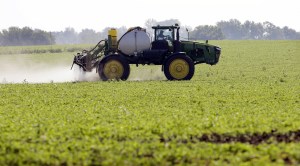
For farmers who didn’t invest in industrial hog confinements, Prop 12 gave them a boost in the California market. Save Our Bacon hands that market back to the giants. Farm Action brought together people who’d actually be affected: Iowa hog farmers who were getting a step up because their practices met California’s requirements.
|
|
|
Chris Petersen started raising pigs in high school because he wanted a better car, married the girl he was trying to impress, and built a farm with her outside Clear Lake. Then hog prices collapsed in ’98. He went bankrupt like thousands of other independent Iowa farmers. The choice, he told me, was to sign on as a contractor raising someone else’s hogs, or get out for good.
“Our American dream was over,” he said. “They’d done it to us, along with tens of thousands of other independent pig farmers.”
Farmers like Petersen were doing better business because they were rearing better product. When Prop 12 raised California’s standards, it meant producers like him were more competitive.
I reached out to Hinson’s campaign about these concerns. A spokesperson said SOB “stops at the farm gate” and wouldn’t touch anything but the narrow production standards Prop 12 sets. The bill defines “production” narrowly enough that much of what farmers worried about at the press conference—disease-testing rules at the border, mostly—might survive a legal challenge untouched.
Buried in a Harvard Law School analysis of the bill is an Iowa law that has nothing to do with disease control—a statute regulating production contracts that bind farmers to companies whose hogs they raise. It’s arguably the most exposed law in the state, and it’s the one nobody mentioned Wednesday.
What does that mean in practice?
Iowa Code § 579B.3 is a production contract lien. When a company—the “contractor”—owns the hogs but pays a farmer to raise them, the law gives the farmer—the “contract producer”—legal status as a secured creditor over the animals in their barn. If the hogs haven’t been sold yet, the lien sits on the hogs themselves. If they’ve been sold, it follows the cash. If they’ve been slaughtered, it attaches to other company property.
In plain terms: It’s the legal hook that’s supposed to let a farmer actually collect what a contract promised instead of watching an unpaid bill turn into an unrecoverable loss.
That’s the law sitting in the fine print right now protecting Iowa farmers. Save Our Bacon sweeps it off the books in the name of protecting … well, the largest producers in the country.
And in that spirit—read closely, ask directly—I asked for more reader questions:
|
|
|
|
|
“When I mail my completed absentee ballot, is the return envelope pre-stamped? If not, how much postage is needed for the outsized envelope?” — Mary Ellen, Corydon
|
|
|
Good news: you don’t need a stamp. Iowa’s return envelopes for absentee ballots come postage-paid statewide — the Secretary of State’s own voter guide confirms it. It’s important that you use the pre-paid envelope supplied by your county auditor.
|
|
|
“I was watching a Miller-Meeks interview with Ray Baccari, and I noticed that she says she will debate her opponents at 6:48. To my knowledge Miller-Meeks still hasn’t accepted the Iowa Press debate invitation… It’s very concerning to me that our sitting congresswoman seemingly doesn’t want to debate her opponents.” — Kasey L.
|
|
|
|
You’re onto something real. The Gazette reported this month that Iowa’s fall debate calendar is filling up for most of the state’s big races—but the 1st Congressional District was conspicuously missing.
In 2022, Republican US Rep. Mariannette Miller-Meeks and Democrat Christina Bohannan debated. In 2024, Republican US Rep. Mariannette Miller-Meeks and Democrat Christina Bohannan debated. In 2026, both candidates say they are planning to debate. Yet, no debate has been set. Why?
On Sept. 3, Independent Michael Bridgford announced he’d accepted an invitation to join the Iowa PBS debate. He called on Miller-Meeks and Bohannan to debate.
The campaign manager gave the Gazette the same “looks forward” to providing “the voters of IA-01 the same contrast” as previous years.
As of this writing, no date has been set.
|
|
|
|
|
“[H]oping you folks will ask Rob if he doesn’t know the ongoing history of the relationship between civil/human rights, labor groups, and the Democratic party or if he does know of them but just doesn’t think they matter?” —
|
|
|
— Dirk, via Amie, referencing Rob Sand’s Bluesky post: “I’ve never heard a good reason yet why we have to be Democrats and Republicans.”
|
|
|
Dirk, it’s always good to hear from you. I haven’t asked this specific question, and I’m not on Sand’s payroll, so I also don’t have to defend any statements from the guy. But in the spirit of discourse—and because I think it makes for a better newsletter—I’d still like to take a swing.
While I think Sand is trying to make a case for Republicans and independents to vote for him, I don’t know that that post comes from an affinity for one party over the other. I think it comes from a deep-seated and ancient instinct in the American psyche that parties suck.
Sure, you know George Washington’s farewell. But have you read W.E.B. Du Bois’ “I Won’t Vote,” where he said democracy had vanished in the United States and that there was “but one evil party with two names,” the Republicans and the Democrats? Or Fannie Lou Hamer, who went after the two-party apparatus for shutting out and compromising away the rights of Black Americans? And of course you remember the Black Lives Matter network disavowing political ties to the DNC?
We are a people made suspicious for countless reasons. Our parties are just another institution that in their many lives have failed us in one way or another. That’s the history worth sitting with.
And the alliance between civil rights and labor didn’t happen because Black organizers and unions had some natural affinity for the Democratic Party. It happened because people like Bayard Rustin made a calculated bet: that moral protest alone couldn’t write law; that a coalition built inside a major party could. Rustin laid the case out explicitly in his 1965 essay “From Protest to Politics,” arguing the movement’s next chapter meant exactly what Sand’s post sounds skeptical of: durable coalitions built inside party structures, not just outside them. Walter Reuther and the UAW didn’t just show up to the 1963 March on Washington to listen. They helped bankroll and organize it, because Reuther understood the same thing Rustin did: A movement without a political machine behind it can win a headline, but it has a much harder time winning a law.
That coalition is how you get the Civil Rights Act and the Voting Rights Act on the books within a year of each other. But it’s also how we got to our current political era of partisan gerrymandering, brinksmanship for control of SCOTUS, and a Congress that won’t rein in the executive.
When Sand says he’s never heard a good reason for the two-party system, I don’t hear a historical critique. I hear someone echoing a long-held suspicion of parties in Western democracy that dates to our founding.
I think the more interesting question—the one I hear my longtime friend Dirk hinting at—is whether Sand thinks that coalition still functions the way it did in 1965, or whether the party has calcified into something else?
Du Bois and Hamer weren’t wrong that parties fail people. Rustin wasn’t wrong that refusing to organize inside them fails people worse. Both are true, and tied up in that tension is this moment where the parties are reaching new basements of disapproval. It makes me wonder: Will the call to end suffering in my lifetime come from the party? Will the demand for rights for our brothers and sisters come from the party? Will the song for liberation start because the party’s passing out the music? I don’t think so. And I don’t think you do either.
|
|
|
I think the future of our politics is, and has always been, in its people and what institutions they can build in their image and keep. And while I owe my life and no small amount of my conscience to the names above, I don’t share the same obligation to their party.
My guy Henry Thoreau wrote back in 1849, “If the injustice is part of the necessary friction of the machine of government, let it go, let it go: perchance it will wear smooth,—certainly the machine will wear out. If the injustice has a spring, or a pulley, or a rope, or a crank, exclusively for itself, then perhaps you may consider whether the remedy will not be worse than the evil; but if it is of such a nature that it requires you to be the agent of injustice to another, then, I say, break the law. Let your life be a counter friction to stop the machine.”
That was a lot, but I’m glad it found you. As always, there are more questions than I can get to—I’ll keep working through the mailbag. Send yours my way, and follow me for more—@zacharyorensmith on Instagram, YouTube, and TikTok.
See you on the trail.
Yours,
|
|
|
|
|
🗓 Oct. 7
First IA-SEN debate, Josh Turek vs. Ashley Hinson, hosted by Iowa PBS
🗓 Oct. 13
Second IA-SEN debate, hosted by Nexstar/WHO-TV
🗓 Oct. 14
Early/absentee voting begins
🗓 Oct. 19
Pre-registration deadline
🗓 Nov. 2
Last day to vote absentee in person at the county auditor’s office
🗓 Nov. 3
Election Day
|
|
|
|
Do you enjoy reading this newsletter?
|
|
|
Thanks for reading.
Iowa Starting Line is free for everyone. Your support makes our work possible.
|
|
|
You are receiving this email because you opted in via our website.
Our mailing address is:
Iowa Starting Line / COURIER Newsroom
3229 Greenpoint Ave., PMB 532
Long Island City, New York 11101
Want to change how you receive these emails?
You can update your preferences or from this list.
|
|
|
|