What makes it fall in Iowa?
“It’s fall in Iowa when the leave begin to change colors.” Mikky G.
“Falling leaves makes it Fall!” Vincent
“Seeing college football games. Seeing maple trees turning yellow and orange and red. Days getting shorter.” Dave G., Moline, Ill.
“Amongst so much else, Fall is camping trips when we make soups slowly over a low fire and watch endless sunsets, with less concern for ticks and more focus on the dappled light as leaves fall to crunch underfoot. And during an election year, Fall means door knocking and texting for candidates and ballot issues before working the election here in my Michigan precinct.” Jeff S.
“Bugs in the house.” J. Swartslander
Health care costs:
“Iowans are already struggling with rising health care costs. Hospital facility fees are making the problem worse.
These are separate hospital charges that can be added to outpatient care, sometimes even when a patient receives routine treatment at a clinic rather than being admitted to a hospital. In 2024, the Des Moines Register reported that Des Moines resident Colby Grabill was charged $488.78 in facility fees for each of three $150 psychiatrist visits—nearly $1,500 in additional charges.
Meanwhile, health insurance costs continue to rise, with several insurers proposing double-digit premium increases for 2027.
Republicans have controlled both chambers of the Iowa Legislature for nearly a decade, yet Iowa still lacks broad protections preventing patients from being hit with these facility fees for routine care outside hospitals. A health care price-disclosure bill introduced this year did not advance beyond committee.
The Legislature has options. Iowa can limit facility fees for routine care outside hospitals, require patients to be told about additional charges beforehand, require hospitals to report what they collect from these fees, and pursue site-neutral payment policies so routine care doesn’t cost dramatically more simply because a hospital system owns the clinic.
I’m a colon cancer survivor, and that experience is one reason health care is an issue I care deeply about. I believe health care is a human right.
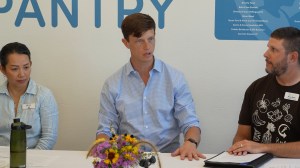
Iowa families have waited long enough for meaningful action on health care costs. They deserve legislators who will take on this problem instead of allowing another session to pass without fixing it.” Molly Buck, Democratic candidate for Iowa House District 41
“John has Type 1 diabetes. Insulin is simply part of our family’s life. We make sure it’s in the refrigerator, we deal with insurance, and we know it’s not something he can choose to go without if it gets too expensive. He needs it to live.
That’s why we’re frustrated Iowa hasn’t done more to protect families from high insulin costs. The federal government caps insulin at $35 a month for people on Medicare. Twenty-nine states and D.C. have capped insulin copays for people on state-regulated commercial insurance. Iowa hasn’t.
In 2025, a bill in the Iowa House would have capped insulin copays at $25 a month. A similar bill sat in the Senate. Neither passed before the legislature adjourned. Iowa families are still waiting.
This isn’t abstract. Nearly three-quarters of people who depend on insulin pay more than $35 a month for it, and about 250,000 Iowans live with diabetes. Nobody should have to ration insulin because of price. And when a prescription runs out unexpectedly, Iowa’s emergency refill law doesn’t work for insulin the way it does for pills, a problem several states, including ones led by Republicans, have already fixed.
Amy is running for the Iowa House because affordability has to include health care. If elected, she will push to cap insulin copays at $25 a month for Iowans on state-regulated plans and to fix Iowa’s emergency refill law and she’ll work across the aisle to get it done.
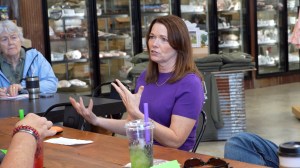
Our family is fortunate that John has access to the medicine he needs. That shouldn’t depend on luck. Insulin isn’t optional. Affording it shouldn’t be either.” Amy Tagliareni, candidate for Iowa House District 42
Ideas you have:
“10 of the best places to see in Iowa.” David F.
“We need to set up a national don’t buy gas day; it should coincide with the truck drivers’ strike day.” Tracy S.
“Hi! Just want you all to be aware of the Authentic Remsen Oktoberfest last Saturday of October every year. This year is the 52nd and includes a craft show, children’s contest, Golden Keg, and Authentic German Feast. Check it out on Facebook.” Samantha S.
“Not sure if ISL is covering what is happening near the area known as Morgan Valley on the western outskirts of Cedar Rapids, as I can’t recall seeing it.
The communities, areas and Iowans that will be most negatively impacted by a proposed new 720-megawatt Alliant Energy power plant near HWY 30 and the Linn-Benton Road include multiple schools, with over 20,000 students, teachers and their families. And the primary force driving this expansion seems to be the energy drain caused by about 20 data centers already in and around Cedar Rapids.
The self-directed, grassroots group trying to stop this encroachment is Save Morgan Valley.
Community and city council meetings are happening this week and into October. Still lots of unanswered and deflected questions. …
Our daughter and her three kiddos live in the path/zone of the environmental fallout of this proposed power plant expansion, as do their schoolmates, teachers, neighbors, friends and more.” Kris F., Granger [NOTE: We’ve been covering it some, and I suspect we’ll keep on it!]
Books you’re reading:
“Wanted to talk a bit about the books I took back to Carnegie-Stout last week:
‘The Hardest, Longest Race: Henry Ford and The Cross-Country Race Which Changed America’ by Eric Moskowitz is a fantastic look at a contest which dominated national news in the summer of 1909. Eric sets up the story well about why many auto companies (and there were a zillion of them in 1909) declined to take part, but Henry Ford saw a marketing opportunity. As the race progresses, the story focuses on the two Ford entries and the Shawmut car. We learn about how awful the roads were when it rained and how awful some of them were when it was sunny. There was chicanery, such as a ferry transporting Ford over the Missouri River but mysteriously breaking down before it could take the Shawmut. I especially enjoyed the book as the race moved into Colorado and Wyoming on the way to the finish line in Seattle as I don’t know much about that part of the country. Description of the towns and people involved there was wonderful. Eric’s writing style is greatly enjoyable and the book is well worth your time. …
I’ve always struggled with reading grammar guides. I know now that’s partly because of my cognitive struggles, but it was also a little bit because those guides were boring. ‘The Best Punctuation Book, Period’ by June Casagrande is the most enjoyable grammar book I’ve read in a long time. Every item of punctuation is given its own chapter. June also provides information on how business, newspaper, academic and science styles differ in how writers should compose their words. Unlike other grammar books which go on and on, June provides her instruction quickly with understandable examples. Enjoyed reading this and greatly recommend it.” Don C.
Survey confusion:
“I notice now, in your pleas, you offered a $5 whatever, yet absolutely nothing in your text. Now I regret even completing your survey, these tactics expose the fraudulent nature of your work, sadly. You can now unsubscribe me. Your loss!” Elizabeth S.