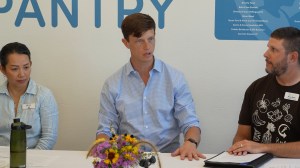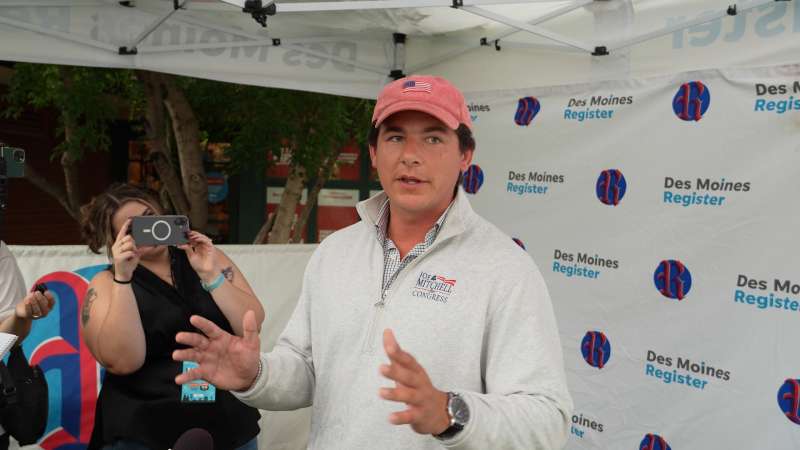
Joe Mitchell has made one line a centerpiece of his campaign for Iowa’s 2nd Congressional District: Mitchell doesn’t take corporate PAC money, that he isn’t part of the “broken political system that works for insiders and lobbyists.”
Asked directly about his ties to the industry at the Iowa State Fair, Mitchell told Iowa Starting Line the record needs correcting: “I’ve never been a registered lobbyist, ever, at the Capitol.”
And that’s true, but it’s also not the full story.
What are Joe Mitchell’s lobbying ties?
From the earliest moments of his career, Mitchell has moved between posts working for Iowa politicians and the lobbying industry. Radio Iowa reported that in college Mitchell clerked in the Iowa Senate, before interning for Gov. Kim Reynolds and US Sen. Joni Ernst’s offices. According to his bio on Future Caucus, he then worked for “a multi-client lobbying firm where he helped represent a variety of clients on issues involving healthcare, taxes, education funding, and regulations.”
At the young age of 21, he took the oath of office for Iowa House District 84 in 2019. But during his first term, new district maps put him in the same district as State Rep. Jeff Shipley for the 2022 election. Southeast Iowa Union reported Shipley said he spoke to Mitchell about whether one of them should move or accept other roles. In the end, both stayed in the race, and Mitchell lost his primary.
READ MORE: Joe Mitchell voted to grow a tax credit his companies later cashed in on.
In the years that followed, Mitchell was the paid executive director and chairman of the Iowa Real Estate Developers Association, a trade group he founded in 2022, after losing his reelection campaign. Nonprofit tax filings show he drew a $25,000 salary in that role in both 2023 and 2024, and according to his public disclosures, he held the position from November 2022 through March 2025. During that stretch, Salon first reported his association spent $74,175 lobbying the Iowa Legislature, according to its 2023, 2024, and 2025 filings.
‘Unnecessary’ environmental regulations
IREDA’s top priority, in Mitchell’s own words, was regulating the powers Iowa cities had to mandate requirements for stormwater and topsoil rules on construction sites.
“One of the big things that we’ll be pushing on this year is the issue with stormwater retention,” Mitchell said on the Land Development Podcast. He described local regulations as “unnecessary regulatory compliance” and complained that “some city council member decided that this was going to somehow improve their environmental standards that much more, I think is unfair.”
The bill IREDA lobbied for, Senate File 455, was signed by Gov. Kim Reynolds in April 2024. It caps local topsoil rules at the federal construction-site runoff standard and only lets cities set stricter stormwater rules if they foot the entire bill themselves. That includes engineering studies, the equipment costs, and compensation to property owners, functionally discouraging cities from bothering.
Stormwater runoff is one pathway for PFAS and other contaminants to reach drinking water, according to the EPA. Iowa has the second-highest age-adjusted rate of new cancer diagnoses in the country and is one of only two states where the rate is still climbing, per the Iowa Cancer Registry. Iowa hasn’t adopted the PFAS drinking-water standards the EPA finalized in 2024 into its own state rules.
Mitchell isn’t new to the subject matter. In the same podcast appearance, he described sitting on the Iowa House’s State Government Committee, which he said “could fix things such as stormwater retention, topsoil, sort of things” and “could deregulate or put regulation on a lot of different local things.” He did so while building his own real estate development business on the side, a fact he attributes to the Iowa Legislature’s part-time schedule.
Mitchell claimed the rules cities were imposing on stormwater cost as much as $110,000 per lot in some Des Moines suburbs—a figure that never appeared in testimony during the bill’s House or Senate debate, and one that dwarfs the only comparable available number: In 2021, the Home Builders Association of Des Moines claimed that a separate regional stormwater standard added up to $15,000 in cost per lot, which the city’s own public works director said at the time was higher than the city’s own cost estimates.
Mitchell’s campaign did respond to any questions from Iowa Starting Line including a call for clarification on this figure.
Mitchell’s defense
Asked why the association he ran and funded shouldn’t count as lobbying, Mitchell has pointed to a two-year cooling-off period barring former legislators from registering as lobbyists at the Capitol.
“I couldn’t lobby legally because there’s a moratorium for two years, and I’d left the organization before that two years was up for the lobbying period,” he said.
But while he was its executive director, IREDA mobilized lobbyists from Cornerstone Government Affairs and, later, CWL Group to do exactly that work. And his work at the intersection of industry and government didn’t stop there.
Data centers and more
The Lever first reported this month that Mtichell worked as a paid consultant for KAOH Media, a public relations firm that markets itself directly to data center developers, telling clients it “helps AI developers navigate public opinion, regulatory hurdles, and community concerns.” According to his financial disclosures, KAOH paid Mitchell $92,500 in consulting fees between 2024 and 2025.
That work sits close to home. At least three communities in Mitchell’s own district—Waterloo, Clayton County, and Tama County—have considered pausing data center construction, citing concerns over water resources, agricultural land, and electricity demand.
Mitchell’s ties to industry-aligned advocacy groups also extend beyond paid consulting work. His financial disclosure lists him as a board member of ALEC Action, the political advocacy arm of the American Legislative Exchange Council. ALEC is a national network that connects state lawmakers with corporate-backed model legislation. In 2024, ALEC pushed for legislation that would offer immunity to groups like opioid manufacturers from public nuisance lawsuits that have been widely used to hold big business to account.
That year, Mitchell publicly backed a “strategic partnership” between ALEC Action and Run GenZ, the youth conservative group he founded and chaired, saying at the time that “state lawmakers across the country recognize ALEC Action as a powerful voice for trusted and principled policy solutions.”
The same federal disclosure lists Mitchell as a “Community Advocate” for RWE, one of Europe’s largest energy companies and developer of wind projects in Iowa.