Iowa has a new governor.
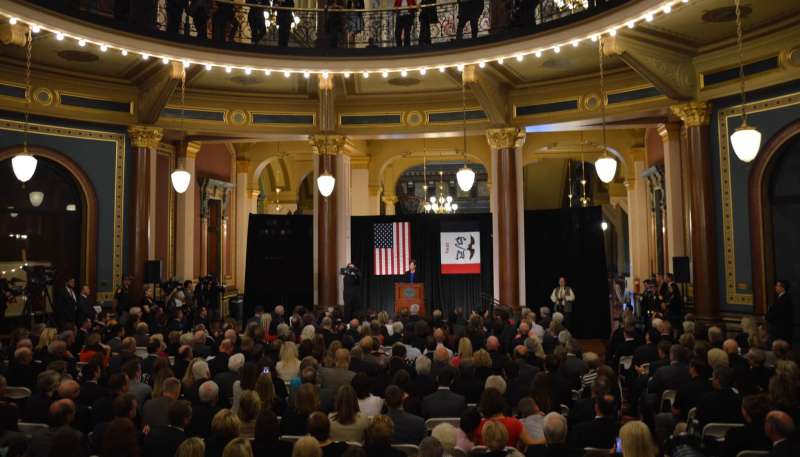
Kim Reynolds was officially sworn in this morning at a large ceremony in the rotunda of the Capitol, with many of the state’s top officials, Republican legislators and major conservative activists in attendance. Terry Branstad resigned the office and was immediately installed as America’s next ambassador to China.
All those things have been in the work for months now, but the big question was what vision Reynolds would lay out for her administration. Would she set a separate path from Branstad or stay the course in both substance and style? Would she lay out key, measurable goals or stick to overarching values?
The answer is that she very much stuck to a theme of continuation of the Branstad Administration, with a simple, four-part agenda that focused on tax reform, renewable energy, innovative education and workforce training. In simple political and stylistic terms, it was a well-delivered speech that effectively laid out her life story – going from a rural Iowa upbringing to service in county government – and put forth a modest governing plan.
But what was noteworthy about Reynolds’ introductory speech is what it left out. Obviously, she wasn’t going to tick off a dozen priorities or lay out 15-point plans for each one. But Reynolds did ignore three major topics that will likely consume the majority of her first term: healthcare, water quality and wages.
Healthcare
You don’t need to be an expert in the field to realize that Iowa is heading toward a massive healthcare train wreck. The Branstad/Reynolds Administration’s decision to privatize Iowa’s Medicaid program has already proven to be a complete mess. We’ve seen providers not getting paid, Iowans receiving poorer service and the private companies requesting hundreds of millions of dollars to cover their losses.

That problem hasn’t gone away with a new governor, and things are about to get much worse. In just over half a year’s time, as many as 70,000 Iowans could not only lose their current insurance, they may not have any options to replace it at all. The decision by three major insurers to leave the ACA’s healthcare exchange in Iowa come 2018 will result in a dramatic spike in the number of uninsured Iowans. And they’re not simply leaving the exchange, which provides subsidized coverage, they’re not offering any individual plans at all. So if you live in Iowa and don’t get healthcare from your employer, Medicare or Medicaid, you may have no way to purchase coverage, no matter how much you pay.
Perhaps with so much in flux at the national level regarding Congress’ ACA changes, Reynolds didn’t want to wade into that debate much yet. But the accessibility and quality of Iowa healthcare is poised to absolutely consume Iowa politics and government for the entirety of 2018. Hopefully they’re working on plans behind the scenes to address that.
And this is all without even mentioning Iowa’s mental healthcare crisis, which is growing more and more severe every day.
Water Quality
Oddly, Reynolds had a line in her prepared remarks about water quality, but skipped over it in her speech. It was supposed to read, “Building a better Iowa means protecting our resources. I look forward to working together on finding a long-term solution to Iowa’s water quality.”
It was probably just an in-the-moment mistake, but it also highlighted the other major looming problem: Iowa’s water quality isn’t getting any better, even with the very minor measure that passed the Legislature this year. With recent reports that more than half of Iowa’s water bodies are polluted, the issue is only growing in prominence. Democrats have been much more aggressive on this front and look to own the debate in 2018.
Wages
Reynolds focused in on job creation, touting Iowa’s low unemployment rate, while still noting that over 50,000 Iowans are still looking for work. And she talked up the renewable energy sector’s ability to create jobs, as well as workforce training giving people successful careers.
“As governor, I will wake up every day thinking about what we can do to help these Iowans gain the meaning and purpose that comes with earning a paycheck,” she said.
But notice that she only mentioned a “paycheck,” and not about how big it is, or what kind of benefits come with it. Reynolds seems to be developing blind spot here. Travel around Iowa and it’s easy to realize the biggest economic problem isn’t a lack of jobs, but of well-paying jobs with decent healthcare coverage. She easily could have inserted some language into her workforce training section about how it prepares people for better-paying jobs, but didn’t.
Interestingly, this is a departure from Branstad’s 2010 campaign promise to raise Iowans’ incomes by 25%. That was a goal no one expected him to actually accomplish, nor did his policies actually focus on raising wages, but at least Branstad talked about it. Reynolds now seems to have abandoned that approach.
Maybe it’s just an acceptance that their policies have actively driven down wages this year, not prop them up. The minimum wage preemption bill lowered tens of thousands of Iowans’ paychecks by nullifying individual counties’ increases. And the gutting of collective bargaining this year ensures that public employees will slowly fall behind in wages with the rest of the workforce.
The slow decline of the middle class in Iowa may not produce as dramatic of an urgent policy problem as healthcare and water quality next year, but it’s a ticking political time bomb. Blue collar voters across Iowa abandoned the Democratic Party in part because they didn’t feel the candidates were speaking to their economic issues. A key part of that is the frustration that longer hours at work haven’t resulted in better pay or a middle-class lifestyle. Again, the problem is not a lack of jobs, but a lack of respectable pay and benefits.
Reynolds can lay out whatever agenda she wants, but reality has a funny way of messing with politicians’ plans. Given her choice of focus in her introductory speech today, she could get caught flat-footed on solutions for what will prove to be the biggest policy challenges Iowa faces in her first year. If she doesn’t find a better way to address those, Reynolds may have a short governorship that ends after 2018.
by Pat Rynard
Posted 5/24/17