“We are being policed. We are being swept off the streets. We are being harmed. We are being murdered.”
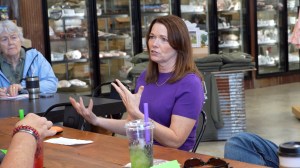
That’s Christie Cellman. You may remember her sharing her story a couple months ago about her home-based health care being slashed.
Cellman is a 39-year-old Ottumwa native and disability advocate with a master’s degree in social work who is working toward a Ph.D. at the University of Iowa.
Her goal with all of that education is to transform the way Iowa polices its vulnerable residents—including disabled folks—and provide more jobs in the community as well.
“Planting social workers alongside police actually put social workers in harm’s way,” she told me.
You may have heard about “crisis intervention” or “crisis response” teams, where you call for help with a mental health issue, and social workers or other licensed mental health professionals accompany law enforcement to try and de-escalate the situation.
Cities like Cedar Rapids, and regional organizations like Elevate, are two examples in Iowa.
The idea behind a crisis intervention team is to reduce violence. But Cellman said an armed officer can actually increase the risk.
“Police are very under-trained and under-resourced in” de-escalation, she said. “And so social workers are being put in a position where they not only have to de-escalate whoever they’re there to serve, but de-escalate a police officer as well.”
That’s especially a worry when someone with a disability is involved.
“There is a very high percentage of people with disabilities that are harmed and even killed at the hands of police,” Cellman said. (The Ruderman Foundation estimates that disabled people make up at least a third to half of all Americans killed by law enforcement.)
Cellman’s idea is a crisis response team made up of social workers, medical professionals, and trusted community members—and, more importantly, no guns.
“So you want to build a crisis response team that has not only social workers, but somebody that is equipped medically and somebody who knows that community and has ties to that community and is somebody that the community trusts,” she said. “Not somebody that’s coming in armed, and not somebody that’s showing up to houses with more ammunition than compassion.”
That might be a tough sell in a state where the Iowa Legislature just this year considered a bill that would have ended yearly de-escalation training for law enforcement. (Ultimately, that portion was removed from the bill.)
But Cellman thinks piloting the program to prove the concept might sway folks.
“ It’s gonna be a challenge in Iowa,” she admitted. “But I think that we have places within our state that would push for something like that. Like you look at the Iowa City area, the Des Moines area, I think implementing something like that—and seeing the positive outcomes from instituting something like that—will go a long way for people to see the positive results.”