At a closed-door Republican event, Rep. Ashley Hinson assured GOP activists that DOGE is still alive. Iowa farmers have been living that reality for over a year.
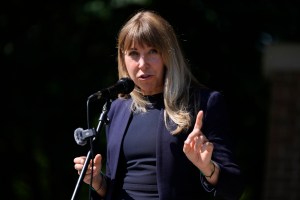
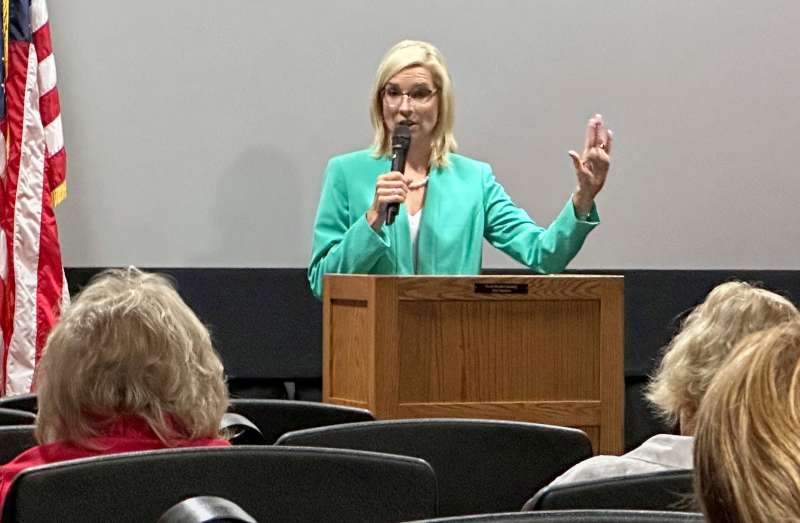
US Rep. Ashley Hinson told a closed-door Republican gathering in Lake View this month that the work of the Department of Government Efficiency (DOGE) is still very much operational. When an audience member lamented that DOGE had disbanded, Hinson corrected him saying, “It’s not.”
“Elon [Musk] was a good person to get that initiative going, but he was a little bit of a firebrand,” she said, talking about the billionaire who led DOGE. “… But the work continued at these agencies to try to uncover a lot of this waste.”
As the impact of DOGE-related cuts has become more widely known, Hinson, an early DOGE booster, has come under fire.
DOGE was created by executive order in January 2025, embedding Musk’s team inside federal agencies to identify waste, fraud, and abuse. The goal was to find $2 trillion in savings—a goal that was quietly revised to $1 trillion, then again to $150 billion.
According to a December 2025 analysis by the libertarian Cato Institute, it hit none of those targets. Federal spending in the first 11 months of 2025 was approximately $248 billion higher than the same period in 2024, with no visible effect from DOGE on the trajectory of outlays. The reason, the Cato analysts noted, is structural: most federal spending flows through entitlement programs like Social Security, Medicare, and Medicaid, which only Congress has the authority to cut.
What DOGE did accomplish was eliminating roughly 271,000 federal jobs, a 9% decline that Cato called the largest peacetime workforce reduction on record, comparable only to military demobilizations after World War II and the Korean War.
Even Musk has offered a subdued assessment of his own initiative, telling Reuters last December that DOGE was only “a little bit successful” and that he would not do it again.
Hinson was an early and vocal supporter of DOGE. The Des Moines Register reported her cheering Musk’s efforts to root out waste in the federal bureaucracy, despite concerns about DOGE dismantling the US Agency for International Development (USAID) and gaining access to sensitive government data. Later that month, she told WHO 13 that DOGE was “already saving taxpayers about a billion dollars a day” and called the pace of the effort “really important.”
She is a member of the House DOGE Caucus and invited the chair of Iowa’s newly created state DOGE task force as her guest to the State of the Union address in Washington, DC, declaring like Gov. Kim Reynolds before her that “Iowa was doing DOGE before it was cool.”
Hinson’s optimism for DOGE collided with the reality of the impacts it had on Iowa’s beleaguered farm economy. One of DOGE’s direct impacts in Iowa was the layoff of agricultural researchers, rural support staff, and Farm Service Agency employees. Farmers utilizing these services reported the offices were understaffed.
In February 2025, the Des Moines Register reported that roughly $10 million owed to Iowa farmers had been frozen—payment for soil conservation work they had already completed under federal contracts. The freeze came at a particularly difficult moment: US farm income had fallen about 28% over the prior two years, and farmers were lining up financing for the upcoming planting season.
The cuts deepened in March, when the USDA eliminated $1 billion in local food programs nationally, including $11.3 million in Iowa. Around 300 Iowa farm families were left facing large financial losses. Ashley Wenke of Pleasant Grove Homestead near Montezuma told the Register the cuts amounted to “tens of thousands of dollars in losses for our farm.” Another farmer said, “We’re going to hustle, but we’re going to lose money.”
Hinson defended the cuts throughout. The Gazette reported in March 2025 that even as DOGE fired tens of thousands of federal workers—including agricultural researchers and rural support staff—Hinson said she supported DOGE’s work and had “a chance to hear directly from Elon.”
By April 2026, Iowa farmers were reporting understaffed local Farm Service Agency offices following DOGE layoffs. Maisah Khan, policy and partnership manager at the Regenerative Agriculture Foundation, said farmers were already seeing impacts at local Farm Service Agency offices, which she described as understaffed.
“Those were the offices that served rural farmers, that served under-resourced farmers. They were the one-stop shop for farmers to go to our agencies to get resources, to learn about best practices,” she said.
Van Buren County farmer John Whitaker told WQAD that the cuts were making it harder to bring the next generation into farming. “With the price of land and the price of machinery, we’ve got to have a way to get young people started in agriculture,” he said.
Hinson supported a House Appropriations Agriculture Subcommittee bill in April 2026 that would cut an additional $675 million from current USDA funding levels. She has pushed back on criticism of her record.
“I will always stand up for Iowa farmers to ensure their voices are heard,” she said in a statement. “Doing what’s right for Iowa farmers is not a political game — I’ve repeatedly stood up to my own party to deliver for Iowa farmers.”