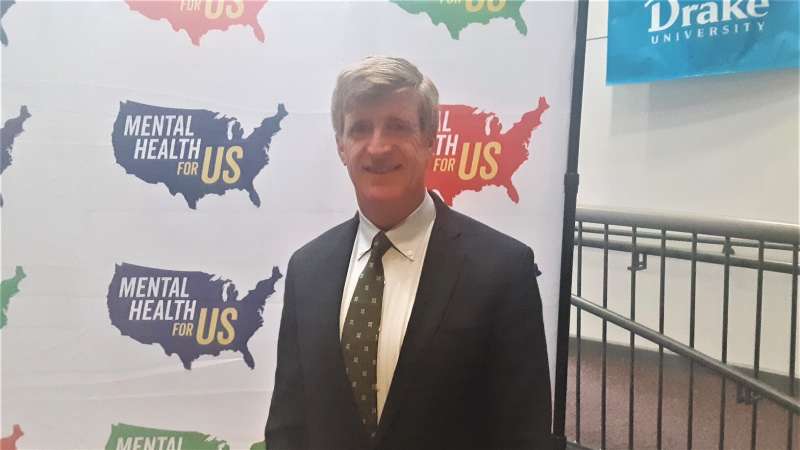
Patrick Kennedy knows a thing or two about the effects gun violence has on a family.
He also knows about mental health and addiction disorders.
Patrick, the youngest son of Ted Kennedy, is open about his past use of OxyContin, alcohol and cocaine. He sought rehabilitation for drug use the day after he crashed his car into a barricade on Capitol Hill in Washington, D.C., in 2006.
What’s more, Kennedy knows what it takes to get legislation passed through Congress.
He served in the United States House of Representatives from 1995 to 2011.
Kennedy has thoughts on gun violence and how to end it. And he has thoughts on America’s unwillingness to invest in solving mental health disorders before they reach a point that they’re as difficult as stage 4 cancer to cure.
But, he talks about them as two separate issues.
“I don’t want to conflate the gun issue with the mental health issue because we all know that the rest of the world has the same percentage of people with mental illness as we have,” Kennedy said, in a recent interview with Starting Line. “But, they don’t have the same mass shootings. And the reason they don’t is because they don’t have the guns.”
[inline-ad id=”0″]
Kennedy made the comment while he was in Des Moines last week getting ready to speak at a “Mental Health for US rally.” He has dedicated his life to figuring out how to bring transparency to a system that oppresses people with mental health and substance abuse disorders.
While headlines of mass shootings appear all too often in America, some of which blame mental health disorders rather than guns for the shootings, Kennedy said the silence generally surrounding mental health and addiction disorders signifies how much the general population doesn’t care about treating people who are living with them.
Talking about mental health issues is the best way to bring transparency to an oppressive system, Kennedy said.
“We got civil rights because people got active,” Kennedy said. “We haven’t gotten rid of racism and bigotry, but it is illegal to practice it in the form of discrimination, and that changes attitudes.”
[inline-ad id=”2″]
“If we enforced equal rights coverage for mental illness and addiction, eventually people would start to see it normalized,” he said.
On any given night, nearly half-a-million Americans are relegated to the streets or in jail because of mental health or addiction disorders. That, Kennedy said, is a symptom of a larger problem.
“My uncle, President Kennedy, was known for trying to begin a new process where people were let out of the asylums and provided community supports,” Kennedy said. “What ended up happening is people with intellectual disabilities got covered because when Medicaid came along you didn’t see that as their fault, but people with mental illnesses and addictions were not given the same coverage.
“The reason for that was there was this feeling that they brought it upon themselves,” he continued. “That’s frankly been the same attitude that has existed for the last 50 years.”
[inline-ad id=”1″]
Now, twice as many people are dying of suicide and overdoses than died during the height of the HIV crisis.
But, the country is spending less than one-fifth of the amount of money it spent to attack AIDS.
Kennedy estimates a person who has a mental health disorder is worth about 1/100th of what a person afflicted with cancer is worth, in terms of sheer health care dollars allocated to treat each person.
“My view is we were right to spend the money on AIDS,” Kennedy said. “And thankfully, we were right to spend it largely on cancer. It took us 40-plus years to move the needle on turning cancer from a fatal disease to largely a chronic illness. Obviously, there are many cancers that are not there yet. The one that took my dad’s life is one of them.”
Two of Kennedy’s siblings and his mother also battled cancer.
“We’ve made great progress,” Kennedy said. “But this is not an ‘or.’ I’m just using these other illnesses as a comparative to illustrate that folks do not treat these as equal illnesses.”
No human being, Kennedy argues, purposefully wakes up in the morning and tries to get a DWI or alienate their family and loved ones.
Those acts run 100% opposite of human nature, which is to want to be loved, he said.
“No one can say that these folks who are taking their lives or suffering from addiction that this is a choice,” Kennedy said.
Through the Kennedy Forum, Kennedy is hoping to spread the message that organizations treating broad mental health disorders ranging from addiction to suicide awareness to overdoses should come together and fight.
“We are all sharing 98.8% of the same issues,” Kennedy said. “Because the same thing that’s going to help one is going to help all the others and vice versa. And 2020 is an opportunity for us to come together because there’s a general recognition that these are no ordinary times, to say the least, in our political life and the life of this country.”
“And it calls on all of us to do things with a little bit more urgency and with greater effort,” Kennedy said. “And for those of us as advocates we ourselves needed to do that as well. Because this is an existential crisis, just like our environment is an existential crisis and just like our democracy is an existential crisis, but it’s not one or the other. We need to fight for all of these things.”
Headlines surrounding mental health disorders – including those that involve gun violence – have been dramatic in the past. But for some reason, people are still not translating those headlines in a way that reflects a change in attitude, he said.
“The best way to see where we put our priorities is where we spend our money,” Kennedy said. “So back to square one. We’re not spending our money here, which to me says that all the great words are of little use.”
“Because that’s the real test, as they say in recovery,” Kennedy said. “You not only gotta talk the talk, you’ve gotta walk the walk. And we’ve talked the talk recently, and everyone is giving themselves pats on the back for talking the talk. But we have yet to really walk the walk in this country.”
by Paige Godden
Posted 10/3/19