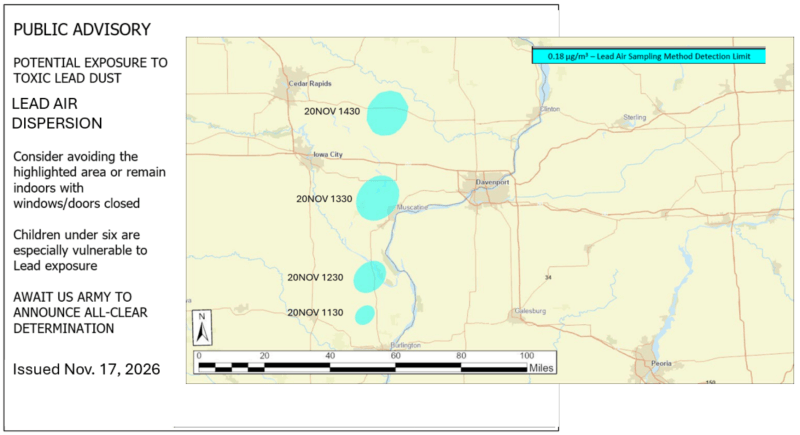
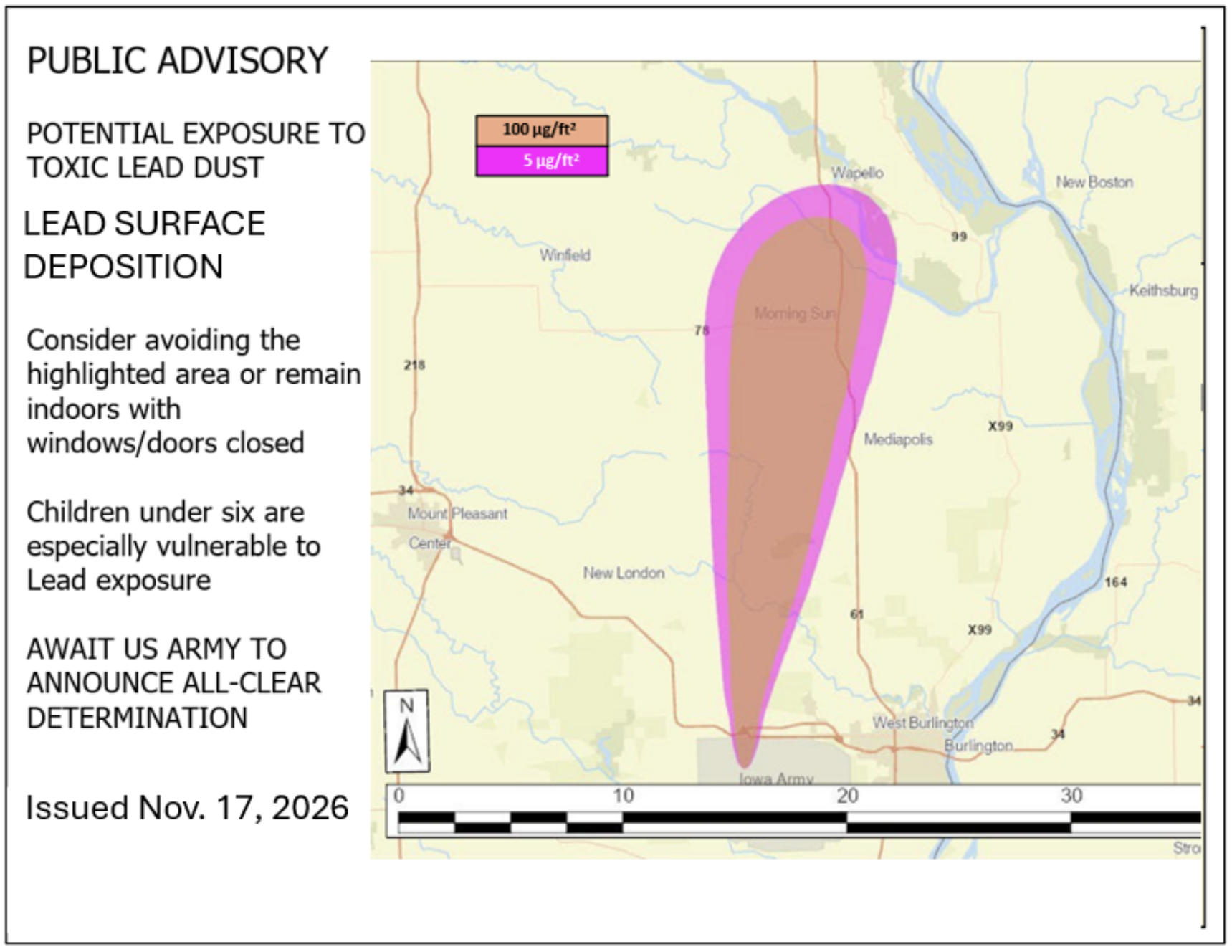
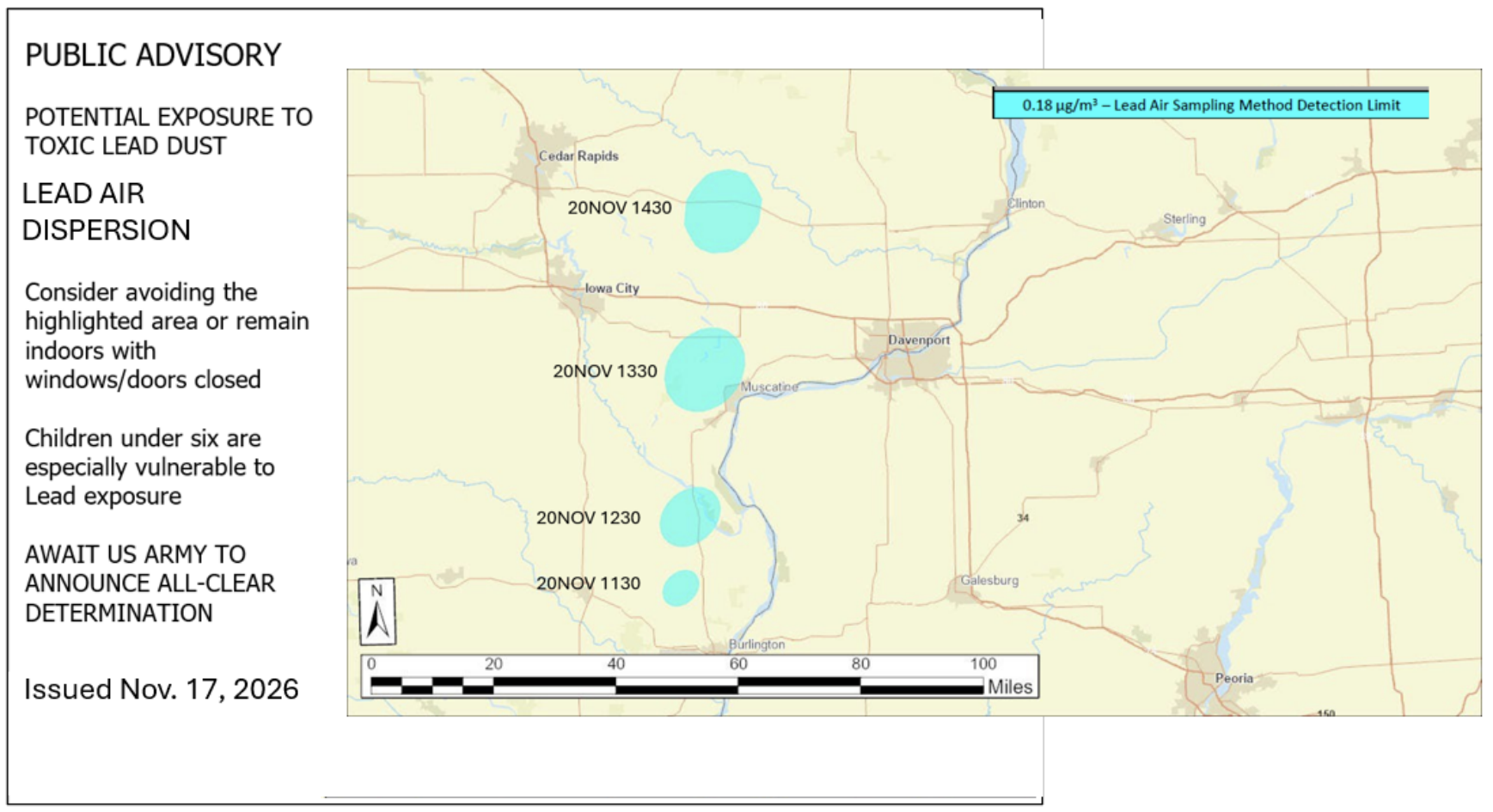
The US Army released new documents offering additional context on its plan to detonate 68 drums of volatile lead azide in Middletown Friday, Nov. 20. The story has alarmed residents of the region who only learned Sunday evening that wind could carry lead-contaminated dust and deposit miles away.
In these new documents, the Army argues that the plume maps assume a worst-case scenario and were created and released only because of a requirement from the US Environmental Protection Agency, which permitted the detonation.
The permit, which was only made publicly available Wednesday (two days before the planned blast), required the Army to run its air model assuming all of the lead in the 68 barrels of lead azide is released.
“Technical experts from both the EPA and the Army agree that the modeling on which public notifications will be based is not necessarily representative of actual conditions that may result from the treatment activity,” the EPA wrote in the emergency permit for the detonation.
The Army plans to detonate the material in two blasts at the Iowa Army Ammunition Plant around noon Friday, Nov. 20.
The permit says the Army believes the real release of lead will be less severe than what the plume maps indicate because of the steps it is taking to contain the blast. Army spokesperson Justine Barati told Iowa Starting Line that a controlled explosion lets crews wet the soil and use water sprayers above the buried cement bunker containing the explosives. A sand barrier has also been erected around it.
However, the EPA says it cannot put a number on the Army’s efforts at reduction, so it chose the most conservative approach to “ensure that the prior notifications are maximally protective to the public.”
Notifications began Sunday, Nov. 15, five days before the blast. While the region could have been notified earlier than that, Barati said the five-day notice was given because that’s what the EPA required.
Why the Army says it needs to detonate the material, cannot postpone
Wednesday’s document dump includes a 41-page environmental assessment that considers the risks associated with a controlled detonation versus the danger of not dealing with the highly-explosive lead azide.
“The findings of this EA demonstrate that the No Action Alternative presents unacceptable, persistent, and escalating risk to human health, safety, and the environment. … “While the controlled detonation will produce severe, instantaneous physical effects (blast, overpressure, noise) and generate a localized, short-term release of hazardous constituents (lead particulates and combustion gases), these impacts are heavily mitigated,” the report said.
The Army’s updated advisory says the lead in the air is expected to stay below the level that would trigger protective actions from EPA.
“Extensive modeling efforts predict that the potential level of lead particles in the air may be elevated but well below the level at which EPA would require protective actions be taken,” it said.
The assessment also further outlines the reasons why detonation should not be delayed. It says the lead azide was stored in an ethanol and water solution and that temperature swings changed its form. In March, crystallization had begun on the material meaning it had become volatile.
“Temperature fluctuations can also cause small amounts of lead azide to dissolve in the alcohol/water solution and then recrystallize into its pure state as needles and platelets, which are significantly more sensitive to shock and friction,” the report said.
This is why the Army determined it could not be transported to another location. It also ruled out neutralizing the lead azide with chemicals because it would require handling the highly explosive crystals.
What residents should do Friday
The advisory asks residents near Middletown City Park and Butterfly Park to leave from 8 a.m. to 2 p.m. It lists the Armed Forces Reserve Center at 16815 DMC Hwy 34 as a place to stay, with access limited to identified Middletown residents. That is a corrected location from what the Army listed Sunday.
For people in the plume’s path, the advisory says to:
- Stay indoors and keep windows and exterior doors closed during the exposure period.
- Set heating and cooling systems to recirculate, if it is safe.
- Avoid unnecessary travel through affected areas.
- Wet-clean children’s play equipment, toys, handrails, and windowsills after the Army says the exposure period has ended.
There is no level of exposure to lead that is safe, according to the World Health Organization. Exposure is particularly harmful to young children and women of child-bearing age. In infants, children, and fetuses, the National Institute of Environmental Health Sciences says lead exposure impacts brain development, lowering IQ, shortening attention spans, and potentially causing behavioral or learning difficulties.