Last week was a time for setbacks in the United States. The only question is which setback was greater.
Was it President Donald Trump’s standing in the eyes of the American people, with a book filled with fresh allegations about chaos inside his White House?
Or was it American journalism’s standing in the eyes of the American people that suffered the most?
I’m no fan of the president’s, as regular readers of these columns may deduce. So, some of them might think I would be thrilled to see several hundred pages of supposed evidence that Trump is little more than an empty suit, albeit a finely tailored suit.
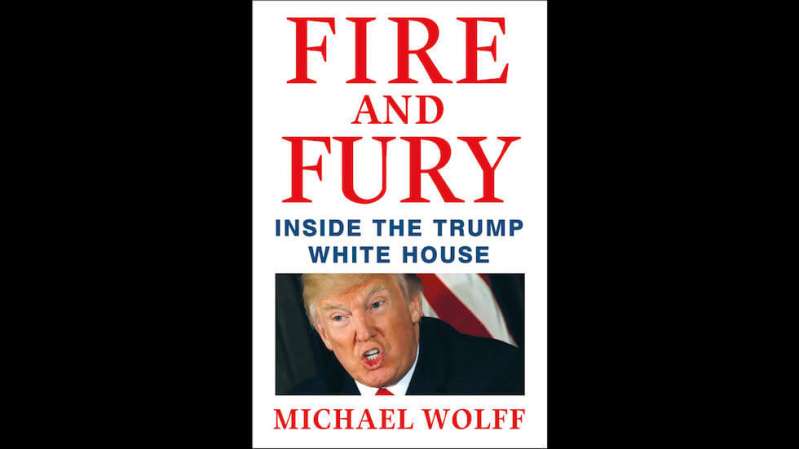
But I worry that the journalism profession’s reputation suffered a more serious blow than did Trump’s legacy, courtesy of author Michael Wolff and his gossipy new book, “Fire and Fury: Inside the Trump White House.”
My journalist’s ulcer had already been working overtime. Stomach acid was flowing like water out of a fire hydrant since the earliest days of the 2016 election campaign due to the evolution of the news business.
I watched with alarm as cable television news transformed itself from being a reliable, around-the-clock source of national and world news to, instead, being little more than a never-ending parade of pundits and pontificators shouting opinions hour after hour, day after day.
The journalist in me sees Michael Wolff’s approach to reporting playing into the hands of critics of important journalism — people who quickly brush off as “fake news” any news coverage the president and his supporters dislike.
The central theme behind “Fire and Fury” may well be in sync with reality inside the White House. The problem, as I see it, is that far too many Americans have decided to dismiss just about anything newspapers and television report if those facts don’t square with the readers’ and viewers’ own opinions.
Wolff says his book was based on 200 interviews, many of them recorded, with White House and Trump campaign staff members. But Wolff’s reporting has been challenged for longer than Trump has resided at 1600 Pennsylvania Ave.
Wolff’s credibility has been questioned through the years over the quotations he uses and over scenes he has reconstructed — or, as some critics put it, the scenes he has constructed.
The reporting techniques that Wolff employs — detailed descriptions of events and conversations that he was not privy to, and painfully few explanations of the sources of such details — erode the credibility of journalism in general.
Wolff’s approach is one that would not have been tolerated during my five decades in the newspaper business and in newspaper management.
Reporters would have been asked to explain to me — and to readers — how they got these juicy quotations since they were not present during the conversations and since it is unlikely the parties were taking verbatim notes.
Back in my working days, editors knew their newspapers would not be credible, authoritative sources of information if readers did not have confidence in the reporters’ work.
These days, that confidence is pretty well diminished. Many readers and viewers don’t believe reporters are fair. They don’t believe the facts journalists gather unless those facts square with the reader’s/viewer’s own opinions.
You can blame cable news and talk radio. You can blame the overuse of unnamed sources. You can blame Michael Wolff. Or Donald Trump.
A friend of mine, Stephen Berry, was a prize-winning investigative reporter in Orlando and Los Angeles in his first career and then became a University of Iowa journalism professor in his second career. Now retired, Berry touched a nerve last week when he suggested in several Facebook posts that journalists need to do more to rebuild their credibility by providing more information about the sources of their information, not less information.
“Because most people don’t believe any facts unless those facts support their world view and ideology, good sourcing that is transparent will add a critical element to any conversation in the public discourse or in private among rational, reasonably open-minded individuals,” Berry wrote.
The reaction was swift and underscored his conclusion about people’s reaction to facts:
“Wolff may be a clown, but he’s exposing a worse clown.”
“This guy’s got a history with stretching the truth, and who needs that when the truth is bad enough?”
“Stephen J. Berry, you are a [bleeping] idiot. Trump is a moron and will be in prison soon.”
“Well, Berry, sounds like you have your lips all puckered up waiting to give Trump a kiss. You disgust me!”
Berry wants journalists to take more time and more space to provide more information about their sources and their background, education and expertise. Such layering of information beyond just the person’s title will add to the transparency and credibility of the sources and boost the authority of the journalists’ reports, he believes.
I agree with Berry’s recommendations and his response to the potshots from the left and the right about the new Trump book: “I am against all bad journalism regardless of whether it favors him or is critical of him.”
by Randy Evans
Posted 1/10/18