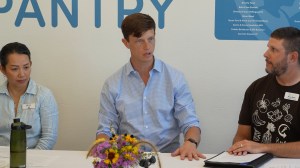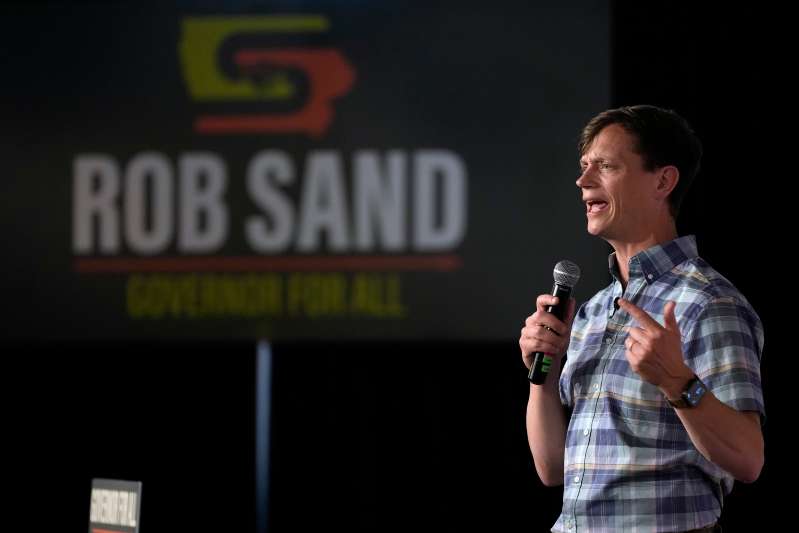
Democratic gubernatorial nominee Rob Sand released a new affordability package of cost-cutting proposals Monday in the latest installment of what his campaign calls the “Truer, Better Agenda.”
“Traveling the state, I’ve heard it everywhere I go: the cost of living is just too high. From health care costs to utilities to groceries and housing, Iowa families are working hard but still can’t keep up,” Sand said in the release. “While costs have skyrocketed, Iowans’ paychecks have mostly stayed the same. What have our elected officials been focused on? Culture wars, gutting the Auditor’s Office, and further dividing us. Enough. I want to focus on solving Iowans’ problems and lowering their costs, and that’s exactly what I’ll do as governor.”
Sand’s full policy page frames the affordability plan against Iowa’s broader economic standing: the state has ranked near the bottom nationally for economic growth and has averaged 48th in the country for personal income growth over the last three years, according to the US Bureau of Economic Analysis.
The plan touches four areas of household spending: healthcare, energy, education, and housing. On healthcare, Sand is calling for an end to Medicaid privatization, action to lower prescription drug costs, support for family caregivers, an expansion of Iowa’s “Surprise Bill” law to cover all medical appointments and procedures, and new protections against medical debt.
On prescription drugs specifically, the plan calls for creating a Prescription Drugs Review Board to negotiate down the cost of drugs like insulin, cracking down on price gouging based on the findings of the state’s pharmacy benefit manager (PBM) audit, and exploring the feasibility of importing generic drugs from Canada.
AARP estimates that family caregivers spend around $7,242 of their own money annually caring for relatives. Sand proposed a non-refundable tax credit of up to $2,000 a year for caregivers—with an additional $1,000 for those caring for veterans—targeted by income and need. The campaign estimates that roughly 57,000 Iowans would qualify.
The Medicaid proposal isn’t new ground for Sand. As state auditor, his office found that Iowa’s 2016 privatization of Medicaid under Gov. Terry Branstad led to an 891% increase in Medicaid members being “illegally denied services.” Now it has been a decade since that shift, with the system’s future emerging as a defining issue in the year’s race. Republican nominee Zach Lahn supports continuing Medicaid privatization and has called Sand’s plan to end it “the exact wrong idea,” according to KFF News.
The number of Iowans with medical debt increased by 55% between 2020 and 2023. A 2025 investigation by KWQC called it the fastest increase in the United States.
According to the plan, canceling medical debt wouldn’t cost Iowa taxpayers because it would be funded through public-private partnerships. That model has precedent elsewhere: Cook County, Illinois partnered with the nonprofit Undue Medical Debt—formerly RIP Medical Debt—in 2022 to buy up and forgive residents’ unpaid medical bills using public funds. The model has since been adopted by Toledo, New Orleans, New York City, and several states. RIP purchases debt on secondary markets for a fraction of its value, then forgives it rather than collecting—Toledo’s program erased more than $72 million in medical debt using an initial $800,000 commitment, according to a press release from the city. The plan also calls for separate protections that would remove medical debt from Iowans’ credit reports, so it can’t affect their ability to rent an apartment, buy a car, or lower their insurance premiums.
On energy, Sand wants to cap flat “service” or “meter” fees that utilities charge regardless of usage, increase transparency in how the Iowa Utilities Commission sets rates, and hold “major corporations and data centers accountable” as the state’s grid absorbs new industrial demand. That accountability language comes from his separate data centers plan released earlier this month. It calls for data centers to pay their own way, cover cost increases they cause, and monitor their water usage. On rates, the plan also calls for mandating that regulators approve utilities’ Return on Equity (ROE) levels to prevent excess profits at ratepayers’ expense, repealing an existing state limit on utility investment in efficiency programs, and expanding incentives for Iowans to sell excess solar power back to the grid.
For Iowa families with children, the plan’s education plank calls for universal school meals and universal Pre-K in Iowa’s public schools, along with more oversight of the state’s school voucher program. On meals, the campaign points to the federal government’s cut of $1 billion from local school food programs in 2025 as a gap it wants the state to help fill.
While Iowa is in the top five ranking for preschool access for four-year-old children nationally, the campaign cites data showing Iowa ranks 40th in state pre-K spending and that more than half of Iowa 3- and 4-year-olds don’t attend preschool at all. When asked how they’d pay for it, the Sand campaign said reforming Iowa’s private school voucher program would free up funding to pay for universal pre-K and universal school meals.
Sand’s own auditor’s office estimated the Education Savings Account voucher program cost $329.6 million in Fiscal Year 2026, with 41,892 students enrolled in non-public schools. Sand’s office calculated that roughly $258.7 million of that spending goes to families who, based on prior enrollment trends, would have sent their children to private school even without a voucher.
“When you subtract the students that were already expected to be enrolled, then you can see how big of a difference the program itself is making in terms of increasing private school enrollment,” Sand said, according to We Are Iowa Local 5 News. “. . . Now, the program itself is still paying tuition for the wealthiest families in the state of Iowa who can barely even feel the check that they write and a lot of people who don’t mind doing it at all.”
It’s not yet clear from the campaign whether “reforming” the program would introduce means-testing participants, capping the currently unlimited number of vouchers available, or something else.
On housing, Sand is proposing to speed up homebuilding by cutting local and state red tape, guarding against price gouging, and making down payment assistance interest-free for first-time buyers. The plan cites a need to build 21,000 more homes by 2030 to close Iowa’s shortage. It points the finger at “red tape,” especially permitting and inspection rules that make it harder to build duplexes, quadplexes and accessory dwelling units, as part of the problem. In addition, he would prevent landlords from using AI algorithms to price-fix and raise rents, an issue that has drawn state and federal legal action elsewhere in the country over software like RealPage. And the interest-free down payment assistance would replace Iowa’s current program, which offers the assistance only as a second mortgage that accrues interest, according to the campaign.
“While costs have skyrocketed, Iowans’ paychecks have mostly stayed the same,” Sand said in a statement announcing the plan.
The plan does not include cost estimates or a funding mechanism for the new spending it would require, including universal meals and Pre-K.
Republican governor nominee Zach Lahn did not respond to a request for comment on Sand’s proposal. While the policy section on Lahn’s website is light on text, it does include a “focus on affordability:”
“Lessening the tax burden on Iowans, food freedom policies and banning Wall Street hedge-funds from buying single family homes will help make life affordable for Iowa families.”