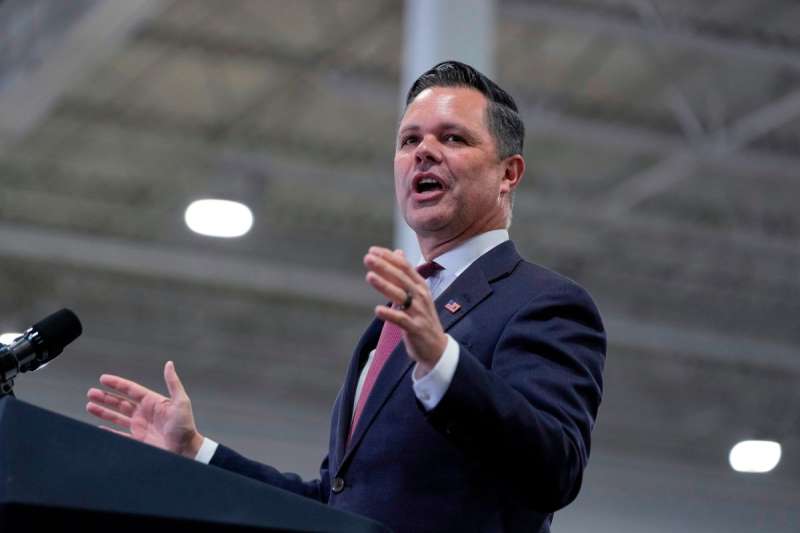
Since President Donald Trump announced that US Rep. Zach Nunn (IA-03) would seek re-election instead of running for governor, the Ankeny Republican has had multiple opportunities to make clear his position on tariffs.
- September 2025: Favored tariffs. In September 2025, House Republicans passed a measure blocking challenges to President Donald Trump’s global tariffs. Nunn voted for it.
- Feb. 10, 2026: Favored tariffs. On Feb. 10, Nunn voted for a rule that would have barred fast-track floor votes to end Trump’s emergency tariffs until July 31. In practical effect, this was a vote to prevent the House from acting against the tariffs.
- Feb. 11, 2026: Favored tariffs. On Feb. 11, Nunn voted no on a resolution to end the national emergency Trump used as the legal basis for tariffs on Canadian goods.
- Feb. 13, 2026: Mixed. Nunn was asked by Iowa PBS about the impacts of President Donald Trump’s tariffs on Iowa’s farm economy. Nunn said he supported Trump “holding offenders accountable,” defended tariffs as leverage, and cited trade gains. But he added, “I don’t want to see tariffs used viciously, and I still believe that the first article of the Constitution says that Congress should be leading this.”
Nunn argued that tariffs have actually delivered for Iowa Agriculture.
“What tariffs have brought us on the good side for [agriculture] is 24 million metric tons of soybeans being sent to China,” Nunn said to Iowa PBS.
A Starting Line fact check found that Nunn’s statement isn’t entirely accurate—and the situation isn’t so simple. China has committed to buy 25 million metric tons of US soybeans a year through 2028, but Chinese state-run companies had purchased about 13.7 million metric tons by late September—well short of the 24 million metric tons Nunn said were being sent to China.
Those purchases also came after US-China trade talks and a buying agreement, making it hard to credit tariffs. China stopped buying US crops for months during the tariff dispute, and its remaining 10% tariff on American beans has kept many private Chinese buyers turning instead to Brazil and Argentina.
China
Nunn’s work on China has intersected with farm policy in ways that raise questions about competing priorities. In February 2025, Nunn was named to the House committee charged with examining China’s economic and national-security influence. That role casts new light on his earlier support for the EATS Act—a bill that would have blocked California from enforcing animal welfare rules on pork sold in the state.
The bill grew out of California’s Proposition 12, which requires pork sold there to meet minimum space standards for breeding pigs, no matter where the animal was raised. Because California buys a major portion of the nation’s pork, Iowa producers who want to access that market have to follow those rules.
One month after the Supreme Court upheld Prop 12 in a 5-4 decision, US Rep. Ashley Hinson, the current Republican candidate for US Senate in Iowa, introduced the EATS Act, and Nunn co-sponsored it.
Opposition to the bill came from the Republican party’s own right flank.
Ten conservative House members wrote they were “gravely concerned about the infiltration of American pork production by foreign adversaries.”
“Smithfield Foods, which controls an extraordinary 26% stake of US pig production and publicly supports the EATS Act, is wholly owned by the [Chinese Communist Party],” the letter said.
Smithfield Foods is majority-owned by WH Group, a publicly traded Hong Kong company.
Separately, the director of Harvard Law School’s Animal Law and Policy Program warned the bill could backfire on Iowa pork producers by stripping state disease protections. The bill did not pass.
That tension showed up again in Nunn’s approach to soybeans.
In October 2025, he urged Trump administration officials to remove retaliatory tariffs and find new markets for Iowa crops, writing that trade friction had priced US soybeans out of China. Later, Nunn credited tariffs with bringing soybean sales back to China.
The money
Nunn has warned that China can use trade to put pressure on Iowa farmers. But his campaign and leadership PACs have accepted $18,750 since 2021 from the corporate PACs of Syngenta and Smithfield, two agricultural companies with Chinese ownership and US farmland holdings, according to Federal Election Commission records.
Syngenta is owned by Sinochem, a Chinese state-owned company. Smithfield is majority-owned by Hong Kong-based WH Group, which says it is not a Chinese state-owned enterprise.
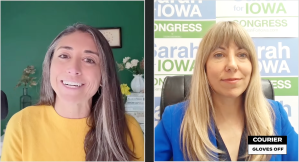
Democratic challenger Sarah Trone Garriott does not accept corporate PAC contributions.