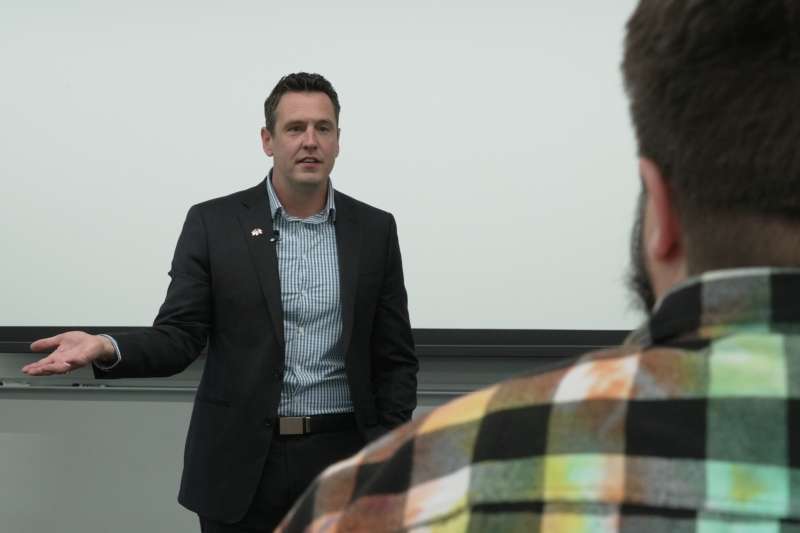
Republican gubernatorial candidate Zach Lahn has positioned the private school he founded in Kansas as the model for reinventing education.
“I don’t think a better model exists today for equipping children with real-life skills from an early age,” Lahn wrote in one of 15 promotional emails sent to prospective families first reported by Kansas Reflector.
Lahn, co-founder of Wonder, a private “learner driven” school in Wichita, Kansas, has told Iowa voters he’d push for “innovation waivers” freeing public schools from mandatory testing and some graduation requirements, Radio Iowa reported. He’s pointed to his own school, and the eight years he spent building it, as proof the model works.
A look at Wonder’s own numbers tells a more complicated story.
According to salary data from the school’s IRS filings, Wonder’s average teacher—the school calls them “guides”—makes an estimated $40,000 a year. That’s below the average for teachers in Kansas ($61,470), according to National Education Association data. It’s even below the average teacher starting salary in Kansas ($44,164).
Meanwhile, tuition at Wonder runs about $1,200 a month or $12,000 a year. Lahn has spoken openly about the financial strain that puts on families.
“I’ve had parents say to me, I don’t care if I need to take a second job, I will find a way to pay the tuition,” Lahn told Jordan B. Peterson on his podcast back in 2023, years before he entered the governor’s race.
The school’s finances, however, haven’t been steady, either. Kansas Reflector reported that Wonder ran a deficit in five of its six years open, and by 2025 owed Lahn and his wife, Annie, roughly $4.5 million in personal loans the couple made to keep it running.
Wonder also isn’t equipped to serve most students with disabilities. The school says on its website it can only accommodate mild cases of ADHD, dyslexia, “some minor forms” of autism, and is not “currently equipped” for other learning needs.
This is true for non-public schools in Iowa. They are not required to accept students with disabilities the way public schools are, according to Disability Rights Iowa. That distinction matters beyond Wonder’s own admissions office. Iowa’s Education Savings Account program lets families use public money for private school tuition. But unlike public schools, participating private schools face no requirement to accept or serve students with disabilities.
During the primary, Lahn said he disagreed with fellow Republican gubernatorial candidate Randy Feenstra, who argued in April that ESA-funded private schools should have to take every student who applies.
“Every school has to make sure they take every child,” Feenstra said at a Westside Conservative Club event in Urbandale reported by Iowa Capital Dispatch, Feenstra added that a child with an Individualized Education Program should be able to enroll anywhere a parent chooses “and the school should accommodate.”
Lahn has said this “the wrong debate to be having.”