“Nine hundred million dollars is a figure 10 times the amount of all other types of theft in Iowa combined,” Nate Willems told me. “And Brenna Bird’s never gonna do a thing about that.”
Willems is a longtime Iowa labor lawyer who lives in Mount Vernon, running for Iowa Attorney General against the incumbent, Brenna Bird.
If elected, he wants to do something about Iowa’s biggest theft problem: Wage theft.
“We have a $900 million a year problem in the state of Iowa; $900 million a year stolen from Iowa workers’ paychecks,” Willems said, including “people working off the clock, not getting paid overtime, misclassified as independent contractors, tips stolen, or illegal deductions from pay stubs.”
What’s the problem?
That $900 million figure Willems uses comes from a 2022 study by Common Good Iowa.
One of that organization’s solutions? The state should actually enforce existing laws.
Willems said that’s not happening right now under the Department of Inspections and Appeals and Licensing.
“They just knock on the door of employers against whom complaints have been brought and say, ‘Hey, we think you may owe Joe here $7,000. You know, it’d be a pretty good idea if you paid that.’
“So the worst-case scenario presently for an employer that steals wages from their workers, at least vis-a-vis state government, is that they obtained an involuntary zero-interest loan from their workers’ paychecks.”
But, he points out, Iowa Code has stiffer penalties for wage theft on the books. And he’d use them if elected in November.
“We’re not seeking to change or alter the law,” he said. “We’re seeking to simply enforce laws that many people have taken for granted.”
What’s his solution?
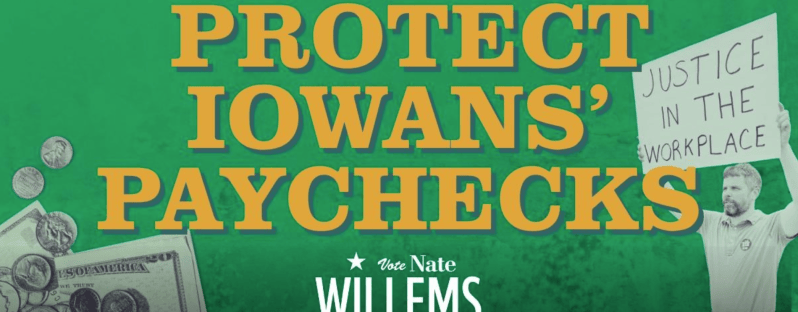
As part of his campaign’s Protect Iowans’ Paycheck plan, Willems plans to start up a Wage Theft Enforcement Unit within the attorney general’s office.
He says the unit will prioritize cases of wage theft as well as worker misclassification and other labor laws ignored by companies.
“Whether that be an employer that fails to carry worker’s compensation insurance, if there are employers who are doctoring or altering timecards in order to avoid overtime or simply not pay wages—there are criminal implications there.”
He also plans to do education and outreach with police and sheriff’s offices, who sometimes say to people reporting stolen wages, according to Willems:
“Well, that just seems like a civil matter.”
Willems acknowledges the unit will need partners, like nonprofits and unions, particularly if lawmakers put up roadblocks to his work. But he said it would be a big step in advocating for Iowa’s workers.
“To have a unit figuring out how best to go about getting people paid the wages which are due, it’s important to have somebody focused on that within the AG’s office,” he said.