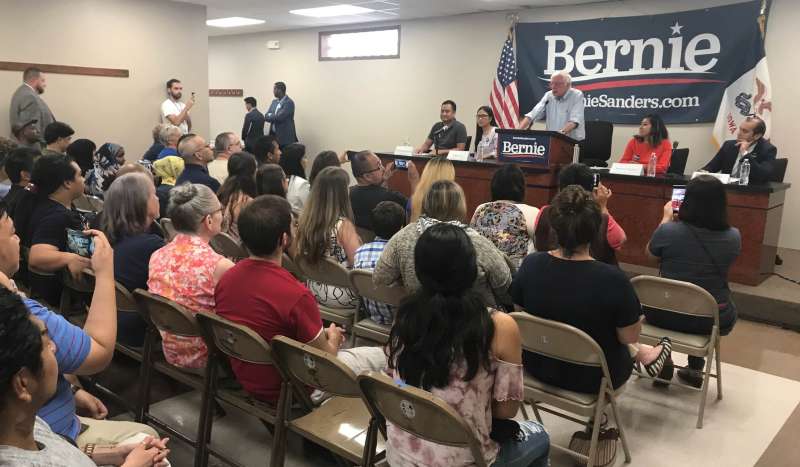
An immigration roundtable this afternoon gave immigrants the platform to tell their story and explain their struggles to Senator Bernie Sanders during his three-day Iowa visit.
About 100 people turned out in Des Moines to see Sanders, who opened with remarks about his own family and how they came to America from Poland.
“What demagogues do, instead of paying attention to the real issues, is looking at immigrants and saying, ‘it’s their fault’ when discussing issues facing the country,” Sanders said, to kick of the discussion. “That’s called demagoguery, and it has no place in American society.”
Sanders had four guests on the panel, all of who either immigrated here themselves or are the children of immigrants. On the panel were Mohammad Ali, Antonia Rivera, Abigail Sui and Phouty Keopraseuth, who were all given time to tell their story before Sanders asked each of them what has gone well, and poorly, in their experience and what changes they would suggest to make experiences easier for people coming to the U.S.
Antonia Rivera
A single mother and a survivor of domestic violence, Rivera came to the U.S. in 1996, when she was six years old. Her mother was awarded a visa, but had to return to Mexico to retrieve the paperwork and faced a ten-year ban upon doing so.
“Even though my sister will qualify to be a U.S. citizen soon, everything she did for 30 years in this country could qualify her as an inadmissible criminal,” Rivera explained, discussing the overly-bureaucratic process of gaining and retaining legal permission to reside in the U.S.
Rivera also talked about passing “real immigration reform” that would allow people to live with dignity. She brought up legislation currently in place, like DACA, but said America needs more immediate and permanent solutions than passing mandates and extending pieces of legislation.
Mohammad Ali
Now a father, Ali came to America for educational opportunities and graduated from Iowa State University. He told stories of being continually racially profiled in airports for as long as he has been here.
While going through security to visit his sister in Canada, he described being disrespected by U.S. immigration officers, who surrounded their car with guns pointed and put his father in handcuffs, hurting his shoulder. Ali said they had gone through Canadian customs with no problems and showed all proper documentation at every point, but were still harassed when coming back into the U.S.
“I’m here to stress the importance of fixing legislation that allows for me to be unjustly harassed by law enforcement,” said Ali. He also stressed that the U.S. should put technology to use for good to end racial profiling, citing fingerprints, laser scans and other methods of identifying people.
Abigail Sui
A Burmese refugee, Sui discussed the difficulties of taking part in regular parenting as an immigrant, including the inability to speak to a child’s teachers or a doctor, and being overburdened by work demands to make ends meet.
“Many people from my community feel like refugees aren’t welcome,” Sui said. “In the past six months, randomly, we received a letter to show up to the U.S. immigration office for an interview, with no reason given.”
She talked about the harsh transition coming from Burma, detailing how long and tedious the wait is just to get a chance to come to the United States in the first place, and said she would like to see the refugee-acceptance process become more efficient.
“We just want the same chance to have a better life as everyone else,” Sui said.
[inline-ad id=”0″]
Phouty Keopraseuth
A Lao-American, Keopraseuth was raised in Des Moines, whose parents came from Loas as refugees in hopes of a better life.
“I’m here with Bernie Sanders because I believe he is leading us on a path to a better America for all of us,” Keopraseuth explained.
Keopraseuth was very open that he has never felt unwelcome in the United States, but that his family still had to struggle and be incredibly frugal to get where they are today. When asked what he would do if he were president, Keopraseuth explained that he’d like to see more basic struggles resolved so that everyone can do well.
“The difficulty of being here is the cost of college continues to rise, good jobs are still hard to come by and it’s very hard to attain decent wages in order to raise a family, to have adequate healthcare in case an emergency happens,” Keopraseuth said. “All these things effect all of us, whether you’re undocumented or not.”
by Josh Cook
Posted 7/3/19