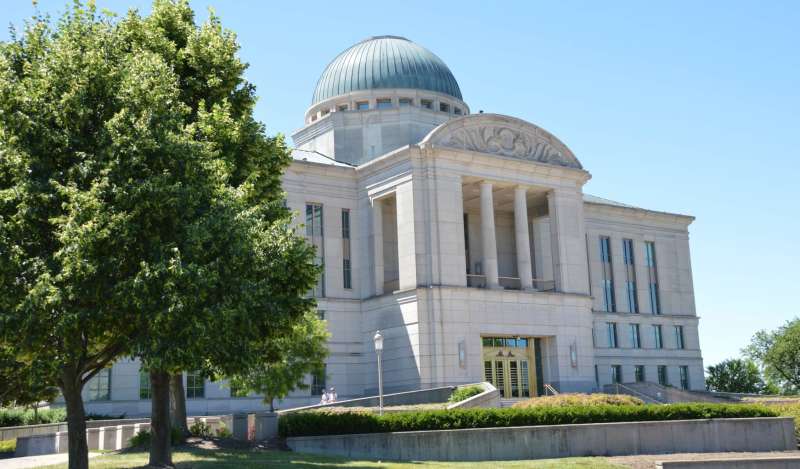
The Iowa Supreme Court Thursday heard arguments concerning the injunction on the near-total abortion ban passed is a special session last summer.
Peter Im, staff attorney at Planned Parenthood Federation of America, told the justices and reporters in a press conference afterward that allowing the ban to go into effect would be “devastating.”
“It bans abortion at six weeks of gestational age, and that’s six weeks of measurement from first day of the last menstrual period,” he said. “So it’s really incredibly early in pregnancy. More than 90% of the abortions in Iowa happen after six weeks.”
Im argued for Planned Parenthood of the Heartland Inc., Emma Goldman Clinic, and Dr. Sarah Traxler. Eric Wessan, Iowa’s solicitor general, argued on behalf of the state.
The court has until June 30 to release its decision.
The main issue in question was whether the Iowa Supreme Court should dissolve the temporary injunction currently blocking enforcement of the ban. Specifically, the issue is whether the district court was wrong to issue the injunction in the first place.
“We’re arguing that the district court was right to block this cruel law. Doing so is essential to protect the bodily autonomy and freedom of Iowans, as well as their health and safety,” said Rita Bettis Austen, the legal director for the American Civil Liberties Union (ACLU) of Iowa.
Bettis Austen was also in the courtroom, but she didn’t address the justices.
Iowa’s near-total ban prohibits abortion after electrical impulses are detected in an embryo—anti-abortion figures falsely call this a “fetal heartbeat,” but no physical heart is present at this point in pregnancy. Most people don’t know they’re pregnant this early either.
The ban has exceptions for rape, incest, and medical emergencies but they’re narrow and the rape and incest exceptions have reporting requirements (45 or less than six-and-a-half weeks and 140 days or 20 weeks, respectively).
In the courtroom
In the hearing, Wessan spoke first and the justices asked questions about his argument. Im went second and also answered questions from the justices.
The justices focused a lot on what standard of review should be used for abortion bans because that’s key to how the district court made its decision.
“As we explained to the court today…abortion bans like this violate Iowan’s right to exercise autonomy and dominion over their own bodies to make private medical decisions,” Im said in the press conference. “Also, abortion bans disproportionately affect women, and there are guarantees for women’s equality in the Constitution.”
In recent years, the Iowa Supreme Court has ruled abortion is not a fundamental right under the Iowa Constitution, and that equal protection arguments don’t apply to abortion bans.
Im’s main argument was that the Supreme Court should allow the injunction to stay in place and the district court was correct at the time it issued the injunction.
He argued the court should adopt “intermediate scrutiny” because the law infringes on the right to bodily autonomy. This level of review comes into play when states pass laws that discriminate against or negatively affect protected classes.
“[The Iowa Constitution] says that men and women are by nature free and equal, and it also guarantees to men and women the rights to enjoy and defend liberty and the rights to pursue and attain safety,” Im said. “And certainly that is more than broad enough, in our opinion, to mean that an abortion ban as draconian as this one is unconstitutional.”
The state argued the justices should use “rational basis,” which is the lowest standard and would likely allow the abortion ban to stay in place. Rational basis requires the state to prove it has a legitimate governmental interest and there’s a rational connection between that goal and what the law requires.
This standard used in cases where fundamental rights and protected classes aren’t at issue, and it’s typical for cases involving due process and/or equal protection.
Im argued if the court wants to impose that standard it should send the case back to the district court so the two sides can develop arguments on those grounds.
Will of the people
The justices also asked the attorneys whether it mattered that the law was passed by legislators who were elected by Iowans.
In court, Im explained that elected officials are still capable of passing laws violating people’s rights. He said some of the justices’ specific questions can be explored if the court allows the case to go back to the district court level.
Im said ultimately the justices should consider the freedom of Iowans and allow the injunction to stand while the parties figure out details in lower levels of the court.
Mazie Stilwell, director of public affairs for Planned Parenthood North Central States, pointed out in the press conference that 61% of Iowans have said abortion should be legal in all or most cases.
Strict abortion bans have taken effect across the US, and reports have shown a significant impact on the health and well-being of women. Voters in many of those states have consistently voted in support of abortion rights, which isn’t an option in Iowa.
An Ipsos/Axios poll from March 29 shows 81% of Americans (65% Republicans, 82% Independents, 97% Democrats) believe “abortion issues should be managed between a woman and her doctor, not the government.”
Before the Iowa Supreme Court released its 2023 opinion on the 2018 ban, Iowa Republicans also refused to talk about abortion and their plans for it in the wake of the US Supreme Court overturning Roe v. Wade in 2022.
“No matter how you slice it, these policies are deeply unpopular and harmful,” Stilwell said. “And we know that so many thousands of Iowans have made their voices heard on that.”
You can watch the Iowa Supreme arguments here.: