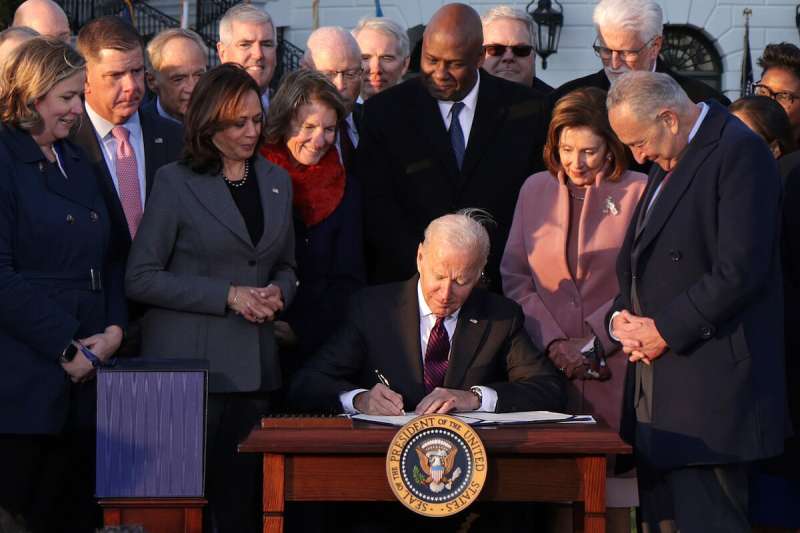
Iowa labor leaders expect a tremendous boost in construction work and the economy following the signing of the Infrastructure Investment and Jobs Act, which will bring about $5 billion in federal money to the state.
“This is the greatest single piece of legislation for the American worker in 80 years—since the New Deal,” said Jeff Shudak, a union plumber and president of the Western Iowa Labor Federation.
The $1.2 trillion legislation was spearheaded by President Joe Biden and passed with bipartisan support, including two members of Iowa’s congressional delegation, Democratic Rep. Cindy Axne and Republican Sen. Chuck Grassley. Sen. Joni Ernst and Reps Randy Feenstra, Ashley Hinson, and Marianette Miller-Meeks—all Republicans—voted against it.
“Chuck Grassley voted for it, which kind of surprised me, but even he sees that it’s an important thing,” said Craig Levine, a union electrician and president of Northwest Iowa Building Trades. “We need infrastructure; it’s been long overdue. We’ve kicked down the road; it’s time to fix it.”
According to a White House fact sheet, over five years Iowa will receive $3.4 billion for roads, $638 million for water-quality projects, $432 million for bridge repair and replacement, $302 million for public transportation, $120 million for airports, $100 million for broadband, $51 million for an electric vehicle charging network, and more.
“A plumber like me is going to have work for the rest of my life because of this infrastructure package,” Shudak said.
Shudak and Levine said the infrastructure act will create plenty of good-paying, skilled-trade jobs, although a lot of the existing workforce is booked and there is a worker shortage in the sector.
“It’s going to make us even more busy, which, believe me, I’m not going to complain; I’ve been through some of the harder times,” Levine said.
Levine and Shudak also pointed out how impactful broadband expansion will be to Iowa. BroadbandNow, a data company that researches broadband in America, ranked Iowa the 45th-best connected state.
Levine said improving broadband connectivity in Iowa poses the same life-changing impact the additions of electricity and telephone lines did in the 20th century.
“People are working more remotely—even before COVID there were a lot more people working remotely—and broadband in some of these rural areas will expand people being able to work remotely because there’s more jobs in that area,” he said.
“There is no broadband in certain spots, so that’s naturally going to be big for the rural folks and the lineman, the telecommunication workers—there’s really work for everybody and for a long time,” Shudak said.
by Ty Rushing
11/15/21
[inline-ad id=”0″]