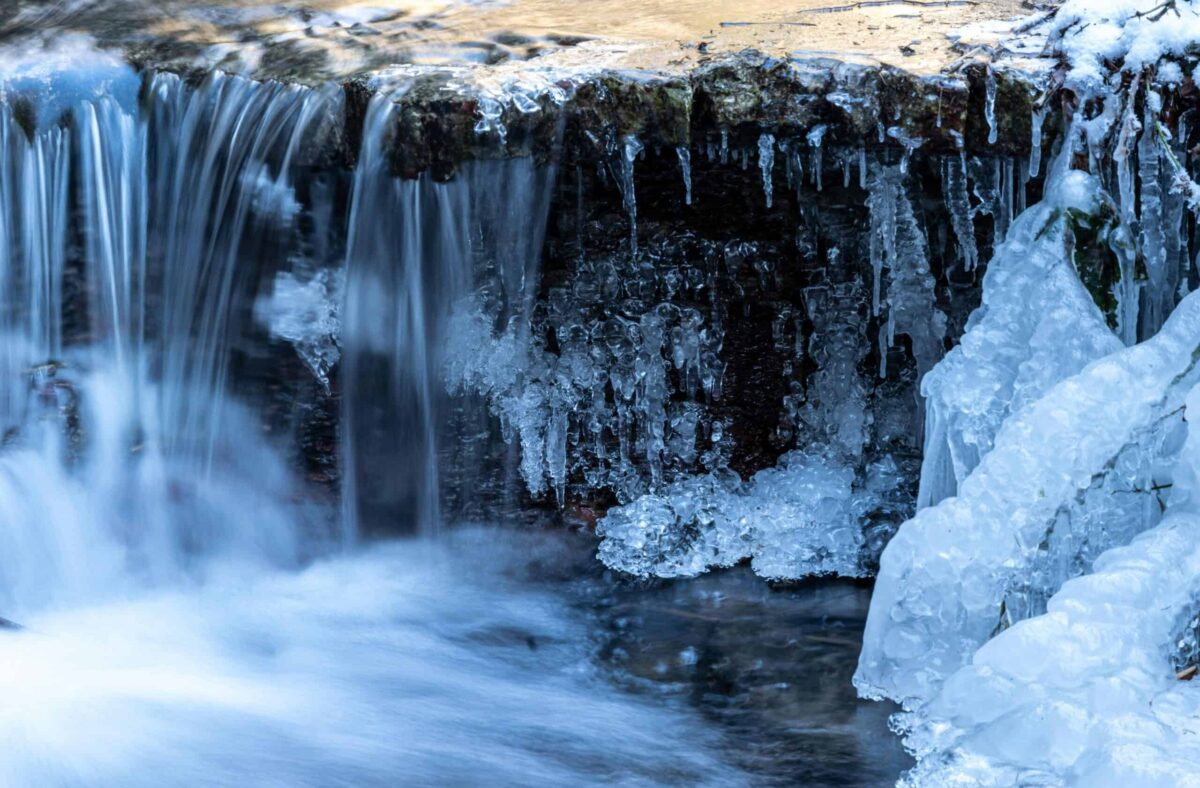
These Iowa waterfalls really show off during the winter months. (Leon S/Unsplash)
Discover the natural beauty of winter waterfalls across Iowa. Find locations, hike details, and essential safety tips for winter exploration in this guide.
Perhaps the most magical winter sight in nature is a frozen waterfall. Many Iowans will likely be surprised to hear they can find these beautiful wonders in their own backyard. While some of Iowa’s falls transform into solid walls of ice, others are unique “warm” springs that continue to flow even in the coldest months.
To help inspire your own winter waterfall adventure, we’ve compiled a list of some of the best waterfalls in the state, ranging from spillways that often freeze solid to defiant, ‘warm’ springs that typically flow all year long.
1. Dunning’s Spring Waterfall, Decorah
Location: Dunning’s Spring Park, Ice Cave Rd, Decorah, IA 52101
Difficulty: Easy
Total hiking distance: 0.2 miles
Standing as one of the state’s highest vertical cascades, Dunning’s Spring Waterfall flows approximately 200 feet down a limestone bluff, making it an impressive sight. While much of Iowa freezes solid, Dunning’s Spring is a winter anomaly. Because it is spring-fed, the water tends to maintain a constant temperature around 50 degrees, which often allows it to flow even in freezing temperatures. The contrast between the frozen backdrop and the flowing water is nothing short of beautiful.
Along with its height, this waterfall’s popularity comes from its accessibility. Visitors only need to take a short 200-yard walk from the parking lot to enjoy this sight. The surrounding 115 acres of Dunning’s Spring Park are also worth exploring. Extend your visit by following the path another half-mile from the gravel lot to the park’s famous ice cave, which features ice deposits that can last until summer. It’s an easy side trip for most families.
2. Malanaphy Spring Falls, Decorah
Location: Malanaphy Springs State Preserve, 2834 Bluffton Road, Decorah, IA 52101
Difficulty: Easy
Total hiking distance: 2 miles
This spring-fed waterfall is perhaps lesser known than some of its Decorah counterparts, but it is just as magical in the winter. Like Dunning’s Spring, the water here flows from an underground source at a constant temperature, preventing it from freezing solid. The result is a vibrant, flowing stream that cuts through a silent, snow-covered landscape.
It’s an Iowa hidden gem with a parking lot just big enough for a few cars. From there, it is about a mile walk to the falls, making your total hike close to two miles. While walking, enjoy the more than 300 native plant species that call the preserve home, including sugar maple, basswood, and ironwood.
3. Backbone State Park Spillway, Dundee
Location: Backbone State Park, 1347 129th St, Dundee, IA 52038
Difficulty: Moderate
Total hiking distance: 5.6 miles (West Lake Trail)
The easiest way to see the Backbone State Park Spillway is to drive along 129th Street through the park. That said, Backbone is known for its hiking, with several miles of trails ranging in difficulty.
West Lake Trail is a popular alternative route to the spillway if you are looking for a bit of a hike. It’s often considered moderately difficult due to its length and occasional elevation changes. While visiting Backbone, you might also want to stop by Richmond Springs, where you can see spring water coming up from the ground.
4. MacBride Falls, Solon
Location: Lake MacBride State Park, 3525 Hwy 382 NE, Solon, IA 52333
Difficulty: Easy
Total hiking distance: 2.1 miles
While technically a spillway, MacBride Falls is still a spectacular sight. One of the most popular ways to get there is via the MacBride Waterfall Loop, which is about 2.1 miles roundtrip.
It offers plenty of stunning waterfront views, but can be a bit muddy depending on the weather. In the winter, spend some extra time by Lake MacBride, which often freezes. If you are very quiet, you might even hear the ice “sing.”
5. Union Grove Falls, Gladbrook
Location: Union Grove State Park, 1215 220th Street, Gladbrook, IA 50635
Difficulty: Easy
Total hiking distance: 2.3 miles
Featuring a 110-acre lake, Union Grove State Park is known as a picturesque destination for hikers and snowmobilers alike. The winter’s cold air can turn Deer Creek and the Union Grove Falls into an icy wonderland that can be enjoyed while exploring the park’s three miles of trails. While it may be possible to see the spillway from the car, if you want a more complete hiking experience, plan on taking the Union Grove Lake Lower Loop, which is about 2.3 miles roundtrip.
6. Big Springs Nature Area, Guttenberg
Location: Clayton County X56, Guttenberg, IA 52052
Difficulty: Easy
Total hiking distance: 0.2 miles
If you are looking for a short hike that leads to a peaceful, fairytale-like setting, look no further than the Big Springs Nature Trail. While only 0.2 miles in length, this trail has a lot to offer with its secret waterfall. The gentle cascade of water follows irregular paths, which allows you to find little mini waterfalls along the way. While gorgeous in summer, it is perhaps even more whimsical in its winter state.
Winter hiking safety tips
Winter hiking trips, even short ones, require a little extra preparation. Take a look at these tips to ensure you have a safe and enjoyable waterfall adventure this season.
Focus on footwear
One of the first things to consider is your shoes. For the best traction on slippery snow and ice, consider getting micro-spikes (or YakTrax), which slip over your regular hiking boots. If the snow is particularly deep, you may also want to try snowshoes, which can make the hike a little less strenuous. Keeping your feet dry and warm is also vital. Waterproof boots and wool socks are a great addition to any winter hike.
Dress in layers
Sweating in winter is dangerous because the moisture can rapidly chill your body when you stop moving, leading to chilling. For this reason, it is best to avoid cotton (as it retains moisture) and wear synthetic and wool materials instead. Focus on having a moisture-wicking base layer, a warm fleece mid-layer, and a water- and wind-proof outer layer. The best part is that if you do start to get overheated, you can always take off a layer or two.
Don’t forget about your head and hands
Heat loss can happen quickly in the wind and cold, and your extremities are particularly vulnerable. While we already talked about your feet, don’t forget to consider your head and hands, which can get just as cold. Whenever going out for a winter hike, be sure to bring along a warm hat that covers your ears, along with insulated and waterproof gloves or mittens. It’s not a bad idea to keep a pack of hand warmers in your bag in case of emergency or if the conditions are colder than you expected.
Stay hydrated
It’s easy to remember to stay hydrated in the summer when the sun is beating down on you, and the temperatures are warm. But don’t be fooled, you can get just as dehydrated in winter. Cold air and increased activity can make you lose fluids faster than you may think. For this reason, always bring an insulated water bottle for your hike.
Plan for extra time
In the winter, ice and snow can dramatically increase the time it takes to complete even the easiest trails. When planning, try to allow for at least 50% more time than you think the hike will take. The last thing you want to do on an icy stretch is rush. Also, don’t forget to check the weather before you leave, and as a good rule of thumb, be sure to tell someone your route and expected return time.

8 Iowa flower festivals worth driving across the state for
Bask in beautiful blooms at these flower festivals happening across Iowa this spring and summer. As winter loosens its icy grip on the Hawkeye...

Protests, rallies, candidate meetings for Mar. 10-17, 2026
Protests, rallies, and candidate meetings for Mar. 10-17, 2026 Candidate meet and greets: US Senate candidate Zach Wahls: 6:30 p.m. Tuesday, Waukee...

Protests, rallies, and meet a candidate: Mar. 3-10, 2026
Candidate meet and greets: US Senate candidate Zach Wahls: 6:30 p.m. Tuesday, Mar. 10, Waukee Iowa Auditor of State candidate Taylor Wettach: 6:30...
11 best spring & summer festivals in Iowa in 2026
The best festivals in Iowa this spring and summer range from food-centric events to those that support marginalized voices. Here are 11 you won’t...

Protests, rallies, and events across Iowa: Feb. 24-Mar. 3, 2026
Candidate meet and greets: US Senate candidate Zach Wahls: 7 p.m. Saturday, Ames US House District 2 candidate Dave Bushaw: 4 p.m. Tuesday, Grinnell...

10 women-owned businesses to support in Cedar Rapids
From a French bakery to a pet spa to a plant shop, discover Cedar Rapids’ top women-owned businesses. Cedar Rapids is home to tons of small...