Iowa voters say clean water is a top priority. As US Rep. Ashley Hinson campaigns for Iowa’s open US Senate seat, her voting record shows a consistent pattern of opposing federal clean water protections.
It was billed as a common-sense fix for bureaucratic red tape. When US Rep. Ashley Hinson voted for the PERMIT Act in December 2025, her office said it would help “get the government out of the way of infrastructure projects.” What it would actually do is strip clean water protections from the agricultural drainage pathways that feed directly into Iowa’s drinking water supply.
In an open letter signed by Environmental Law & Policy Center, Food & Water Watch, Iowa Citizens for Community Improvement, and 11 other organizations, the groups said the PERMIT Act would “gut critical clean water protections.”
The bill, which passed the US House but stalled in the US Senate, would limit the scope of the Clean Water Act by narrowing which water sources it regulates, creating exemptions for certain industrial and agricultural pollution. It would exclude groundwater, prior converted cropland, and waters that only flow after precipitation, such as creek beds that are dry part of the year—precisely the pathways through which agricultural nitrate enters Iowa’s drinking water supply.
As Iowans grapple with a drinking water crisis, the topic of clean water has emerged as a key issue among registered voters.
And yet Hinson has repeatedly voted to weaken the federal protections designed to set limits on pollution and invest in cleaning our water—a record now drawing attention as she seeks to climb into Iowa’s open US Senate seat.
And the PERMIT Act vote was not isolated.
In July 2025, Hinson voted to cut the Drinking Water State Revolving Fund by 19% and the Clean Water State Revolving Fund by 25%—providing the lowest levels of funding since 2008. These federal programs help Iowa communities maintain treatment infrastructure.
A month earlier, she voted against increased funding for rural water and waste grants, part of a funding package that would cut $44 million in such grants nationally. And in 2021, Hinson voted against the American Rescue Plan Act (ARPA), which ultimately delivered $38 million for Iowa water infrastructure projects. When federal and state funding later dried up, Polk County was left using remaining ARPA funds to keep a critical water quality monitoring network alive.
“Unfortunately, they’ve made decisions at the legislative and at the federal level to not do that,” Polk County Board of Supervisors Chair Matt McCoy told Radio Iowa.
The League of Conservation Voters has given Hinson a 0% environmental score in 2025 and a lifetime score of 8%.
A February 2026 poll commissioned by Food & Water Action found that 82% of Iowa voters would be more likely to support a candidate who prioritizes clean water. That includes 72% of Republicans. Rising cancer rates were rated a more serious concern than cost of living by 72% of respondents.
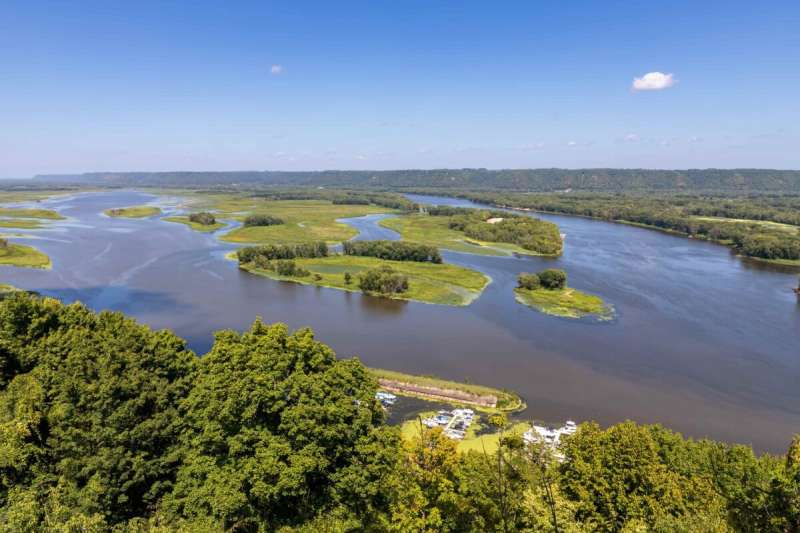
In April, Central Iowa Water Works reported that three of central Iowa’s main drinking water sources exceeded the EPA’s 10 milligram-per-liter nitrate standard, with the Raccoon River testing at 15.72 mg/L. The nitrate removal facility costs $11,000 per day to operate. This year, it began operating in January, an uncommon need for winter months. This month, Axios Des Moines reported that the Central Iowa Water Works had spent $660,000 operating and maintaining the system.
A 2026 report by the Iowa Environmental Council and the Harkin Institute found associations—though not definitive causation—between nitrate in Iowa’s drinking water and increased risk of colorectal, kidney, bladder, and other cancers. According to the US Department of Agriculture, corn accounts for 45% of US crop acreage and those acres get 65% of the 8.7 million tons of nitrogen applied by farmers each year. Farm runoff is responsible for 80% of water nitrate contamination, according to the IEC and Harkin Institute report.
Hinson’s deregulatory approach comes as the Big Ag and ethanol industries have been among her top donors. Ethanol producers rely heavily on corn.
Individuals and PACs associated with POET LLC, the world’s largest ethanol producer with major operations across Iowa, contributed $31,600 to her campaign, making them her top donor in the 2023-2024 cycle, according to OpenSecrets. Individuals and PACs tied to Valero Energy and Marquis Energy, two other major ethanol and fuel producers, contributed an additional $39,650 combined.
Hinson is the frontrunner in the Republican primary for Iowa’s open US Senate seat. On the Democratic side, Iowa Sen. Zach Wahls and Iowa Rep. Josh Turek are competing in a primary. The winner will likely face Hinson in November.