
The top of the Wells Fargo building in Des Moines. (Pat Rynard/Iowa Starting Line)
It’s the big, sudden layoffs or closings that really get our attention—when hundreds are let go at John Deere plants across the state, or Tyson closes in Perry.
Companies don’t generally want the bad press that goes along with that. So some are trying something new, and it may be even more insidious:
It’s called rolling layoffs, or forever layoffs. Bosses make smaller cuts, but they do it throughout the year—adding up to big layoffs without many people noticing.
As soon as I heard that term, I immediately thought of one Iowa company in particular that has been doing this: Wells Fargo, and namely at their campus in West Des Moines, which employs around 11,000 workers.
The top of the Wells Fargo building in Des Moines. (Pat Rynard/Iowa Starting Line)
Looking at historical data from Iowa’s WARN Act website—which tracks the layoffs that large companies are mandated by law to submit—Wells Fargo has laid off a total of 461 workers in 2025 from its Jordan Creek campus alone.
Certainly, that’s not the largest number of workers lost by one company in 2025. Across all its Iowa plants, John Deere laid off 598 workers in 2025. But those were spread out, and in larger batches—sometimes hundreds at a time—and, thus, got more attention.
By contrast, Wells Fargo’s largest single-day layoff was 63 workers on Dec. 26. The company was far more likely to lay off a couple to a few dozen at a time, normally one to two times per month.
The company says they expect that trend to continue. And it’s not just Wells Fargo trying it, either.
(Axios screenshot)
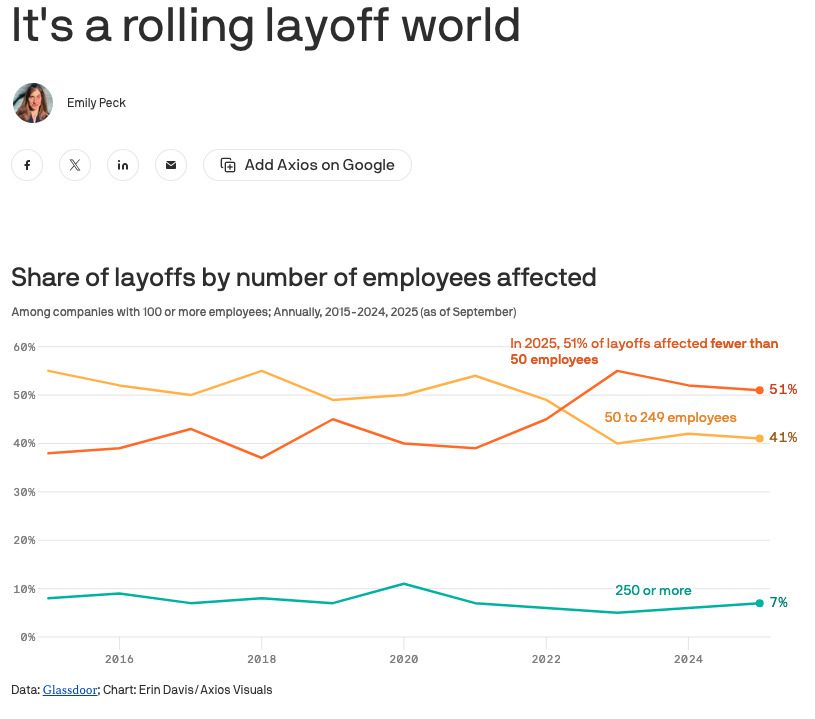
In 2015, so-called “micro-firings” made up 38% of layoffs, according to Glassdoor data. Now it’s 51%, becoming the most common type of layoff.
Are you seeing this where you work? Share your thoughts.
@iowastartinglineWells Fargo laid off over 450 employees last year, but you probably didn’t hear about it. That’s because the company has a new trick for keeping things under wraps. Follow for more from our series Clocked In: Iowa At Work.
This article is exclusive to subscribers of our newsletter; thank you for subscribing!

Support Our Cause
Thank you for taking the time to read our work. Before you go, we hope you'll consider supporting our values-driven journalism, which has always strived to make clear what's really at stake for Iowans and our future.
Since day one, our goal here at Iowa Starting Line has always been to empower people across the state with fact-based news and information. We believe that when people are armed with knowledge about what's happening in their local, state, and federal governments—including who is working on their behalf and who is actively trying to block efforts aimed at improving the daily lives of Iowan families—they will be inspired to become civically engaged.
How River Hills health care workers won their union in Iowa
Health care workers aren't largely unionized across the country. But that's now changing: In Iowa, a second hospital system's workers have...
More workers say they’re struggling than thriving: Iowa Worker’s Almanac, Mar. 26, 2026
Workers are struggling: More workers report struggling in their lives (49%) than thriving (46%), according to a new Gallup poll, a reversal from...
Why Iowa women’s wages have gotten worse in 2026
Thursday, March 26, is Equal Pay Day, a day highlighting how much less the average American woman makes compared to the average American man. In...
Donations needed for Cedar Rapids TSA workers: Iowa Worker’s Almanac for Mar. 19, 2026
Iowa Worker's Almanac layoffs and news briefs for Mar. 19, 2026: "Eastern Iowa Airport seeks donations for TSA workers" Do you work for the...
Teachers at Iowa’s public colleges say these bills threaten freedom of speech
It's not just about education—it's about controlling what teachers can say in their own workplace. "They're all trying to reign in higher...
Iowa has ‘catastrophic’ psychiatrist shortage: News and layoffs from Iowa Worker’s Almanac Mar. 12, 2026
This week's must-read Iowa worker news: Reining in data centers: Linn County residents are concerned about what happens when large corporations...