Amie here. Another young college graduate from Iowa can’t find any sort of entry-level job, she told me last week. And AI may be to blame.
Meghan Holloran just graduated from Drake University this May with an environmental journalism degree. She did a year-long apprenticeship with Better Homes and Gardens magazine, was on the school newspaper for three years, and even had a federal government internship last summer—all things she thought would help her in the job market.
But eight months after she started her search in February, she’s still looking.
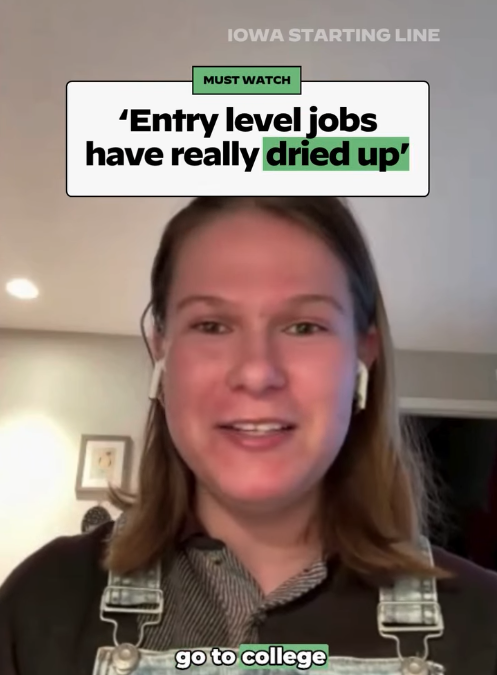
“Everyone said, ‘Go to college and you’ll have a bunch of job offers. It’ll be great,’” Holloran told me. “And that is not what is happening.”
|
She’s on all the recruitment sites she can think of: Indeed, LinkedIn Premium, Journalism Jobs, Media Bistro, Public Media Jobs, and “just scrolling all of the journalism job boards I can find.” She’s willing to work anywhere, do just about anything. But she’s found entry-level jobs are scarce.
“I’ve looked everywhere,” she said, noting she’s willing to move. “I’ve looked into consulting work, dump work. It is just entry-level jobs have dried up because, at least in my opinion, AI.”
Holloran is correct, I found: According to CNBC, postings for entry-level jobs in the US have declined 35% since January 2023, per labor research firm Revelio Labs.
And AI, or artificial intelligence, plays a big role in that now, and will do so even more in the future (unless we stop it): Anthropic CEO Dario Amodei forecast 50% of entry-level jobs could be wiped out by AI as the technology improves.
And it’s coming for journalism, for writing, for art. The ladder young humanities majors used to start their careers is being dismantled by robots that simply mimic them (and not very well).
“The job market is really against, I feel, a lot of creatives right now,” Holloran said. “I know several people in my major who have yet to find jobs.”
Holloran said she and her peers don’t want a handout. They just want the same fair shake people like me got 20 years ago. But she doesn’t see “an end in sight for all of this,” she said.
“We’re really trying, and we might not have all the years of experience you want for that set job role, but please just give us a chance,” she asked of us. “Ninety-five percent of us are really hardworking, and we just want a shot at stability—and not working, you know, two to three retail jobs just to make ends meet.
“Just give us a chance.”
Are you an Iowan having trouble finding a job? Email me.
|
|
|
|
|
Amie Rivers
Newsletter Editor, Iowa Starting Line
Member, COURIER United (WGA East)
|
|
|
|
-
‘No Kings’ is back: The Indivisible-organized protests against President Donald Trump’s authoritarianism, which first took place in June, are back this Saturday, Oct. 18—and there’s likely one near you.
-
The federal government shutdown continues: As the shutdown, which began Oct. 1, drags on, furloughed federal workers can’t pay their bills, Trump is firing thousands more of them in an attempt to pressure Democrats to cave (which no president has ever done), and he’s also slashing programs that he says are “never going to come back, in many cases”—all part of the Project 2025 plan. But those cuts, workers say, could harm everything from public health to the VA to worker safety.
-
Spending millions on union busting: UnityPoint has spent between $3.7 million and $6.1 million to quash a union effort by 1,776 full- and part-time registered nurses and PRNs at Iowa Methodist Medical Center, Blank Children’s Hospital, Methodist West Hospital, and Iowa Lutheran Hospital in Des Moines. Worse, the workers haven’t yet been able to vote on joining the Teamsters because of the government shutdown.
-
Trump’s new rules for universities unveiled: The “Compact for Academic Excellence in Higher Education,” which ties federal funding to those who sign on, includes a ban on affirmative action, a mandate on standardized testing, a “don’t be mean to conservatives” clause, a requirement for “political neutrality,” and a ban on campus protests, among others. The new Iowa Higher Education Coalition, which includes faculty unions at the University of Iowa, Iowa State, and the University of Northern Iowa (UNI), urged the Iowa Board of Regents not to sign it yesterday. “The compact would subject our Iowa-operated public universities to extortion, based on demonstrating partisan loyalty to the federal government,” said Christopher Martin, president of UNI’s United Faculty.
-
County trying to help mobile home owners fight back: The Johnson County Board of Supervisors last week requested a meeting with Havenpark Communities, which owns four mobile home parks in the county. The county previously asked Havenpark for a two-year lot rent freeze until it addressed outstanding maintenance issues at the parks, something residents have been organizing for.
-
Workers win raises in Cedar Rapids: More than 200 working musicians with Orchestra Iowa unionized with the American Federation of Musicians Local 137 won 10% raises in the first year of their three-year contract, which Orchestra Iowa called the largest increase in its 100-year history. “It may be the largest in history because they haven’t given raises in the past that amounted to anything,” said Local 137 secretary Bruce Western, noting musicians agreed to freezes or raises that didn’t keep up with inflation during the pandemic, derecho, and flood years.
-
Low-income seniors die 9 years faster than rich ones: That’s according to a new report that shows “a strong indicator of the impact wealth has on health.” The report’s authors will speak at the 2025 Harkin Retirement Security Symposium in Washington, DC, today.
-
Where’s the support for farmers? Treasury Secretary Scott Bessent said last week we “should expect some news on Tuesday on substantial support for our farmers, especially the soybean farmers.” Many farmers were expecting a bailout, even if they would rather have a trade deal. Instead, Tuesday came and went, and all Trump did was threaten China with even larger tariffs (and said some nonsense about making our own cooking oil?).
-
I don’t know what’s going on with local unionization efforts unless y’all tell me, because the National Labor Relations Board website database has been offline since the shutdown began Oct. 1. “NLRB Offices will reopen after a funding bill is passed by Congress and signed by the President,” the site says (which is a lot less partisan of a message than some government sites have on them).
|
- Wells Fargo in West Des Moines is laying off 10 workers by Saturday, 12 workers by Nov. 14, 23 workers by Nov. 28, and one worker by Dec. 12.
-
Burlington Trailways is closing and laying off 79 workers by Saturday: 6 workers in Burlington, 5 workers in Cedar Rapids, 13 workers at two locations in Davenport, 8 workers in Des Moines, and 47 workers in West Burlington. Read more here.
-
John Deere is laying off 101 workers at the East Donald Street site in Waterloo by Monday (read more here), and 40 workers at Des Moines Works in Ankeny by Nov. 3 (read more here).
- Fellers in Urbandale is closing and laying off one worker by Oct. 24.
- RTX in Cedar Rapids is laying off two workers by Oct. 31.
-
Dubuque Bank and Trust/UMB in Dubuque is laying off 40 workers by Nov. 1. Read more here.
-
Winnebago Industries is closing and continuing to lay off, including 26 workers in Charles City by Dec. 12. Read more here.
-
Toyota Financial Services in Cedar Rapids is closing and laying off 54 workers by Dec. 31. Read more here.
|
|
|
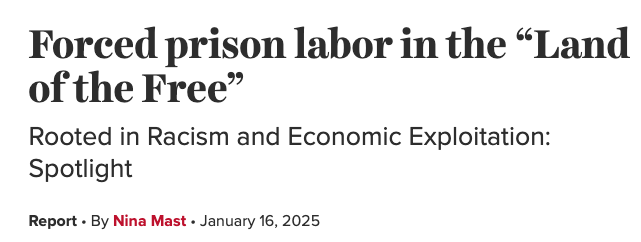
If you’ve read “The New Jim Crow” or seen “13th,” you’re probably aware that the United States has figured out how to replace slave labor with…well, basically slave labor from millions of prisoners.
And they’re not just making license plates: They’re working at McDonald’s and fighting deadly wildfires. ICE detainees are cleaning their own facilities for less than $1 per day, even as states sue the private prison groups that refuse to hire outside workers for minimum wage.
“Ending forced labor in prisons is not only a matter of humanity but will also deliver transformational fiscal and social benefits to incarcerated workers, their families, and the economy at large,” writes Nina Mast in this EPI deep dive on the topic.
|
|
|
Would you pass this newsletter along to your fellow workers?
|
|
|
Do you want to support Iowa Starting Line’s mission while showcasing your products or services to an engaged audience of 21,000+ subscribers?
Email advertise@couriernewsroom.com for more information.
|
Thanks for reading. This newsletter was written by Amie Rivers. It was edited by Paula Solis.
Iowa Starting Line is free for everyone. Your support makes our work possible.
|
|
|
You are receiving this email because you opted in via our website.
Our mailing address is:
Iowa Starting Line
c/o COURIER Newsroom
101 Avenue of the Americas
8th and 9th Floors
New York, NY 10013
Want to change how you receive these emails?
You can update your preferences or from this list.
|
|
|
|