By Amie Rivers
I’d been measuring my nitrate test results all wrong. Chris Jones, a former lab scientist at Des Moines Water Works, confirmed it.
During the summer, I sent out nearly 100 nitrate test strips to Iowans across the state. Over half returned those strips back to me—not bad!
Sometimes the photos weren’t perfectly clear; people occasionally emailed me the “nitrite” number instead, and I had to rely on my eyes. But the bigger issue was that the numbers on those test strips don’t match how the Environmental Protection Agency (EPA) and water treatment plants count nitrates.
“The convention in the United States [is], we regulate nitrate as nitrogen,” Jones said.
Without getting too deep in the chemistry, that basically means I have to divide all the results our readers sent in by 4.4. (Why Europe and the US can’t agree on how to measure this is beyond me.)
Our experiment, which we launched after publishing our report on the relationship between Iowa’s water quality and rising cancer rates, includes results from cities across the state. Interestingly, we had a cluster of tests from Central Iowa, where Water Works has had problems with nitrate contamination in recent years.
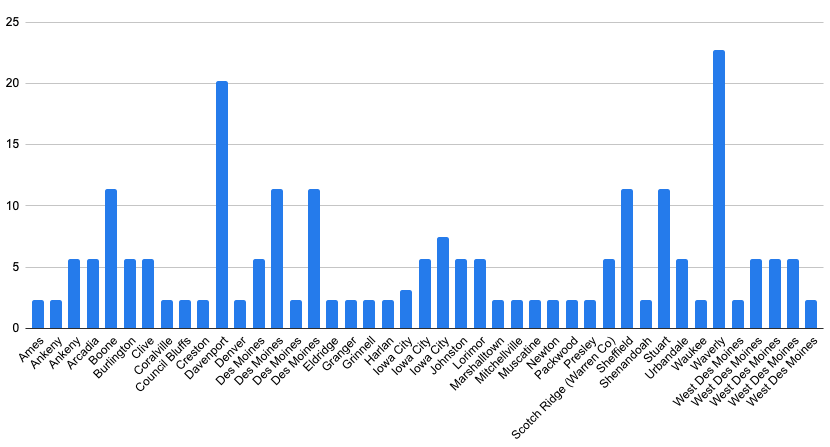
What the reader-submitted water tests show is a wide range of nitrate levels, depending on where you live.
Reading the nitrate test results
The EPA is in charge (as of this writing) of regulating nitrates in the nation’s water. It has set the “maximum contaminant level” of 10 parts per million, or ppm, in order to prevent blue baby syndrome.
Anything over 3, however, will “generally indicate contamination,” the EPA also notes. And, as I’ve previously reported, nitrate contamination is associated with cancer.
Expressed in nitrate-as-nitrogen, a result of 10 ppm on the test strips we sent out would actually only be 2.3 ppm, and a result of 25 would be 5.7, which is considered contaminated. Anything over 44 ppm on that test is officially over the maximum.
But picking out that result—is it light pink, or slightly darker pink?—isn’t an exact science.
“I have to say it’s really hard to tell!” Julie Santee of Shenandoah told us via email after testing her water.
Alex Hammer sent us a video of his test results from the township of Scotch Ridge in rural Warren County, just south of Des Moines. The results (correctly calculated) showed a nitrate level from his city water of “at least” 5-6 ppm, over the EPA’s level of contamination.
“So that’s cool,” Hammer says sarcastically in the video.
But, he added, he was grateful someone was reporting on it. “Thanks for making this central to what people are talking about. Appreciate it as a colon cancer survivor. Keep up the good work.”
Mike Stein of Iowa City already filters his water through a reverse osmosis system, which removes nitrates. He recorded testing his unfiltered tap water on camera on different dates between July and September, and found levels up to 7.5 ppm, which he considered good news: “Nitrate levels seem to be coming down in the Iowa River a bit,” he said.
Overall, results averaged 3.3 ppm—showing contamination—across all results that came back.
These are, of course, only a snapshot in time of what the drinking water was like the day of testing, so take these results with that grain of salt.