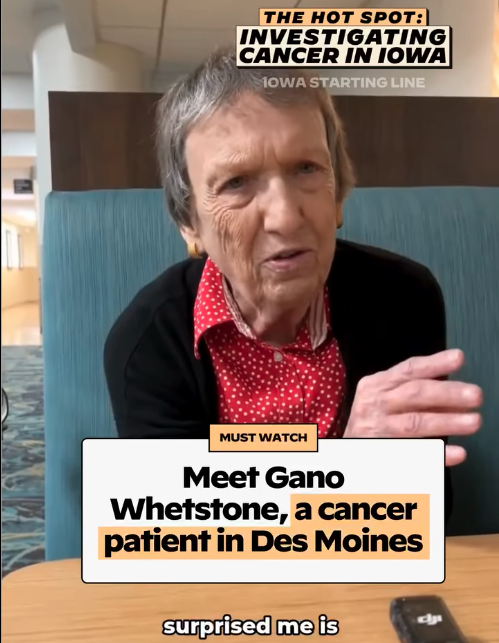
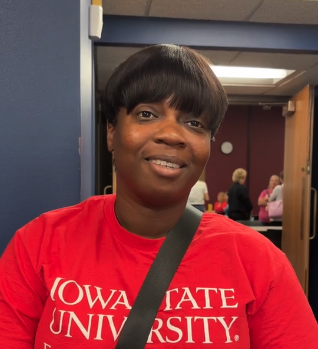
Gano Whetstone settled into the infusion chair at Des Moines’ Mission Cancer + Blood and asked for her usual: black coffee and a warm blanket. On treatment days, she takes the paratransit bus to the hospital, arriving early to wait in the lobby until it’s her time.
The 80-year-old retired teacher has done this routine every three weeks for nearly a year now. The nurse wheels over a machine and hooks it up to Whetstone’s infusion port—a device surgically installed in her shoulder that allows her to receive her slow drip of Herceptin on treatment days without requiring the poke of a needle.
“I don’t feel anything,” she says, watching the IV work. “I just sit here, drink my coffee, and watch TV.”
It sounds mundane, but Whetstone said catching the cancer feels miraculous.
Last July during a routine mammogram, doctors found what was likely a cancerous tumor in her breast tissue.
“I just looked at the floor,” she said, as the doctor delivered the news.
For the last year, Whetstone has been navigating the aftermath of that moment—a journey familiar to many cancer patients across Iowa who face a complex matrix of decisions about their care.
This week on The Hot Spot: Investigating Cancer in Iowa, Zachary Oren Smith and I are sharing some of those stories. We’ll have more in the weeks to come, too; share your cancer story with us here.
Survivors of this disease know: Cancer in Iowa isn’t just about receiving a diagnosis and figuring out the right treatment. It’s navigating hurdles related to insurance and care, wondering what might have caused the disease in the first place, and living with the physical and emotional aftermath long after the last scan.
Read the rest of Whetstone’s story, and those of other Iowans, below.
If this was forwarded to you, subscribe to the rest of our Cancer in Iowa series here.
|
|
|
‘Give yourself grace’: Iowans share their cancer stories
|
Clockwise from top left: Leah Fisher of Waterloo, Gano Whetstone of Des Moines, Karen Kinney of Waterloo, AnMarie Rodgers of Oakland, California (formerly of Newton), and Rick Widman of Altoona (formerly of Storm Lake). (Graphic by Iowa Starting Line)
|
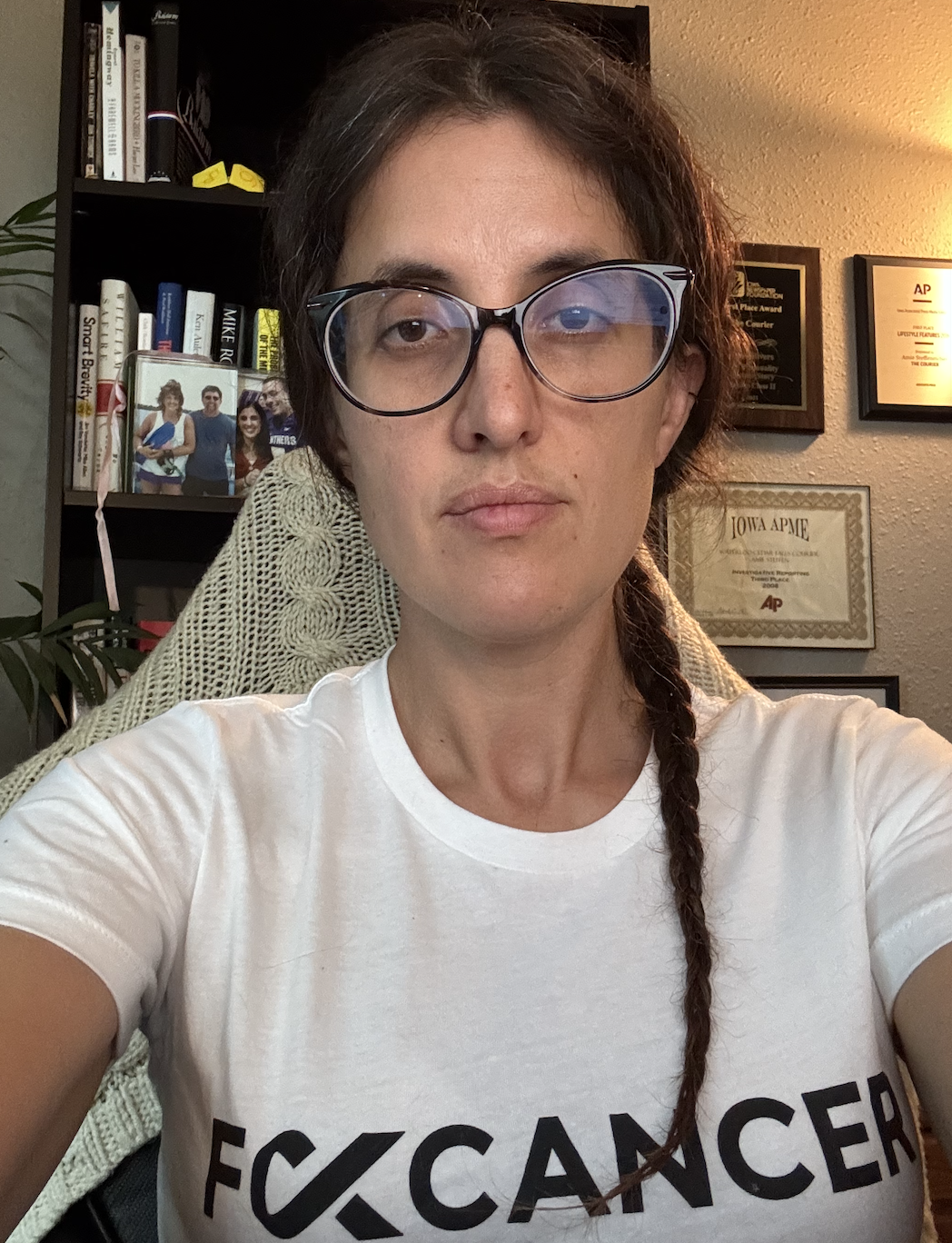
By Zachary Oren Smith and Amie Rivers
(continued from above)
Whetstone’s doctor offered her three options: radiation, chemotherapy, and immunotherapy. When her mother went through cancer treatment decades earlier, she remembered watching her struggle with the side effects of chemo. Seeing her mother lose her hair was a memory that stuck with her.
“You never really understand a lot of it when they’re explaining it to you,” Whetstone said.
Instead of chemotherapy or radiation, she decided to go with immunotherapy because it had side effects she was willing to manage. Keeping her hair was a bonus.
Her doctor prescribed a course of Herceptin. It’s sometimes used to treat breast and stomach cancers by blocking a particular protein that promotes cancer cell growth. The drug is estimated to have saved more than 3 million lives since its introduction in 1998. The rub: Herceptin—a brand name for the chemical trastuzumab—is expensive.
Whetstone said each infusion treatment costs around $5,000, a fortune on a fixed income. Even with Medicare, Whetstone couldn’t afford the mounting costs. She applied for an elderly waiver to get Medicaid coverage, then hit another wall when the surgeon’s office initially said they wouldn’t take her insurance. Three phone calls and three-and-a-half weeks of waiting later, she finally got approval for the surgery.
“If [the insurance companies] make mistakes and stuff, you know, then you’re stuck waiting,” she said. “And you can’t have your surgery or treatment because they have to get the insurance straightened out.”
Whetstone lives in an apartment complex with a number of other elderly Iowans. When they meet once a week in the common area to talk about politics or the news, she said she wonders how her neighbors would fare navigating the system.
“There’s no way they can do this themselves,” she said. (She herself had help thanks to a service coordinator from Broadlawns Medical Center.)
As the machine beeps to signal her treatment is finished, Whetstone cautiously reflected on the road ahead. In two weeks, she’ll have her final infusion. And come September, a mammogram will determine if she’s in remission.
“They said, it looks good, and I feel really confident that it’ll be okay,” Whetstone said. “But the thing is, I did this before.”
Before starting her first dose of Herceptin, surgeons operated to remove the tumor in Whetstone’s breast. But within weeks, the cancer came back, and she needed a mastectomy. Now, with her immunotherapy complete, she hopes next month’s mammogram brings good news.
“ I don’t wanna get false hope in here,” Whetstone said, “because I did last time. A lot of times I don’t even think about it. I just … go to the activities of my building and, you know, meet people and do things.”
|
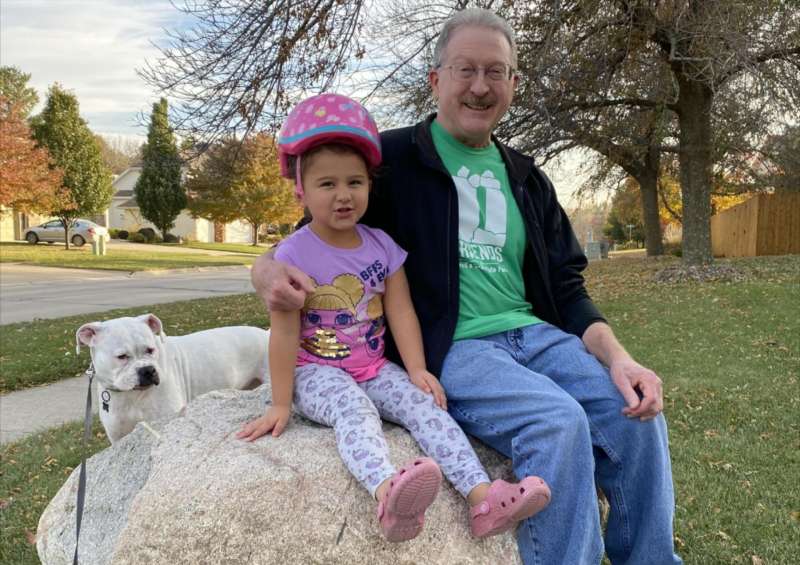
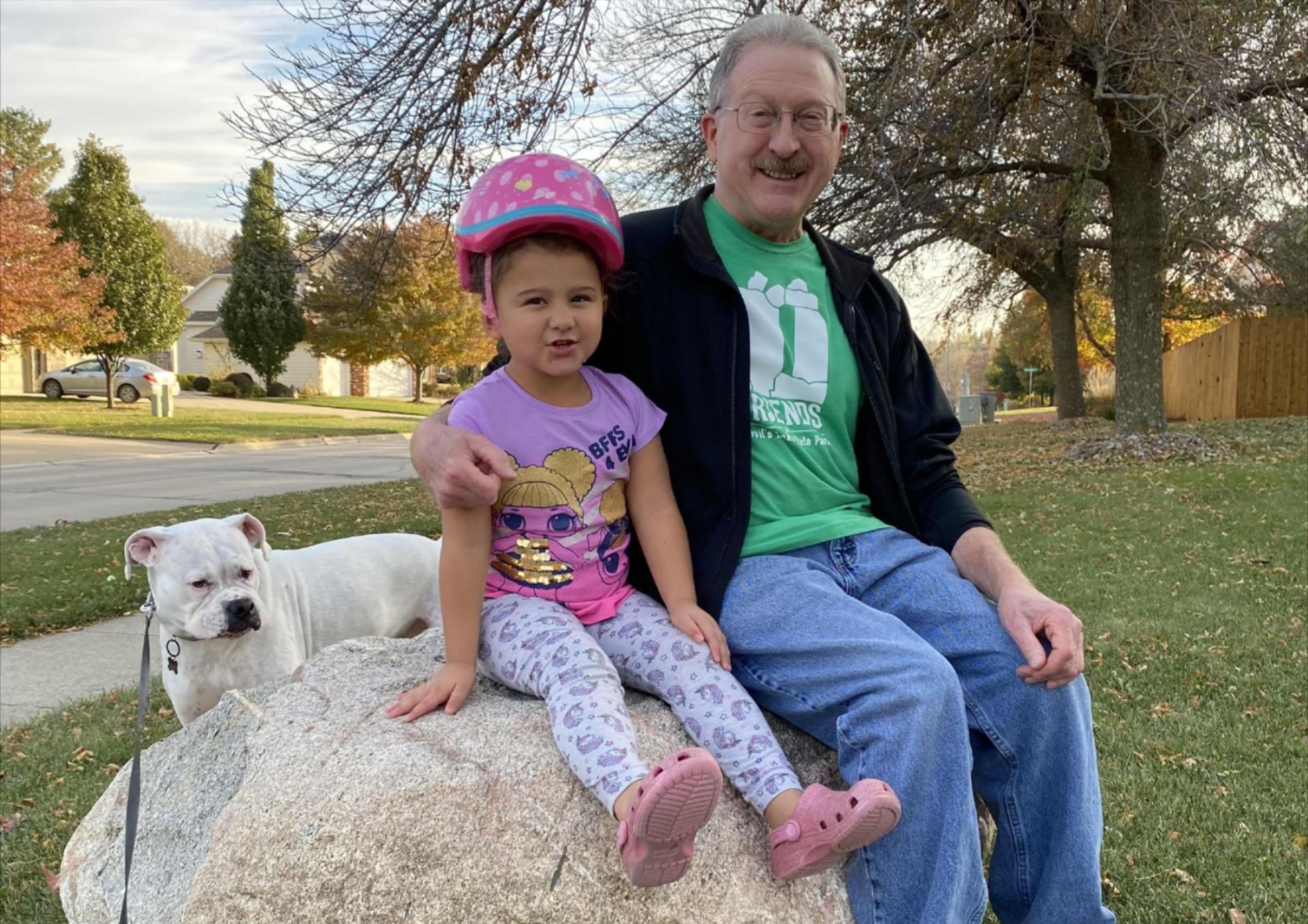
Rick Widman of Altoona, right, with granddaughter Alaina and dog Kirk. (Courtesy Rick Widman)
|
When Rick Widman was diagnosed in 2007 with chronic lymphocytic leukemia, he wasn’t surprised.
His grandmother and an older brother both had died of blood cancer; his mother died of breast cancer when he was a kid. All had lived on the family farm in Storm Lake.
Widman lists off others: His neighbor down the street. A classmate and her brother.
“So it’s just been all over the place, you know?” Widman said.
Now living in Altoona, Widman has his theories: He points to widely used herbicides glyphosate and atrazine, along with the petroleum chemical benzene. He also remembers using the insecticide DDT prior to its ban in 1972, and the herbicides 2,4-D and dicamba.
“My brother and I always thought that it had something to do with exposure to something on the farm,” Widman said.
His family’s case was interesting enough that Mayo Clinic is including Widman and his family in a study of families with blood and lymph node cancers. Widman says more of that research is needed.
“ The federal government is cutting cancer research; they’re just doing the total opposite of what they should be doing,” he said. “And, really, the state’s not really doing as much as they should be doing. … I just don’t think that’s a priority.”
|
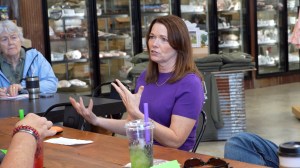
Screenshot of Leah Fisher, a breast cancer survivor from Waterloo. (Iowa Starting Line)
|
Leah Fisher of Waterloo is a four-year breast cancer survivor. But there’s no history of breast cancer in her family, which has led her to consider other possible causes.
“I was raised on the east side of Waterloo, and I know we have a lot of manufacturing facilities,” she said. “It could have been environmental. So that worries me.”
At the top of her list is the former Chamberlain Manufacturing Company, which produced munitions beginning in World War II until it closed in the mid-1990s. It was designated a “brownfields” site and has gone through expensive cleanups from federal and local sources since the early 2000s.
The Environmental Protection Agency found the soil on that site contaminated with “several metals and semi-volatile compounds,” including arsenic, lead, and cadmium. It also found groundwater contamination and “vapor intrusion of trichloroethylene” in nearby homes.
Arsenic, cadmium, and trichloroethylene are known cancer-causing chemicals. Lead is a probable carcinogen, according to the EPA.
“ It’s a lot of minority Black women or Black people on the east side of town that are greatly impacted by cancer, whether it be breast cancer, colon, prostate, whatever,” Fisher said. “So that scares me.”
Among Black residents getting cancer, Iowa ranks No. 2 in the nation and No. 3 for deaths, according to the Iowa Cancer Registry. Black Iowans have the highest rate of cancer and cancer deaths among all ethnicities, even accounting for income levels.
While breast cancer is the most common cancer for all Iowa women, Black women still die of it at greater rates.
Fisher received treatment at a different hospital from where she was diagnosed. She said people shouldn’t be afraid to ask for a second opinion, and be willing to go out of state if they’re not finding care they need here.
“ Thank God I was blessed with a great support system,” she said. “But you do have to advocate for yourself and try to do your research.”
Her other advice for those dealing with a cancer diagnosis?
“ Give yourself grace,” she said. “Give yourself patience. You can beat this. This is not the final step.”
Stories of three other Iowans will be online starting tomorrow at iowastartingline.com.
|
|
|
Missed a story in this series? Here’s where you can find them all:
|
|
|
Would you recommend this newsletter to your friends and family?
|
|
|
Do you or your company want to support Iowa Starting Line’s mission and showcase your products or services to an engaged audience of more than 21,000 subscribers at the same time?
Email advertise@couriernewsroom.com for more information.
|
|
|
You are receiving this email because you opted in via our website.
Our mailing address is:
Iowa Starting Line
c/o COURIER Newsroom
101 Avenue of the Americas
8th and 9th Floors
New York, NY 10013
|
|
|
|