Amie here. I grew up in Iowa, where we’re steeped in a heavy drinking culture. Kids I grew up with drank by (at least) their early teens.
I remember drinking in high school: bottles of Smirnoff Ice and Mike’s Hard Lemonade (what we called “cheerleader beer”) at house parties, or cans of Busch or Keystone Light (whatever $20 got you the most of at the gas station) at bonfire parties out in the country.
That’s probably because nearly all of the adults around us drank often. It was odd if you didn’t drink—unless you were pregnant, had an obvious health reason, or proclaimed yourself the designated driver. Even my mom, who had virtually no tolerance for alcohol, sometimes caved to the pressure of a social situation (and paid for it afterwards).
We always knew, in theory, there were health costs to drinking. But mainly, we thought those were liver damage and drunk driving (and only for those “really bad” alcoholics). Nobody thought you could get cancer from drinking.
That’s because it’s only recently that science has found the link. Read my story below for more on how alcohol causes cancer (and how some are trying to hide that evidence).
Thankfully, I see the younger folks are leading the way nationally in drinking less. Even in Iowa, I’m noticing breweries making non-alcoholic beers and bars introducing mocktail menus for those of us who want to cut back but still like going out.
It’s a way we can curtail our cancer risk, while continuing our social connections and keeping our favorite bar afloat.
Did someone forward this email to you? Subscribe to the rest of our Cancer in Iowa series here, and share your cancer story with us here.
|
|
|
Iowa leads the nation in binge drinking — and faces higher cancer risks
|
(Francesca Daly/Iowa Starting Line)
|
By Amie Rivers
Most Iowans, it seemed, had read the grim statistics about our state’s high and rising rates of cancer, and probably weren’t surprised to hear Gov. Kim Reynolds talk about it in this year’s Condition of the State speech.
But many may have been surprised at what she chose to specifically call out: Alcohol.
“We’re also among the top for alcohol-related cancers, with the highest incidence in the Midwest,” Reynolds said during the January speech. “This month, the Surgeon General warned that alcohol is a known carcinogen.”
That warning came from a January report, “Alcohol Consumption and Cancer Risk,” which finds evidence of a causal link between drinking alcohol and an increased risk of seven different types of cancer. It also recommends warning labels on alcoholic beverages that address the cancer risk.
But it’s a safe bet most drinkers haven’t heard of it.
”Only 40% of Americans are aware that alcohol has really any association with cancer,” Dr. Mary Charlton said in an interview.
Yet Iowa is fourth in the nation for rates of alcohol-related cancers, and (as Reynolds said) highest in the Midwest.
That’s the reason Charlton, director of the Iowa Cancer Registry since 2020, made alcohol the focus of the 2024 Cancer in Iowa report, which predated both the governor’s and surgeon general’s warnings.
“Iowans’ alcohol consumption—in volume and frequency—is among the highest in the nation,” the report says. “The bottom line: The more alcohol a person drinks, the higher the risk of cancer.“
|
Bury the evidence
The surgeon general’s recommendation to add warnings to alcoholic beverage containers in 2024 was made by Dr. Vivek Murthy, a Biden appointee. But any changes to labeling would fall under the purview of Congress, which has so far refused to act on the matter.
If anything, the federal government under President Donald Trump is all but giving up on fighting cancer writ large—including downplaying the connections between alcohol and cancer.
The Trump administration has ended a yearslong government study begun in 2022 that had been examining links between alcohol, cancer, and other ailments in order to revise the US dietary guidelines.
Instead, the administration plans to drop any recommendations on alcohol consumption (currently 1-2 drinks per day) in its dietary guidelines, a gift to the multi-billion-dollar alcohol industry.
Paul Gilbert, who studies alcohol use disorders with the University of Iowa’s College of Public Health, and contributed research to the 2024 Cancer in Iowa report, said he’s concerned that scientific research is being buried.
”We’ve got this increasing level of cancers that’s cause for concern … and we know that we are traditionally a heavy drinking state,” Gilbert, who now is on faculty at Santa Clara University in California. “If that doesn’t see the light of day, if that isn’t going to be published or widely known, that really hampers our overall understanding.”
|
How alcohol causes cancer
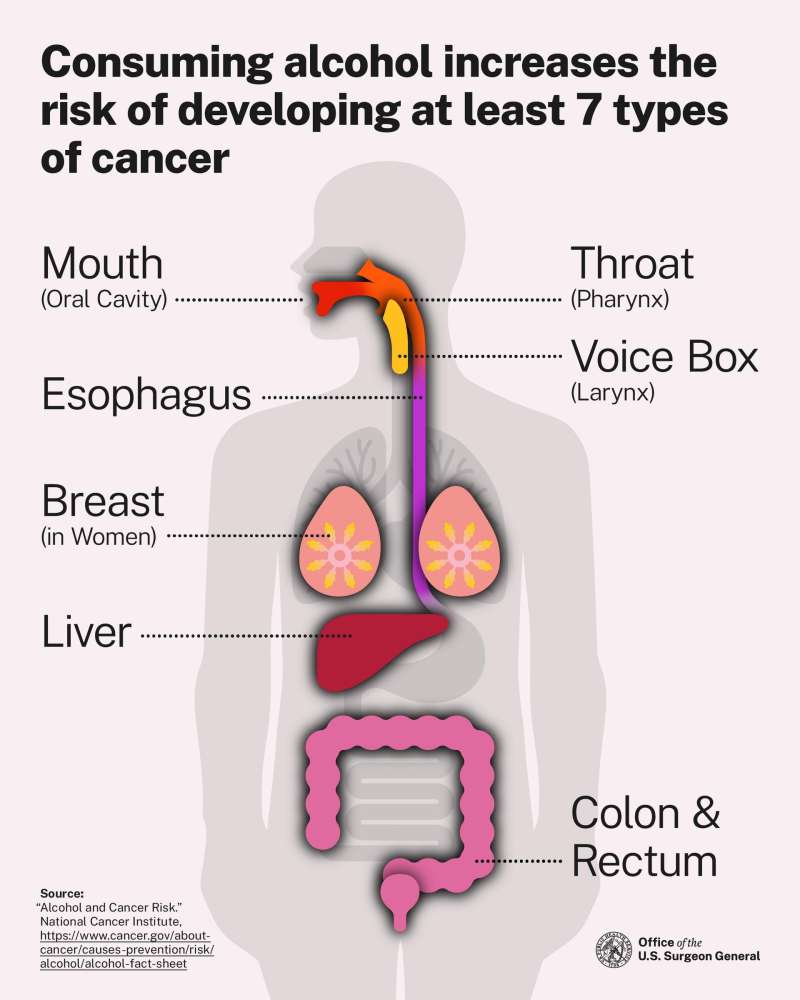
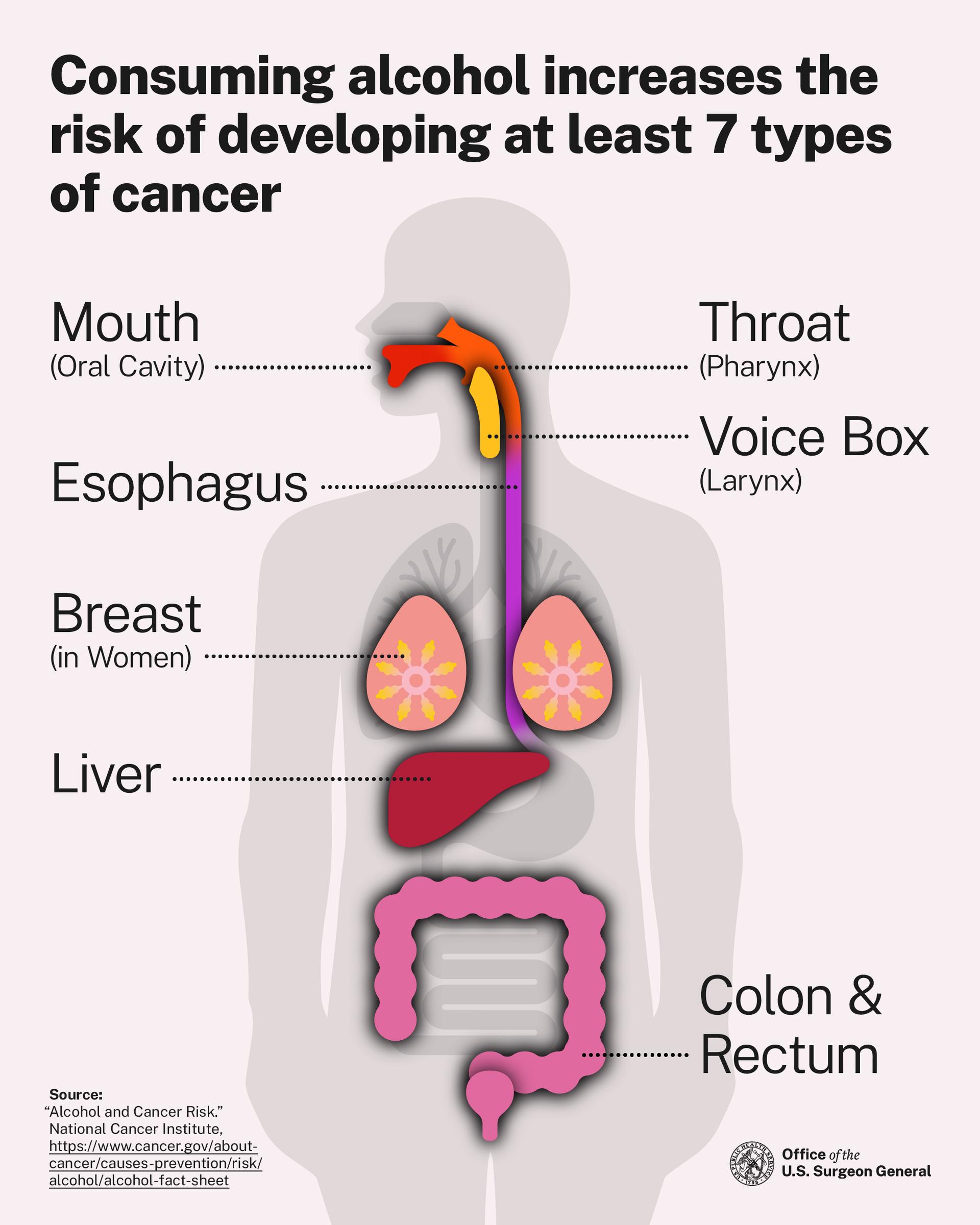
Seven types of cancer are identified with alcohol use:
- Mouth (oral cavity)
- Throat (pharynx)
- Voice box (larynx)
- Esophagus
- Liver
- Colon and rectum
- Breast
“ It’s a causal connection, which is a big deal in science,” Gilbert said. “It actually is really difficult to establish a causal relationship in science. But there is clear and sound and high-quality evidence of a causal relationship between alcohol and seven different cancers.”
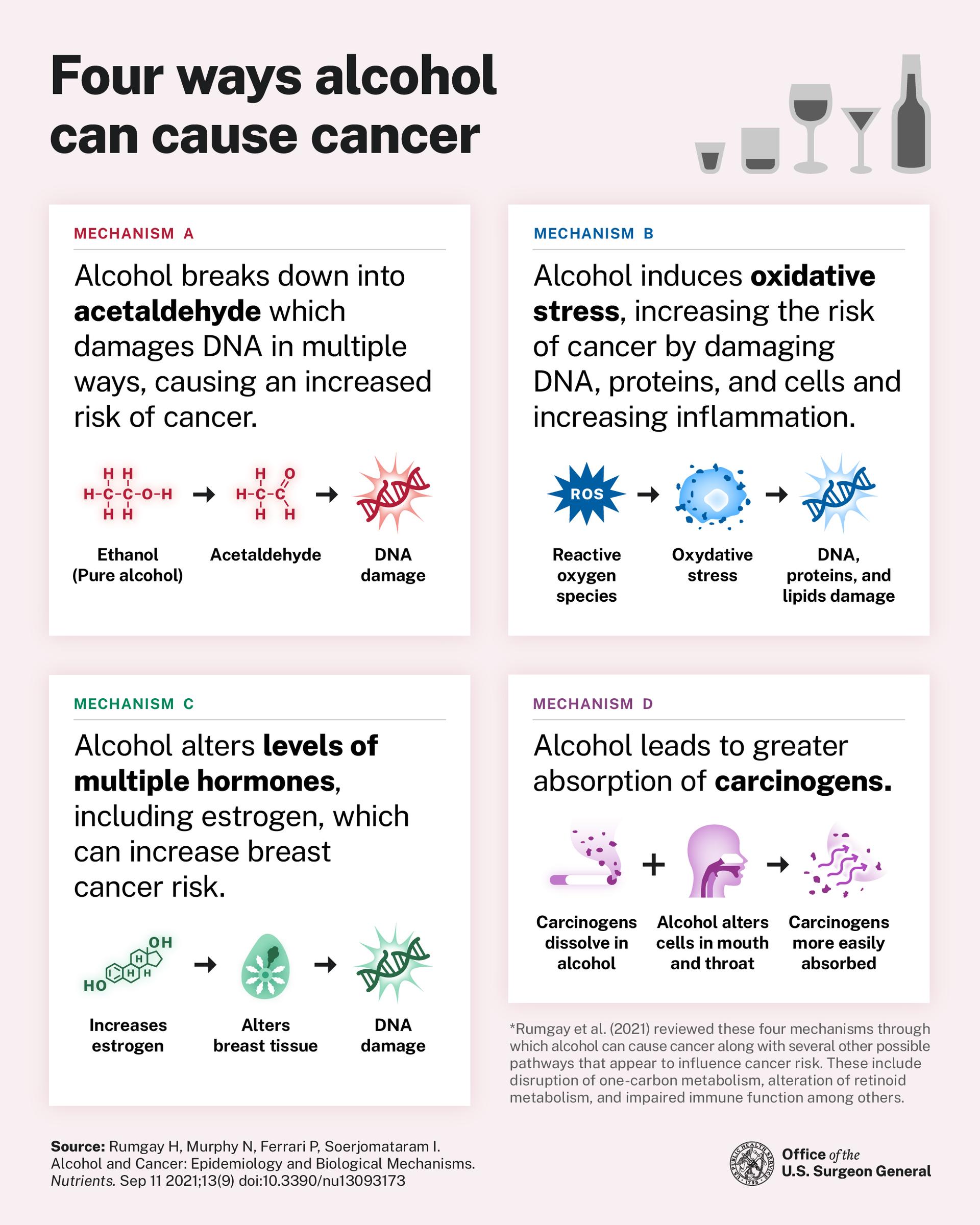
Alcohol causes cancer in at least four ways:
- It breaks down into acetaldehyde, damaging our DNA, which causes mutations that can lead to cancer;
- It induces oxidative stress, damaging DNA, proteins, and cells, and causing inflammation;
- It alters hormones, including estrogen, which contributes to an increased risk of breast cancer specifically;
- It allows other carcinogens, like tobacco smoke, to be more easily absorbed by the body.
“ It starts at probably lower levels than we expected,” Gilbert said. “And it increases with each amount of alcohol consumed.”
Just like many Iowans aren’t aware of radon’s cancer-causing dangers, people don’t connect their drinking to cancer either.
“The knowledge in the general public has always been pretty low,” Gilbert said. “Especially in the last few years, I think there’s been more effort to just spread the word, make sure people know, so that they make well-informed decisions.”
|
Highest rate of binge drinking in the nation
John Stokes of Iowa City didn’t know the connection either.
A two-time cancer survivor and recovering alcoholic, he only heard his drinking may have caused his larynx cancer during a conversation with his doctor—saying it was “really an ‘ah-ha’ moment.”
“As a head and neck cancer survivor, I want to make sure that Iowans know that alcohol can cause cancer,” Stokes said at a news conference for the Iowa Cancer Registry’s 2024 report. “And if you’re thinking about making the move to drink less, reducing your chance of risk is a great motivation itself.”
Around 20,000 Americans die of alcohol-related cancers each year. That’s far higher than the 13,500 who die in drunk-driving crashes.
Yet drinking socially is the norm in states like Iowa, which has the highest rate of binge drinking in the nation: 22.5% of Iowans are binge drinkers, defined as having had more than four drinks (five for men) during one occasion. (North Dakota is a close second place, at 22.4%.)
“ You can get alcohol everywhere; it’s cheap, it’s widely available. Get it at any Casey’s, any Kum & Go,” Gilbert said.
And the highest rates of binge drinking occur among people with higher incomes and higher education.
“ I think it’s really hard in our culture, particularly here in Iowa,” Charlton said. “I generally kind of start with the message like, just anything you can do to reduce your intake is a step in the right direction.”
Even Charlton, knowing what she knows, doesn’t abstain from alcohol either. She said, even at conferences with other cancer researchers who know the risks, social drinking is still the norm.
But she’s trying to be better.
“Sometimes I would have a glass of wine when I was doing email at night,” but she noticed she wasn’t “getting any social benefits of that; it’s only increasing my risk for cancer.”
Instead, she has a new rule for herself: “I never drink alone. If I’m going to have some drinks, I’ll do that in the company of friends, and I’m going to try and minimize the amount that I drink.”
|
|
|
Across the country, the future of local news is uncertain. But here at Iowa Starting Line, we’re staying focused—on you.
Our goal for our fall fundraising campaign is to raise $2,000 by Sept. 30 to keep this kind of coverage strong in Iowa.
If you’ve ever read one of our stories and thought, “I wouldn’t have known this otherwise,” we hope you’ll consider supporting our work.
|
|
|
Missed a story in this series? Here’s where you can find them all:
|
|
|
Would you recommend this newsletter to your friends and family?
|
|
|
Do you want to support Iowa Starting Line’s mission while showcasing your products or services to an engaged audience of 21,000+ subscribers?
Email advertise@couriernewsroom.com for more information.
|
Thanks for reading. This newsletter was written by Amie Rivers. It was edited by Paula Solis.
Iowa Starting Line is free for everyone. Your support makes our work possible.
|
|
|
You are receiving this email because you opted in via our website.
Our mailing address is:
Iowa Starting Line
c/o COURIER Newsroom
101 Avenue of the Americas
8th and 9th Floors
New York, NY 10013
Want to change how you receive these emails?
You can update your preferences or from this list.
|
|
|
|