🗣️ It’s Friday; time for reader replies!
Iowa news briefs:
-
It’s September, AKA the start of fall and flu season. And if the southern hemisphere’s flu season was any indication, we’re in for a bad one this year. (Go get your flu shot!)
-
Have you spotted a cluster of monarchs? The Iowa Monarch Conservation Consortium wants to hear from you, so they can find out what monarchs like to roost on as they migrate through, and plant more of that. Their online form appears to be broken, so report your findings by contacting Kral O’Brien at 515-294-7315 or kralob@iastate.edu.
- Nobody wrote me last week saying they have a cat named Star, which obviously means this whole survey is garbage.
-
Not requiring hard and fast probation rules actually keeps people out of prison, a new Iowa experiment has found.
-
Trump says we don’t need the money, I guess: In an amazing own goal, red states like Iowa lost far more federal grants than blue states, because blue states sued to get them back—while red states didn’t.
-
Over 250 people protested an ICE blockade in Cedar Rapids to escort four families to their immigration check-ins, in the face of “eight masked Homeland Security Police officers armed with non-lethal weapons, police tape, and squad car blockades,” according to immigrant rights group Escucha Mi Voz Iowa. US Rep. Ashley Hinson (now running for US Senate) thinks it’s ICE that needs the protection with a new bill upping penalties for assaulting them, but we’ve all seen the videos of who is actually being assaulted.
|
|
|
Hey, it’s Rob Sand, candidate for Iowa governor.
With Gov. Kim Reynolds out of the race, we have a huge opportunity to take back Iowa from partisan insiders.
My career has been about tackling fraud and corruption. As a prosecutor for the Iowa Attorney General’s office I took on the largest lotto rigging contest in US history—and won. As state auditor, I’ve cracked down on waste, fraud, and abuse to protect Iowa taxpayers—no matter if Democrats or Republicans are doing it.
Now I’m running for governor to continue fighting for every Iowan. I hope you’ll contribute even just a few dollars to help fuel our grassroots campaign. Thanks.
|
Paid for by Rob Sand for Governor and not authorized by any candidate or candidate’s committee.
|
|
|
“The Salt of the Earth,” made during the height of the post-World War II Red Scare, was blacklisted. (IMDB)
|
The US is in the midst of a new upsurge of union organizing.
But Hollywood studios and independent producers have long depicted the collective efforts of working people to improve their lives and gain a voice in their workplaces and the larger society. Think “Norma Rae” or “The Grapes of Wrath.”
Yet some of the best labor movies don’t get the attention they should. Here are five unsung films that dramatize America’s rich labor history.
|
|
|
🐶 This is Zander, “our German Shepherd/ Malamute rescue from German Shepherd Rescue of Iowa,” says reader Sherry K. of Waterloo. “He just turned 8 years old. We got him when he was 3.”
What a fluffy guy!
Send me your pet photos here.
|
|
|
Readers are invited to add to the conversation by emailing responses@iowastartingline.com. Please include your first name and last initial. You may also want to include your city, but that’s up to you. I may edit your content for conciseness or to correct typos.
|
Sen. Joni Ernst’s retirement and which Republicans may go for her seat:
- “BEST NEWS I HEARD ALL WEEK!!” — Curt W.
- “I’ll have to send Joni a card now that she’s not running. Oh happy day.” — James A.
- “My guesses are Kim Reynolds, Brenna Bird and Pat Grassley. Maybe Zach Nunn??? Can Iowa handle TWO Grassleys in DC? Ugh.” — Pat B.
-
“Kim Reynolds for Senate? Might be the easiest one for Dems to beat.” — Paula L.
- “Both Brenna Bird and Ashley Hinson are facing very strong opponents. I know Lindsay James very well and she is the real deal.” — Sue F.
-
“In addition to Hinson and Bird, other possibilities would include [Mariannette] Miller-Meeks, [Randy] Feenstra, Pat Grassley, Matt Whitaker, even Kim Reynolds, and don’t overlook Bobby Kauffman!” — Sue B.
On President Donald Trump wanting to take away voting by mail:
-
“I understand the concern with the mail-in ballots and the military. For years, my husband and I requested the mail-in ballots while we were stationed in Japan and even stateside, as we claimed Iowa as our legal residence. However, we do NOT need mail-in ballots for people who live in the county or state. People can vote early at the courthouse if they are planning on being out of town/country or even having surgery. Heck, the county goes to the nursing homes now so that those residents can exercise their right to vote. We do not need to be mailing out ballots for everyone in the county for people to fill out. You should have to request a mail-in ballot. This is where fraud and ballot harvesting can happen.
I, for one, will be writing to President Trump and my senators to express my concern about the military who are serving overseas or in another state and their right to vote via mail.” — Coleen G.
(NOTE: Fraud by voting absentee, or by mail, is rare and has never occurred in great-enough frequency to change the course of a national election, according to voting experts. Absent making Election Day a federal holiday, it’s also a good way to make sure your vote is counted when you have to work, which a lot of folks have to do, since it falls on a Tuesday.)
Union endorsements of candidates:
-
“Union endorsements are one thing. But the rank and file are red, have been for a while. And the unions are afraid to call out their members. Where do JD voters live and work? Folks who who work in agribusinesses are afraid to vote.” — Donna M.
-
“I was at the AFL-CIO event at the end of August. The [Iowa Federation of Labor] has also endorsed Rob Sand and Nate Willems. Just wanted to give you an update.” — Sheila A.
What about Iowa’s wells?
-
“A recent interview on [KCRG] with the State Geologist highlighted the idea that we don’t know what we don’t know about Iowa’s groundwater. Compared to neighboring states, Iowa has few wells to measure groundwater. There are no funds for more wells, while demand continues to increase. Data farms for cooling, industrial farming of livestock, sand and gravel quarries, municipal uses, above-ground swimming pools, and crop irrigation all place demands on a resource we ALL depend on—yet we are using data gathered from a few measurements that are 50 years old.
In Monona and Harrison counties, new irrigation pivots are installed, while rural residents are faced with the expense to sink deeper wells for household uses.
Storm Lake, Des Moines, Harlan, and Ottumwa are a few communities wrestling with this issue. Raising water rates is closing the gate after the horse is out!
Your readers will have thoughts! Keep up the good work!” — Bonny H.
Radon in Iowa:
- “This is SOO good! I knew Gail Orcutt well, and she would be so proud that people are still talking about her.
When I used to teach about radon, I would anticipate what people would say: ‘I have a new house, I don’t have to worry about cracks in my foundation.’ No, but like AnMarie, your house is more airtight, keeping the radon in without mitigation. ‘I have an old house, it’s super drafty.’ That’s helpful, but that probably means more cracks in the foundation and ways for the radon to get in. We heard it ALL in public health. Thank you for helping spread the word.” —
Gabbi D.
- “Loved your very factual and compassionate article about the health risk of radon in Iowa! We will share it on our socials, too.
We wrote an article about Gail Orcutt a few years ago and hope her legacy will encourage schools to test for radon. Thanks again! Nice job on the piece!” — Zan Jones, Vice President, Sales and Marketing, Radonova
Letter of the Week:
- “Kudos to Kevin Dill who last week penned the letter of the week, ‘Don’t forget those with dementia.’ Well said my friend. Well said.” — Kevin S.
Newsletter feedback:
-
“I pressed the ’email me’ button on your latest email just to say hello and thank you for your work. I have no news about anything and likely never will—but I’m full of opinions and outrage. In other words, I’m a retired old man. Keep up the good work.” — Bill R., Iowa City
|
Letter of the Week: Your opinion on IPERS is wrong
“In your newsletter, I noticed that a gentleman wrote that he believed that IPERS would remain unchanged, but that it was his personal opinion that the ‘defined contribution plan’ proposed by the task force as an alternative to IPERS’ defined benefit plan was a ‘good’ one.
Here’s why defined contribution plans (DC) are NOT a ‘good alternative’ to defined contribution plans such as IPERS!
DC plans are offered to employees (which means many will not opt in for some time) while DB plan participation is mandatory for all covered employees. While this may seem an infringement on ‘workers’ rights,’ its practical effect is that all of DB plan-covered workers’ years of service contribute to their pension while only a portion of workers’ time may count toward retirement benefits under DC plans. Time is, after all, ‘money,’ and this is one reason why DC participants effectively retire with a much smaller ‘basket’ of savings.
Even more important, though, is that DC plans transfer investment risk to workers while in DB plans that is borne by the plan itself. What does this mean in plain English? As you know, markets fluctuate all of the time, sometimes dramatically. DC plan members face two risks that DB plan members do not:
-
Having to decide themselves where to have their contributions and the matching ones from their employers invested (e.g, how much in fixed income? In international markets? In real estate? Etc.); and
-
When it is time to commence their retirement, the monetary value of their total contributions may be either up or down relative to previous years, depending upon current market performance. Under a DB plan, members will receive a monthly retirement pension for the rest of their lives that is determined not by current market conditions but, rather, by a formula that consists of years of service, an average of their highest years of salary (I believe that under IPERS now that is a 5-year average), and a percentage value assigned to each year of service. (When I left IPERS 21 years ago, that formula was: yrs. of service X 2% X 3 yrs. average salary for years through 30, and then an additional + 1% for each year of service up to and ending with a total of 35 years of service.)
To give you an example using the current five years required to compute the salary used in the formula:
A teacher retiring after 28 years of service (let’s say at age 65) with an average “high-five” salary of $65,000 = 28 X 2% X $65,000 = $36,400.
This figure of $36,400 is guaranteed for the life of the retiree and is the gross amount before taxes and also before adding in the additional calculations necessary depending upon the retiree’s choice of options for his/her beneficiary.
However, whatever the choice regarding the beneficiary, the total payout over the retiree’s lifetime (and that of their beneficiary, depending upon the option) will be actuarially calculated to equal 100% of the amount the retiree would have received had s/he designated no beneficiary. In other words, no matter the retiree’s decision, the pension system will remain actuarially in balance. Person X with the same years of service and average salary will never be treated better or worse than Person Y depending upon their respective choice of beneficiaries.
For perspective, someone retiring under a DC plan at age 65—which, remember, has no guarantees regarding longevity of payments at all!—would need to have accumulated $292,565, which, moreover, would be only enough to fund them at an equivalent amount to someone with a DB plan for only 10 years! Moreover, everything would depend upon market performance during the retiree’s remaining lifetime. If a severe recession, let alone depression, hit, that amount might cover considerably less than 10 years!
All such worries, however, do not apply to those covered by DB plans. The other thing I wanted to bring to your attention—and the reason why a similar proposal among Republicans in the ’90s, when I was still CBO at IPERS, is that a defined benefit plan like IPERS represents a tremendous economic engine for Iowa.
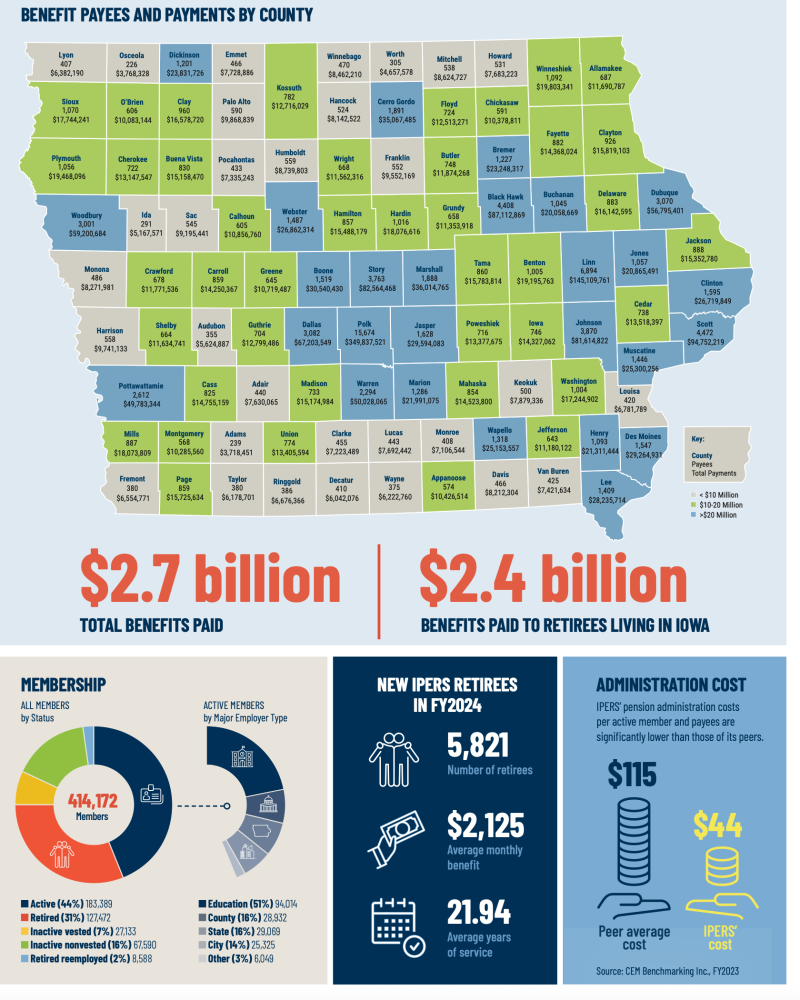
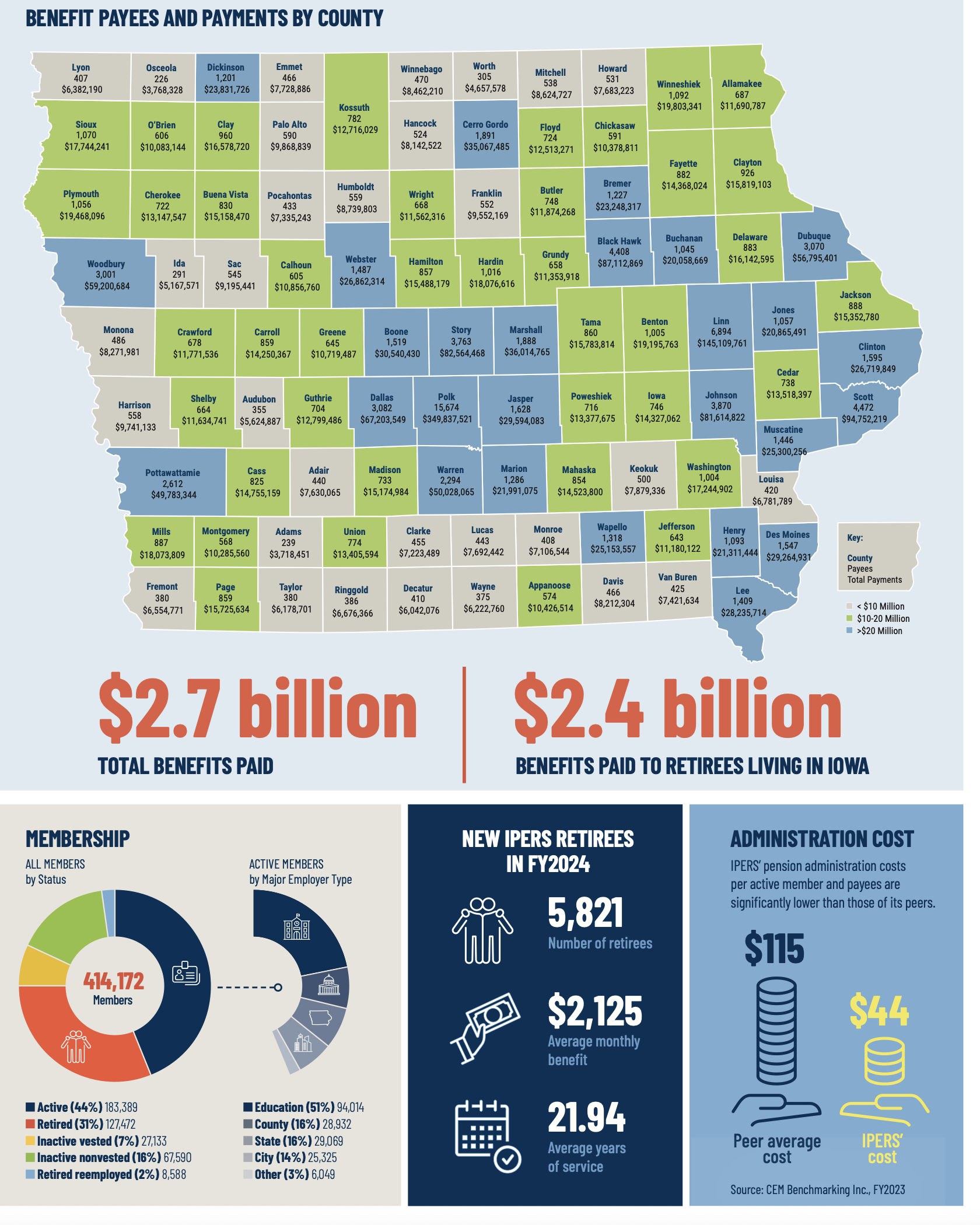
The following chart comes from IPERS’ annual report for the fiscal year 2024. As they reveal, since most retirees remain in Iowa after retirement, their steady stream of income from IPERS’ benefits means that they can remain active contributors to their local communities’ economic activities, including payment of taxes and patronizing local merchants.
The very uncertainties facing retirees under DC plans, however, would make continued reliance upon anything like these current substantial amounts very unlikely.
I apologize for being a tad long-winded, but almost everyone I’ve ever encountered who was critical of IPERS did not, in fact, understand these realities (or they simply didn’t care because their own agenda had predetermined their desired solution.“
— Greg C.
|
|
|
Would you recommend this newsletter to your friends and family?
|
|
|
Thanks for reading. This newsletter was written by Amie Rivers. It was edited by Paula Solis. Iowa Starting Line is happily free to read for everyone. Your financial support means a lot to us.
Donate here.
|
|
|
You are receiving this email because you opted in via our website.
Iowa Starting Line
c/o COURIER Newsroom
101 Avenue of the Americas
8th and 9th Floors
New York, NY 10013
Want to change how you receive these emails?
You can update your preferences or from this list.
|
|
|
|