Lyndi Buckingham-Schutt and her husband Andy Schutt, both Des Moines residents, always knew they wanted to have children.
When Lyndi was 30, they started trying. But as the months passed without a positive pregnancy test, the couple became frustrated and concerned.
“We were under this pretense that, as soon as you roll off birth control, you’d just be easy peasy, get pregnant a month tops,” Andy said. “Our assumption was that it would be this easy process, and it ended up being an immense stressor in our lives.”
Eventually, a friend encouraged them to get their fertility tested, and seven months later, they began the in vitro fertilization (IVF) process. After two years, they conceived the first of their three children.
IVF is a complicated and expensive process that involves multiple procedures to remove eggs from ovaries, fertilize them, and then reinsert embryos into the uterus in the hope at least one implants and develops into a viable pregnancy—and, eventually, a live birth.
The rates of success vary according to factors like age and the quality and quantity of the eggs and sperm being used. That’s why multiple eggs are fertilized at a time. Failures are expected.
“We’ve been really fortunate to be pretty successful,” Lyndi said. “But those times that it wasn’t successful, gosh, the idea of having to wait one more month to have a baby was painful.”
“It’s been such a hard process, but such an important one that if we didn’t—I mean, our kids bring us so much joy.”
They aren’t alone. In 2021, between 511 and 1,120 infants in Iowa were born with assisted reproductive technology, including IVF, according to the US Department of Health and Human Services.
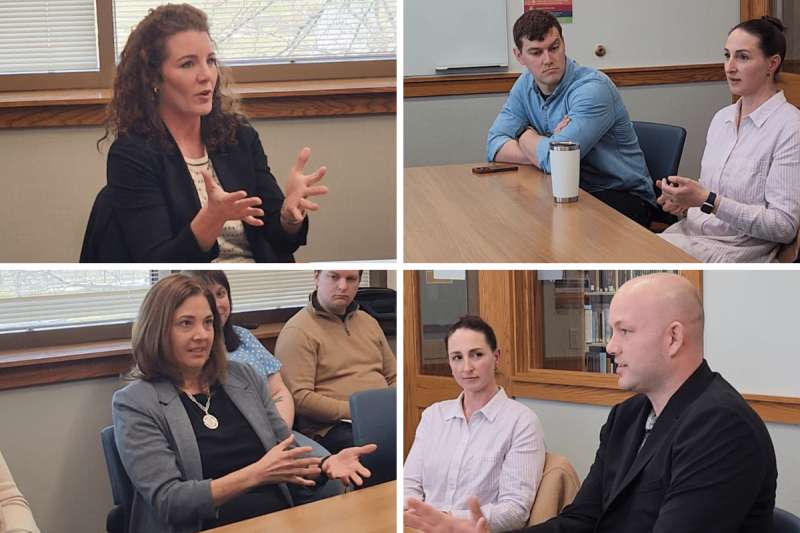
Parents like Lyndi and Andy recently shared their IVF stories at a roundtable hosted by Iowa Sen. Sarah Trone Garriott (D-West Des Moines), who has been a leader on reproductive freedom issues in the Iowa Senate.
Trone Garriott held the event to hear directly from parents who’d gone through IVF, and to listen to their concerns about a bill passed in the Iowa House in March—House File 2575—also known as the “fetal personhood” bill. It would have raised questions about the legality of IVF in Iowa. When the 2024 legislative session ended Saturday, the bill had stalled in the Iowa Senate.
“I struggle every day listening to the news about this stuff,” said Ed Brogean, a father to twins he had through IVF.
In order to have children, he and his partner worked with a surrogate and an anonymous egg donor.
“It’s a very long waiting period,” Brogean said. “Then you have to get the surrogate on board and find the right person for that. There’s so much stuff that you have to go through before you even get to do any of the medical stuff.”
Brogean said the stress was worth it because he loves being a dad—but it’s getting increasingly more difficult to raise a family in Iowa, especially as a gay man.
“I feel like these reproductive bills are stopping good people—any people—[from] being able to have children,” he said. “We have embryos that we still have left that we want to use, and we had to move them to Minnesota.”
Their fertility clinic recommended it because of the fetal personhood legislation. In fact, everyone at the table said their remaining embryos are in Minnesota now.
Iowa’s personhood bill would have made it a felony to “cause the death” of an “unborn person,” and defined personhood from fertilization to live birth—the entire span of a pregnancy. It did not include language protecting IVF, which was the reason Iowa Sen. Brad Zaun (R-Urbandale) cited for not advancing it in the Iowa Senate.
A similar personhood bill in Alabama led the Alabama Supreme Court in February to rule that embryos in the IVF process are “extra-uterine children” and must be stored indefinitely.
Michelle Baker said the idea of that is unthinkable.
Baker was in her mid-30s when she and her husband got married, and her IVF journey started when she was 39. Her doctors told her she would likely have just one chance to get pregnant because of the quality of her eggs.
After a few failed pregnancies, the couple now have a 13-year-old son. After that successful pregnancy, they had to decide what to do with the leftover frozen eggs.
The decision took five years, but Baker and her husband eventually allowed the last eggs to thaw.
“To think, gosh, somebody could be forced to continually go through IVF—because you can’t let them thaw or not use them—to no end? I can’t imagine the emotional pain of that,” she said.
Meg Whitty, another Des Moines resident, learned she and her husband weren’t able to conceive without IVF, and that pregnancy can be dangerous for her.
In her second pregnancy, Whitty had hyperemesis gravidarum, a condition that causes severe nausea and vomiting.
“I don’t want to have any more kids because of how hard it was,” Whitty said. “I was on at-home IVs for six weeks, I lost 20 pounds in my first trimester, and [doctors] were worried about me surviving.”
With two healthy children now, the idea of using their saved embryos is unrealistic. Whitty said nearly all of her friends have had to use IVF, and she’s seen firsthand how important access to it is—along with the freedom to make choices about pregnancy.
She said the conversation can’t be treated like a black-or-white issue.
“Being able to plan how you have a family and making sure that people are empowered to make those decisions—that’s the kind of society that we deserve to have and be a part of,” she said. “And that’s the Iowa that I know exists.”