Iowa Republicans ended a 112-day legislative session on May 3 with a long-promised property tax overhaul estimated to save homeowners $4.2 billion over six years. They also passed an abortion pill restriction that 80% of Iowa voters—including a majority of Republicans—said shouldn’t be the legislature’s priority.
There was only one thing that Iowa Republicans spoke about in the lead up to the 2026 Legislative Session: property taxes are too high. They notably didn’t talk about shelving clinics that let people with low-level nonviolent warrants such as failure-to-appear warrants. They didn’t talk about requiring in-person visits for medication abortions, which is opposed by 80% of Iowans. And no one talked about a bid to change the state constitution on a party-line vote to make it harder for future legislatures to raise revenue from income taxes—in a state that faces a $1.4 billion deficit.
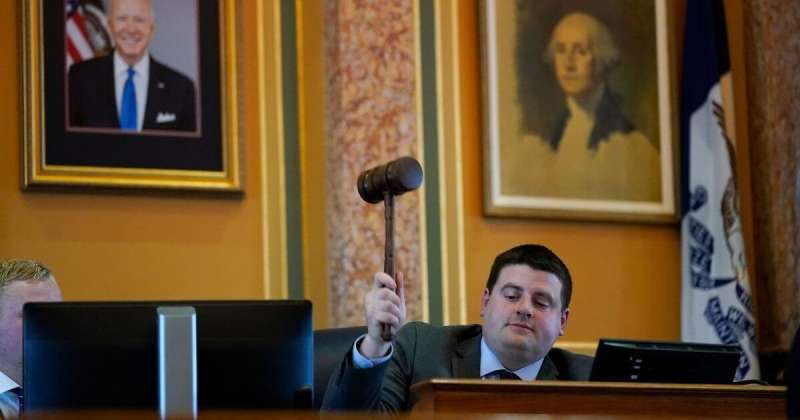
But in a 34-hour, sleep-deprived sprint through the weekend, Iowa Republicans finally passed a property tax overhaul that could save homeowners $4.2 billion over six years. Speaker Pat Grassley called it “mission accomplished.” Gov. Kim Reynolds, in her final legislative session, called it historic.
Senate File 2472 caps local government revenue growth at 2% annually, quadruples the homestead exemption to $20,000, and shifts $175 million in state funding to public schools to lower the school levy. It passed the Senate 41-1 with bipartisan support, though House Democrats voted mostly no, arguing the bill doesn’t touch rising property valuations—the actual engine of higher tax bills.
“This bill does nothing to address the actual singular cause of increasing property taxes, which is rising valuations,” Rep. Aime Wichtendahl, D-Hiawatha, said.
Even some yes votes were hedged. Sen. Cindy Winckler of Davenport said she was “apprehensive” about changes to school funding, but noted the bill’s 2027 implementation date meant “we still might have an opportunity if there are huge problems to fix it.”
Republicans ran 12 days past their April 21 target deadline to get the property tax deal done, working without per diem pay while lawmakers napped at their desks and batted beach balls on the House floor waiting for amendments. House Minority Leader Brian Meyer said the overtime was avoidable.
“They spent months and months and months on kind of weird, social issue crusades that really have no meaning to most people in the state,” Meyer said.
The abortion pill restriction—requiring an in-person visit for medication abortion — passed along party lines in the session’s final hours, as more Iowans have turned to medication abortion since the state’s six-week ban took effect in 2024. A February poll of 584 Iowa voters conducted by Public Policy Polling for Planned Parenthood Advocates of Iowa found 80% of respondents agreed the legislature should focus on household affordability and healthcare costs instead of passing more abortion laws. That included 66% of independents and 36% of Trump voters who strongly agreed.
Senate Minority Leader Janice Weiner of Iowa City said the abortion pill bill would deepen an already acute rural healthcare crisis.
“We have more and more rural health deserts,” Weiner said. “Telehealth has become a lifeline for so many in this state—if you’re a woman in a rural area where you would have to travel an hour and a half and can’t get an appointment, what are your options?”
The session also ended with Iowa facing a projected budget shortfall exceeding $1 billion for a second consecutive year. And Republicans sent a ballot intuitive to Iowans this year asking them to further entrench income tax rates. Democrats warned it could constrain Iowa’s options if deficits persist.
Reynolds, in her final session statement, called it a year of keeping promises. Weiner called the adjournment a different kind of relief: “As the legislative session ends, so does the harm.”