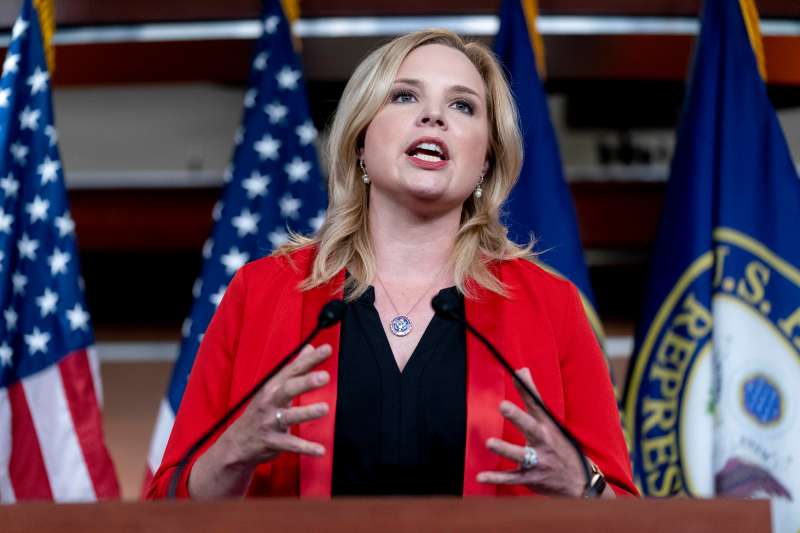
As a US Senate candidate, Ashley Hinson has said she’d fight the special interests. But a new ethics complaint and her own financial disclosures complicate that pitch.
A complaint filed with the House Office of Congressional Conduct this month asks investigators to examine whether Hinson used her office to benefit her husband, Matt Arenholz, and the insurance trade group where he held a leadership role.
Blurring the line?
The complaint draws on NOTUS reporting from late August, which found Arenholz chaired the government affairs committee for the Iowa branch of the Independent Insurance Agents & Brokers of America, a role not previously disclosed on Hinson’s financial forms. In the group’s own magazine, CEO Tom O’Meara credited Arenholz with arranging a meeting with all four Iowa House members in one room, and separately recalled bragging that his chapter met with the state’s full six-member delegation in a single trip.
Jeff Hauser of the Revolving Door Project told NOTUS the arrangement “blurs the line” of what is allowed under the law.
Hinson’s husband’s stock holdings
Separately, Hinson has said she and Arenholz sold their individual stock holdings after she took office, claiming to be tying the claim to her support for banning congressional stock trading. But her 2025 disclosure, filed in August, shows Arenholz still holds between $1 million and $5 million in High Street Insurance Partners, dividends from which totaled up to $1 million last year.
Federal records show two insurance-industry PACs have given Hinson’s campaign committees a combined $135,000 since 2019: $67,500 from InsurePAC and $67,500 from the Council of Insurance Agents & Brokers PAC.
The House Ethics Manual says violations require that a member “exerts influence or performs official acts” tied to a spouse’s compensation. That’s the gap the complaint hasn’t closed. It documents access and appearance, not a specific official act by Hinson connected to her husband’s pay.
Notably, Hinson’s own major insurance-related bill, the Health Insurance Transparency for Patients Act, targets insurer denial practices, a different corner of the industry than the agents and brokers Arenholz’s group represents, complicating any clean “legislating for her husband” narrative.
Hinson’s campaign told the Quad-City Times that Arenholz’s role on the government affairs committee was unpaid and volunteer, and that the delegation meeting was a routine annual fly-in. A longtime Iowa Democrat involved with the group for four decades called claims of impropriety “completely untrue.”