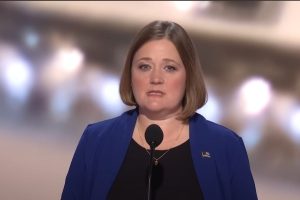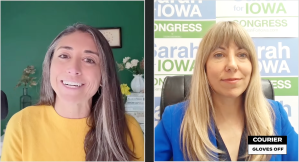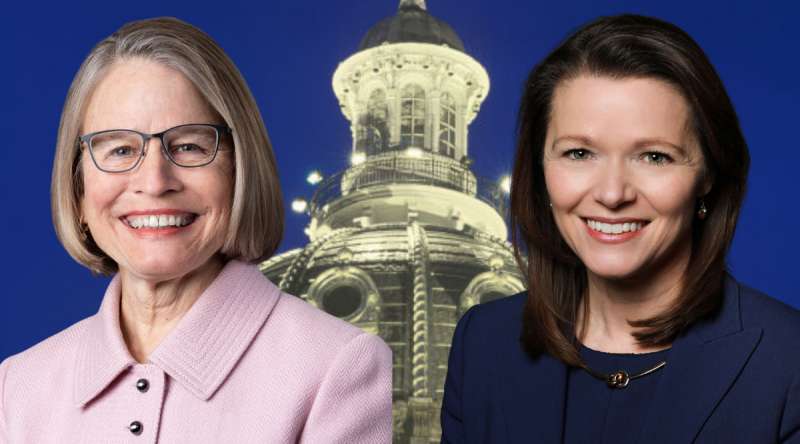
Christina Bohannan opened her third campaign against Mariannette Miller-Meeks by counting her opponent’s terms.
“Three terms in Congress–three chances to do right by the people of Iowa,” Bohannan said in her campaign announcement. “Instead, she has taken over $4 million from corporate special interests and done nothing but vote their way.”
As the Nov. 3 election nears, we’re checking the receipts and fact-checking what candidates are saying to help voters prepare to head to the ballot box. In the race for Iowa’s 1st Congressional District—which includes the cities of Davenport, Iowa City, Burlington, and Indianola—Republican Mariannette Miller-Meeks is running to keep her seat, while Democrat Christina Bohannan is challenging her for the role that’s been characterized as a toss-up by major non-partisan forecasters.
Bohannan
Fifty-five year old Christina Bohannan’s candidate profile on Emily’s List notes that she was the first in her family to graduate from college. She paid for an environmental engineering degree at the University of Florida by working for the Florida Department of Environmental Protection, and then stayed on as an engineer while attending law school.
She attended the UF College of Law, and clerked for the United States Court of Appeals for the 11th Circuit in Alabama.
In 2000, Bohannan became a professor of law at the University of Iowa, where she teaches torts, copyright law, conflicts of law, and intellectual property law, and where in 2014 she was elected president of the university’s Faculty Senate—a role that represents every academic college at the university and weighs in on policy recommendations and committee appointments, and provides consultation to the Board of Regents on leadership and shared governance. .
In 2020, Bohannan ran for the Iowa state Legislature, unseating 20-year incumbent Vicki Lensing with about 66% of the primary vote and winning the general election unopposed.
She served from January 2021 to January 2023 with seats on the Natural Resources and Veterans Affairs standing committees, and on the Agriculture Appropriations Subcommittee. Legislative records show she sponsored or cosponsored 33 bills or resolutions.
A record of the bills she tried to pass in the Republican majority Legislature reflect her history of representing the interest of all constituents—whether in the Faculty Senate or state governance:
- HF 635 – higher penalties for employers who willfully misclassify employees to avoid unemployment contributions
- HF 608 – an appropriation to the Iowa small business relief program
- HF 609 – an appropriation for nonprofit food banks
- HF 466 – required implicit bias training for health professionals
- HF 465 – changes to compulsory school attendance age and truancy penalties
None became law. Democrats held the minority in both chambers, with a Republican governor. In 2021, Bohannan voted against a constitutional amendment declaring that Iowans do not have a right to an abortion.
Miller-Meeks
Sitting Congresswoman Mariannette Miller-Meeks, age 71, had three unsuccessful attempts at the US House in 2008, 2010, and 2014. She set her focus instead of the state Legislature, serving as a state senator from 2019-2021. In 2020, she ran for the US House again, and won by a margin of 0.002%—just six votes. She was re-elected in 2022 and 2024.
Miller-Meeks attended Texas Christian University, the University of Southern California, and the University of Texas Health Science Center at San Antonio on her path to becoming an ophthalmologist. She spent six years serving active duty in the US Army and 17 years in the US Army Reserve.
Miller-Meeks sits on the House Committee on Veterans’ Affairs, and is the chair of its health subcommittee. She’s also on the House Committee on Energy and Commerce, which oversees the US Public Health Service agencies and Medicaid.
In the 117th Congress, which ran from January 2021 to January 2023, Miller-Meeks introduced three bills that became law, all with bipartisan support, to address veterans:
- HR 5529 – required the VA to expand outreach for a program that connects veterans involved with courts or jails to VA services
- HR 4571 – expanded breast cancer screening for women veterans with toxic exposure history
- HR 2591 – allows anyone to drop off controlled substances at VA disposal sites
In the 118th Congress, which ran from January 2023 to January 2025, Miller-Meeks introduced no bills that became law, according to GovTrack.
In the current Congress, the 119th, three of her bipartisan health bills became law on Feb. 3, 2026, all folded into an appropriations package rather than passing on their own: the Accelerating Kids’ Access to Care Act alongside Rep. Lori Trahan (D-MA), a reauthorization of the Lorna Breen Health Care Provider Protection Act, and a Medicare cancer-detection measure.
In May 2025, Miller-Meeks was among 30 Republicans who voted in committee to advance the health portion of President Donald Trump’s One Big Beautiful Bill Act. She also voted for the OBBBA’s final passage in July. That law contained the largest Medicaid reduction in the program’s history, cut SNAP, defunded Planned Parenthood, and repealed clean energy credits nationwide.
KFF reported in June 2025 that 64% of people viewed the “Big Beautiful Bill” unfavorably, including 66% of self-identified non-MAGA Republicans and Republican-leaning independents. A Quinnipiac poll from the same timeframe showed just 18% of registered voters who self-identified as Republicans thought Medicaid needed cuts, while 77% wanted funding to stay the same or increase.
Miller-Meeks defended her vote as preserving Medicaid for its “intended” beneficiaries.
READ MORE: Iowa hospitals brace for impact as federal Medicaid cuts loom.
“This bill protects Iowa families, seniors, and small businesses while strengthening Medicaid for the vulnerable—not for those who can work and choose not to.”
There were roughly $2.4 million recovered Medicaid fraud dollars in 2022. It was recovered through criminal and civil judgements.
The government tracks improper payments rates for government-funded programs, including Medicaid. Improper payment rate is the percentage of total funds that were paid incorrectly. That can include overpayments or underpayments, as well as payments that don’t include proper documentation indicating the correctness of the payment.
Iowa’s most recent projected improper payment rate was 1.9%.
In May 2025, Iowa had about 603,000 Iowans enrolled in Iowa Medicaid. By 2034, the “Big Beautiful Bill” will strip about 68,000 Iowans of healthcare by 2034, according to KFF.