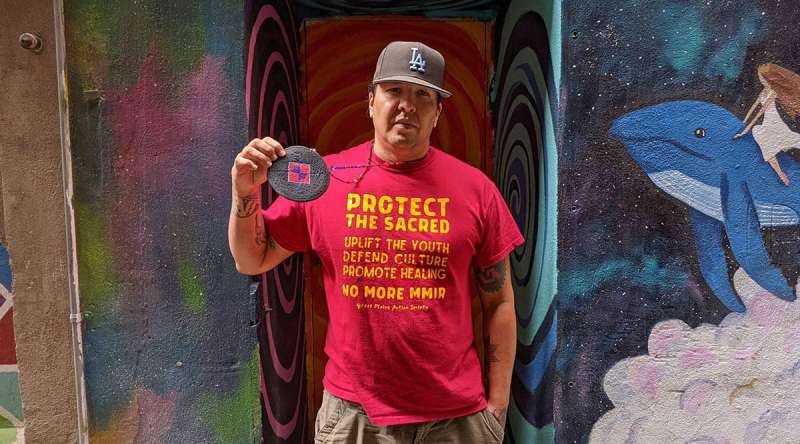
Manape LaMere came home to Sioux City to make a difference.
The son of the late Native American activist Frank LaMere, Manape is an activist in his own right. The 42-year-old spent five years living in South Dakota fighting for indigenous people’s rights, including participating in the Standing Rock Sioux Tribe’s fight against the Dakota Access Pipeline before moving back to Sioux City this summer.
“I feel like I went on zuya—zuya, a warpath,” Manape said. “I want to take all the things that I learned on the warpath and apply them around here, but I’ve been gone and the people are going to have to learn how to trust me again.”
Manape is working to regain that trust.
[inline-ad id=”1″]
He has helped organize events in Sioux City this year, including gatherings to honor the lives of indigenous children who died at boarding schools and whose remains came through town on their way home.
Manape and his partner, SunRose Ironshell, also go around providing food and water to the community’s houseless people and children who are food insecure.
“I don’t want to feed them bologna and chips,” Manape said. “I want to feed them health. I want to feed them buffalo meat. I want to feed them Indian corn. I want to feed them squash and all the healthy stuff; that’s what we need to be giving to the homeless. We need to decolonize our diets.”
Also in the short time since he’s returned, Manape has become a regular speaker at public meetings. Oftentimes, he challenges elected officials and community organizers in attendance to do more to support Sioux City’s indigenous population.
While Native Americans account for about 0.4 percent of Sioux City’s population, the group disproportionately accounts for a lot of arrests, typically for minor infractions such as panhandling or public intoxication.
“We’ve been telling the chief of police, we’ve been telling the department of health and human services, we’ve been telling the recovery programs that Indians have a different way of doing things, you know, and we could help your recidivism rates by implementing different methods,” Manape said.
[inline-ad id=”2″]
One of his suggestions adopts a two birds and one stone approach. Manape doesn’t view feeding people healthy food and helping them get treatment for their addiction as two separate issues. His idea is to create a unique rehabilitation program for people who get incarcerated because of their addictions.
“They need to get in the gardens,” he said. “There’s no reason why we can’t be utilizing them to make a better, healthier community. I think they will learn something when they connect to that ground, connect to that earth.”
It should be noted Manape speaks from a place of experience when it comes to addiction and incarceration. In the depths of his own addiction, he used and sold drugs and was accused of domestic violence by two partners, although he denies the accusations.
“I always try to be open about my life, that way people are completely aware of what they are dealing with when it comes to me,” Manape said.
[inline-ad id=”3″]
Manape tried to clean his life up before completely succumbing to his addiction. He put himself into treatment and moved to a halfway house in Omaha, Nebraska. He got a job at a Hardee’s restaurant and enrolled in community college, but his past caught up with him.
While he was never caught with any drugs, the federal case brought against him was conspiracy to distribute meth.
“The dude they wanted me to snitch on snitched on me, which was like the nail in the coffin,” Manape said. “I pled guilty—no plea agreement—I got sentenced to 89 months behind the fence.”
When it was time for him to serve his time, Manape’s parents and little sister dropped him off at the federal courthouse, a vivid memory that sticks with him. However, Manape maintained his sobriety leading up to his incarceration and had embraced his heritage.
“I had gotten connected with my traditional ways and went to different ceremonies throughout my trial and sentencing and I believe those altars and the spirits helped me,” he said. “Throughout my incarceration, I witnessed that help. It was scary.”
Manape served five years of his sentence and was on probation for 120 months—twice the typical length—but eventually, he was free of the system and had worked a number of jobs before really finding his foot working for the Winnebago Tribe of Nebraska.
[inline-ad id=”3″]
During his time working for the tribe, one of the things he helped with was the development of the Youth Crisis and Intervention Center, a 24-hour facility that provides secure temporary housing to children temporarily removed from their homes.
His work with the Winnebago youth led to him working with other indigenous youth including those who organized the inaugural Run for our Lives protest against the Dakota Access Pipeline, which led to him moving to Standing Rock.
Now his mission has brought him home, an outcome that also seems fated.
“They manifested ‘Go West, young man,’” Manape said. “So I’m going east and I came to Sioux City and I’m going to manifest our own destiny here. Who said we can’t? Who told us that we can’t manifest our own destiny or is it only white people that get to manifest their own destiny?”
by Ty Rushing
10/08/21
[inline-ad id=”0″]