The 2020 Democratic race has for the first time in an election cycle identified the issue of affordable housing as a widening national concern, but advocates are calling for greater emphasis on the issue as it remains “the No. 1 problem” in rural communities.
Out of the gate, the fight for the Democratic nomination up to the Iowa caucuses seemed promising for the issue of housing as most candidates rolled out comprehensive housing proposals. A direct question about the issue was even asked on the November debate stage. But housing specifics were seldom discussed, especially for large scale rural housing needs, as the issue faded to the background and questions of “Medicare for All” and billionaire donations dominated the news.
“It’s been interesting to observe the candidates’ strategy, or maybe lack thereof, on using housing as a defining issue of their campaigns,” Polk County Housing Trust Fund executive director Eric Burmeister said. “I have not seen the kind of, I guess focus, on housing that a housing advocate would have hoped for during the campaigns.”
Former Iowa Lt. Gov. Patty Judge, a Democrat who co-founded Focus on Rural America, said she too didn’t think the candidates addressed housing issues enough on the trail.
“We’ve got to talk more about housing,” Judge said. “It has reached that point that it just has to be addressed. We don’t ever seem to want to think ahead very far, and now we’re being hit in the face with the fact that we’ve got a housing problem.”
Other top issues, such as health care, might have been prioritized over housing, Burmeister speculated.
“In some ways, it was kind of surprising and seemed to be kind of an oversight. On the other hand, maybe the problem is just so big that no one knows exactly what to do about it,” he said.
[inline-ad id=”0″]
Nationally, there is no state or county where a renter working full-time at minimum wage can afford a two-bedroom apartment, according to the National Low Income Housing Coalition. Iowa is rated 45th in terms of highest housing wages.
An NLIHC poll also found that 76% of people polled nationally are more likely to vote for a candidate with a detailed plan on affordable housing.
Champions of housing said the issue didn’t get much attention from candidates themselves. In November, a candidate forum focused on housing was canceled because of what some called a lack of preparedness to talk about the issue.
“It would seem to me that speaking to that particular population, or that particular demographic, with solutions in order to help them, or even acknowledgment of their pain, would be something that would be strategic for a campaign,” Burmeister said. “But I didn’t see that happening.”
Housing advocates also anticipated a mobilized bloc of voters this election cycle with the concern of rising home costs as each year more Americans are impacted by growing rates of unaffordable housing.
But a groundswell of concerned citizens also never came out en masse to talk about the issue with candidates.
“So, I think that unless something’s been brewing in other parts of the country, I don’t see that sort of groundswell. I don’t see the angry mob. And maybe there will be. I don’t know. But right now I think it’s pretty quiet out there,” Burmeister said.
[inline-ad id=”1″]
A Needed Focus On Rural Housing
Despite a disappointing lack of focus on the issue, there has been some improvement from previous election cycles.
“Some of us have been working on this for years or decades and had hoped to get to a point where presidential candidates were putting forward ambitious plans, talking about those plans on the campaign trail, and even getting a question in the Democratic debate a couple weeks ago, which was a big deal, a big breakthrough,” Diane Yentel, CEO of the National Low Income Housing Coalition, told Starting Line in December.
Increases to federal housing funding and eviction protections are among some Democratic presidential candidates’ affordable housing proposals — first-of-their-kind plans in a general election. But discussion of these proposals has plateaued on the trail.
Bill Menner, executive director of the Iowa Rural Development Council and the former state director of U.S. Department of Agriculture rural development, also mentioned that candidate housing plans focus on beefing up the Department of Housing and Urban Development but don’t often mention USDA — the largest player in rural housing.
Rural communities also face unique housing challenges as data from the Urban Institute notes more than 150 rural counties have a severe need for affordable rental housing, and 38% of rural counties have somewhat severe rental housing needs.
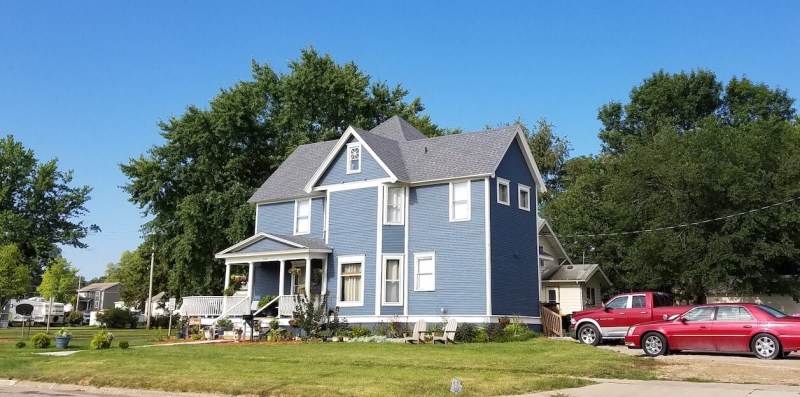
“No matter how big or small a rural community is, there is a housing shortage,” said Zachary Mannheimer, a principal community placemaker at Clive-based McClure Engineering, whose years-long career has focused on rural America.
These shortages are extremely severe, Mannheimer said.
Judge said that the last time she “knocked doors for Democrats” in rural Southeast Iowa was in 2016, and she remembered being shocked at the area’s deterioration.
“It’s just unbelievable to me the difference, how that community has deteriorated. And when you see people storing the used washing machine on the front porch, it’s just like the pride is gone. The nice little houses that are not being maintained,” she said.
[inline-ad id=”2″]
The last real push for rural housing was from the USDA in the 1980s, Judge said.
“That program gave incentives to developers to build and it was very successful,” she said. “Unfortunately, those houses now, if they were put up in 1980, they’re old housing now. And they weren’t particularly well-built houses … it is a crisis point in housing in rural Iowa.”
But rural areas aren’t just in need of affordable housing options, like in the state’s urban areas. They’re in need of “every kind of housing there is,” Menner said. “Single family, owner-occupied. Market-rate rentals, affordable rentals, senior housing, you name it. If you’re in a small town, it’s a challenge for you.”
One way Menner suggests the government — be it federal, state or local — can help is if it buys down the cost, subsides or incentivizes the cost of construction.
The money is out there, Mannheimer said, but it takes a lot of effort to find the money and time to piece plans together. And a focus is not currently on housing.
“The issue is leadership,” he said. “That’s where we’re seeing communities fail. They’re doing a top-down approach … instead, they need to have a grassroots approach to this.”
[signup_form]
Higher Wages Could Really Help
In the absence of detailed housing proposals from politicians, advocates agreed that the simplest and potentially most effective strategy to make housing more affordable in both rural and urban areas is to increase the minimum wage.
Divorcing housing and economic opportunity could be detrimental, Judge said, especially in rural areas.
Focus on Rural America said that when they spoke to campaigns early in the election about rural policy, they highlighted that economic opportunity was the first step in solving any issue — even housing.
“And so to me, that’s really hitting at the heart of what is our rental housing problem. It’s either that or we have to invest a whole lot of money in new subsidies to help people pay their rent.” Burmeister said. “Continuing to say we’re going to add more dollars to help people pay their rent or to help build them cheaper apartments is really the band-aid plan.”
And while housing wasn’t the biggest focus on the national campaign trail, the issue will continue to be a discussion in Iowa at the state level because rural interests, Burmeister said, where this is a huge priority, currently controls the Legislature and governor’s office.
“We’re certainly not going to forget the heat on not only the candidates but our federal delegation to continue to provide new resources, but we’re also going to turn around now and start to focus on what we can do at the state and local level in order to help folks that are struggling,” he said.
[inline-ad id=”3″]
Menner agreed that there needs to be broader public policy incentives to help develop a wider cross-section of housing opportunities, specifically in small towns.
“You have to be able to mitigate the risk that exists for developers, builders, property owners, homebuyers, communities, you have to take the risk out of the equation. Or at least remove some of the risk,” he said.
Rural communities are not really ready to receive new population, based on housing stock alone, Mannheimer said, while the opportunities for high paying jobs exist there.
Judge said that housing may be an issue to be emphasized in the future while trying to mobilize and win back some of the state’s Trump voters, most of which live in these rural areas.
“We as Democrats are trying to understand why people in certain parts of our country decided they were not going to vote for us anymore. And to me, this is just part of it,” Judge said. “We have to understand that the working class, blue-collar workers, whether they’re in urban or rural parts of our country, they want decent housing.”
By Isabella Murray
Posted 2/11/20