For years now, Americans have heard that they can’t trust their elections. President Donald Trump has repeatedly and falsely attacked US election security as rigged or stolen. Despite this, polling shows that Americans’ overall confidence that their vote counted as they intended it increased after the 2024 election.
Instances of voter fraud are incredibly rare and minor—both in Iowa and nationwide. Iowa Public Radio reported in 2023 that Kim Phuong Taylor, the wife of Republican Woodbury Supervisor Jeremy Taylor, was convicted of 52 counts of voter fraud for illegally filling out absentee ballots on behalf of members of Sioux City’s Vietnamese community. She targeted voters with limited English proficiency, offering to help them vote and then cast ballots in their names for her husband’s congressional and supervisor races. A federal jury found her guilty, and she was sentenced to four months in prison.
Iowa’s system caught it. Election officials noticed the fraud, investigated, and prosecutors built a case.
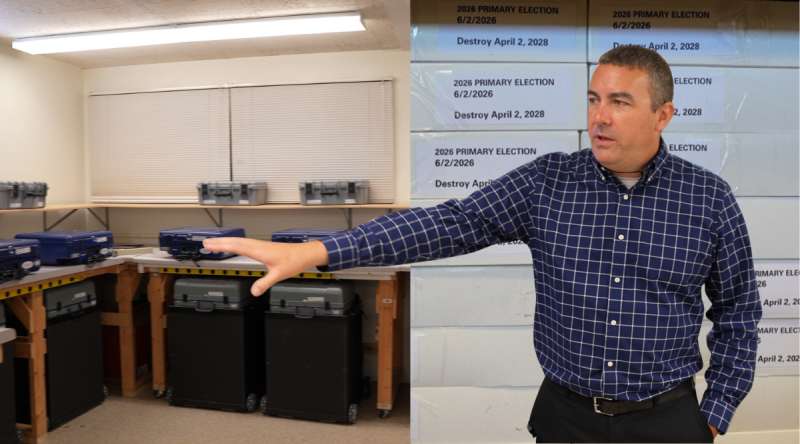
Adam Wedmore is the Cerro Gordo County auditor. In Iowa, that makes him the commissioner of elections, overseeing the county’s 23 precincts, a staff of six, and on Election Day, all the moving parts that guarantee voting goes smoothly.
“We’re essentially a wedding planner running 23 weddings on one day,” Wedmore said, pointing to the string of details his office has to manage at every polling place: grounded outlets, ADA-compliant bathrooms and entrances, adequate parking, backup power.
Iowa’s election procedures are considered among the best in the country. It’s not some threat of a stolen election that’s keeping Wedmore up. It’s the stuff no one plans on.
“What keeps me up at night, and probably others, is the unknowns,” he said, “the ones we just can’t predict. We can’t control.”
During the June primary, a construction crew hit a power line and knocked out electricity to one of his polling places at 9 a.m. His office ran the site on a battery backup for two hours. Iowa also gets tornado warnings during election season most years. Wedmore’s had to walk poll workers through storm sheltering procedures in the middle of an election.
Wedmore said he’s thinking through weather, staffing backups, a backhoe hitting a power line. But when asked how he and the other 98 auditors make sure a ballot gets counted, he said:
Election security ‘starts with paper‘
Every ballot cast in Iowa is a paper ballot. Whether you fill it out by hand or use a machine that marks it for you, it’s done on paper. Whether a voter fills it out by hand or uses a touchscreen ballot-marking device that prints it out. Every polling place has at least one of the marking devices, required for ADA accessibility but open to any voter—Wedmore said he prefers voting on one himself.
Either way, the voter gets to check the paper before turning it in. That paper record matters because it’s the thing officials go back to later if the need arises to double-check the result.
The scanners that read the ballot aren’t connected to the internet, on purpose—it’s one less way for anyone to interfere with a count remotely.
Before Election Day, vote-counting machines are tested publicly
Every piece of vote-counting equipment in all 99 counties has to be tested before it’s used, and by law, that testing happens in view of the public, with both political parties invited to watch.
If you’ve ever wanted to see exactly how your county checks that its machines are counting correctly, this is the moment, and you’re allowed to be in the room. Wedmore said this is one of the most underused ways for voters to see the system firsthand.
“There’s an opportunity for every member of the public to come to a public test ahead of the election,” he said.
Election officials run a pre-scripted “test deck” of ballots with a known outcome, then show that the machine counts them correctly.
After the election, there’s a hand count
The day after every election, the Secretary of State’s office randomly draws one precinct in each of Iowa’s 99 counties.
Wedmore described how it works in Cerro Gordo County: The office notifies party chairs, the media, and the public ahead of time, then a bipartisan team of at least three people hand-counts the ballots from the precinct and compares the total to the machine count from election night.
Iowa Code requires the official canvass of votes the Tuesday after the election, which gives counties about a week to complete the audit, cure any provisional ballots, and process late-arriving absentee ballots from groups like overseas military voters.
A natural question: why not just hand-count everything to begin with? The reality is hand-counts take a long time. And Wedmore said from experience watching headcounts, humans are worse at this than people assume.
“When we do a post-election audit, it very rarely will match up the total number of ballots that we give them to what they counted the first time,” he said. “Ballots will stick together sometimes. Sometimes they get to 24 and think they’re at 25. Human error comes into play. We always get the correct count — but sometimes it takes us a couple of times to count it.”
That’s why the audit exists as a check on the machine, not a replacement for it: to prove, after the fact, that the equipment counted correctly.
Your ballot doesn’t disappear after election night, either
At the back of Cerro Gordo County’s election facility, there are shelves of sealed boxes full of ballots from previous elections.
After polls close, poll workers pack the physical ballots into the boxes, seal them and sign them at the precinct. Iowa law requires ballots to be kept for six months after most elections, and 22 months after any election that includes a federal race. That’s so there’s always a paper trail to go back to if a recount or investigation is ever needed.
Who’s actually watching all of this?
It’s not just county auditors working alone. Iowa’s election security is a partnership between the Secretary of State’s office, the Iowa Department of Public Safety, Iowa Homeland Security and Emergency Management, the Iowa National Guard, the FBI, and all 99 county auditors. Ahead of this year’s primary, those groups held a joint press conference to walk through their preparations.
“As election managers, we have to prepare for the worst, and hope for the best,” Secretary of State Paul Pate said in a release. “Iowa’s county auditors and their election security teams are at the frontline of election security, and ensuring they have the resources and training they need to keep Iowa elections safe and secure, regardless of circumstance, is vital to election integrity as a whole.”
The state also runs cybersecurity monitoring around the clock through the State of Iowa Security Operations Center, with extra staffing during elections. And in the months before an election, county auditors and their teams — plus local law enforcement, IT staff, and emergency managers — run tabletop exercises to prepare for worst-case scenarios, like what to do if a precinct loses power or a system goes down.
Keeping voter rolls accurate
A big piece of election security happens before Election Day even arrives: making sure the list of registered voters is accurate. In 2018, Iowa joined the Electronic Registration Information Center, or ERIC, a multistate partnership that helps states find voters who’ve moved, died, or registered in more than one state. The system helped identify eligible Iowans who aren’t registered yet.
Pate told NPR the partnership was a “godsend” in February 2023. That year, he announced the state was leaving ERIC, joining several other states that left it around the same time. Iowa now handles voter list maintenance without ERIC’s data-sharing network.
Absentee and early voting rules have also changed in recent years. In 2021, the Iowa Legislature passed a law that shortened the windows for both mail and in-person absentee voting. Those changes remain in effect for the 2026 elections.
How does Iowa compare to other states?
Nationally, an estimated 99% of voters will cast a ballot that leaves a paper trail, according to Verified Voting, a nonprofit, non-partisan foundation that tracks elections equipment. Every state now runs some kind of post-election audit. Iowa has required paper ballots for years, which put it ahead of the curve when a meaningful share of the country was still voting on paperless machines.
Where Iowa is more in the middle of the pack: the type of audit it runs. Iowa hand-counts one race in one randomly selected precinct per county — a fixed approach used by most states. A smaller group of states — five, as of recent counts — use what’s called a risk-limiting audit, a statistical method where the number of ballots checked scales up automatically if a race is close. Election security researchers generally consider that approach the strongest available, though Iowa’s traditional audit still gives officials and the public a way to catch discrepancies before results are certified.
“Iowa has a great system,” Wedmore said. “I wish every state did it as well as Iowa does.”
What can you do?
If you want to see any of this yourself, you don’t have to take anyone’s word for it. Public testing of voting equipment and post-election audits are open to any Iowan who wants to watch — contact your county auditor’s office for dates and times.
And if you haven’t checked your own voter registration lately, now’s a good time. You can check your voter registration status online. Iowa does offer same-day registration, meaning you can register to vote right at your polling place on Election Day with proof of ID and residency.
To pre-register to vote, complete a voter registration form and return it to your county auditor’s office. Your county auditor will send you a voter registration card within two weeks.