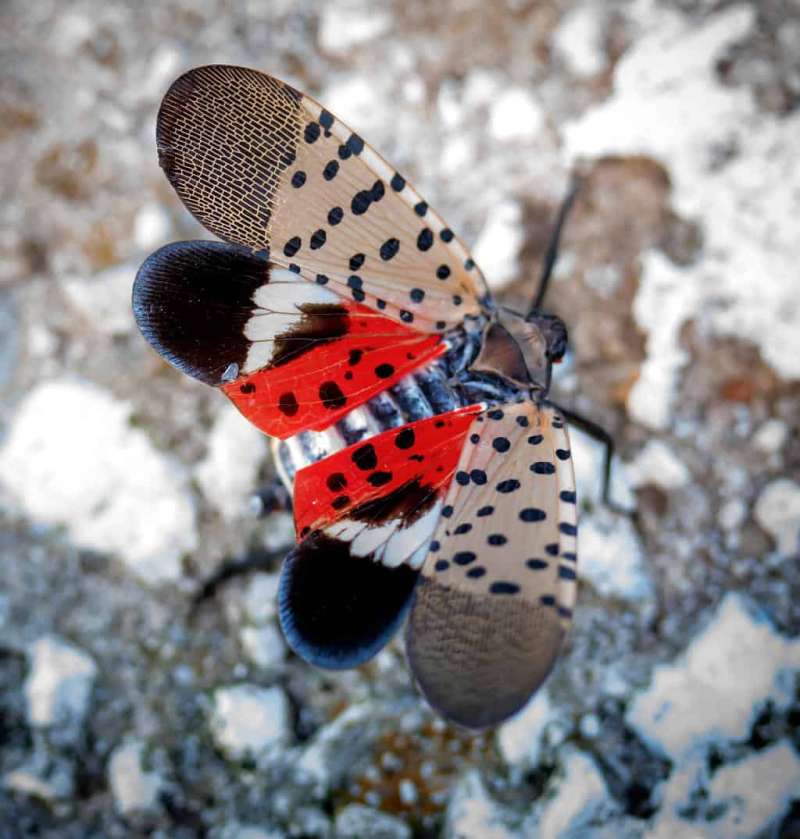
A spotted lanternfly was found in Des Moines in September. The invasive species could pose problems in the future.
An invasive insect has made its way to Iowa, and the state’s Department of Agriculture and Land Stewardship is asking for the public’s help to keep an eye out for additional unwelcomed visitors.
The spotted lanternfly was first seen in the state in September. The individual who came across the bug then notified the Iowa Department of Agriculture and Land Stewardship (IDALS), who have since been on the lookout for additional adult lanternflies. The insect, which is native to Asia, is destructive as it feeds on around 70 different plant species. While there would need to be more than one adult spotted lanternfly to cause destruction, IDALS warns that if it does eventually spread, it would likely threaten orchard, nursery, grape, and logging industries across the US.
Since 2014, the adult spotted lanternfly has been seen in 20 states, the first of which was Pennsylvania. Speaking about how the insect may have made its way stateside, the public information officer for IDALS, Don McDowell, said, “We believe the adult inadvertently hitchhiked to this site on a truck. However, we want to make sure if there is an infestation that we move quickly to address it.”
As of writing, there does not appear to be an infestation in the Des Moines County area where the first spotted lanternfly was discovered. IDALS believes it may have been inadvertently brought in with a shipment, as it was found in an “industrial area with significant truck traffic from outside Iowa.”
What should Iowans be on the lookout for?
The spotted lanternfly prefers a specific host when it settles into a new area: tree of heaven. Tree of heaven is frequently found in Iowa in spaces like vacant lots and alleyways, in addition to woodland and roadside edges, floodplains, and fence rows. According to the Ames Tribune, the tree of heaven is invasive and it grows fast due to the frequency of its seed production. Due to these factors, it poses a risk to native vegetation, which it can outcompete quite quickly.
The Iowa Department of Agriculture and Land Stewardship (IDALS) notes that the insects are usually easiest to see in the evening hours between dusk and nighttime. They’re typically visible moving along trees during this time. They do appear in the daytime as well, but less frequently and are usually clustered toward the bottom of plants or in canopies at these intervals.
If you happen to see one of these insects for yourself, please report your sighting to IDALS directly by sending an email to Entomology@IowaAgriculture.gov or by calling 515-725-1470.
This article first appeared on Good Info News Wire and is republished here under a Creative Commons license.
Related: State Offering Grants to Replace Trees Killed by Emerald Ash Borer