Iowa Gov. Kim Reynolds last week announced she would again ask for a waiver to not have to administer a federal program that ensures children don’t go hungry in the summer when school is out.
The Summer EBT, or SUN Bucks, program gives low-income families with children who already receive free and reduced school meals an extra one-time boost of $120 to help them buy groceries.
That added money is crucial because of how child hunger increases in the summer, said Paige Chickering, Iowa State Advocacy Manager for Save the Children Action Network.
“We’ve seen how much the summer EBT program is a truly evidence-based, fully tested solution,” Chickering said. “We’ve seen how much benefit it has to children. We’ve seen it ameliorate hunger over the summer, and we’ve seen it improve nutrition.”
Adequate food helps fuel brain development, while not enough (food insecurity) has been proven to lead to learning loss and decreased physical and mental health for children.
Difference between food boxes and grocery money
With Summer EBT, families are given money to buy groceries, choosing the specific food that works for their families.
By contrast, Reynolds wants to use her grant program for meal sites, and give people pre-packed boxes of food because she believes that promotes more nutritious food. But, research shows families buy more nutritious food with programs like Summer EBT.
Chickering said meal sites can be difficult for families who live far away, and pre-packed boxes don’t work for those with dietary restrictions because of allergies, religious practices, and more.
With food box programs, “They don’t have the choices available to them to be able to make those nutritional decisions by themselves,” Chickering said. “[Summer EBT] places that freedom back with the families themselves.”
Chickering said stigma around food insecurity and needing benefits is another big impact on children. Giving families money to buy groceries directly rather than relying on boxes of food gives them more freedom and dignity.
“They get that card, they get to go to the grocery store and use those that those funds to buy food, to make the choices that are right for their families to directly participate in the economy in that way,” she said. “That’s kind of ameliorating some of those stigmas around benefit programs that really do still exist.”
Food banks seeing increases
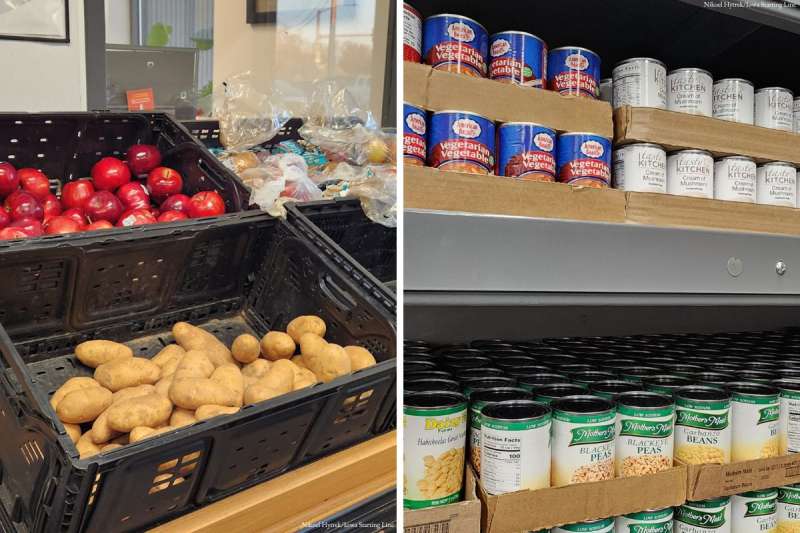
Fresh fruits and vegetables are some of the main things people get from food pantries, said Blake Willadsen, the marketing and communications manager for the Des Moines Area Religious Council (DMARC), which works with 14 food pantries in the Des Moines metro.
DMARC saw its busiest month on record in November, Willadsen said. It was also the first time the pantry saw more than 10,000 children getting food assistance.
“We saw just short of 30,000 unique individuals getting assistance,” Willadsen said. “That’s about 11,000 households, and in those households, we’re talking about one in three people getting the food are under the age of 18.”
When families come to a food pantry, Willadsen said, they’re often looking to make up for what they can’t afford to buy at the grocery store. Those are often high-priced items like fresh fruits and vegetables, peanut butter, and cereal.
DMARC provides families with three days’ worth of food, but Willadsen said families need other lines of support, and the state shouldn’t leave tools like Summer EBT on the table because of the increased demand.
“I think that the easiest way to address food insecurity right now is not just to give out more food,” he said. “It’s about helping us shorten the line at food pantries as well.”
Solutions
That’s why the Iowa Hunger Coalition—which Save the Children Action Network and DMARC are a part of—has urged Reynolds to rejoin the Summer EBT program, expand free school meals to all children, and raise SNAP eligibility to 200% of the federal poverty limit, among others.
Instead, the state has restricted food assistance programs, including SNAP, in recent years.
Republicans in the Iowa Legislature passed a bill in 2023 that requires asset testing for Iowans on SNAP. Any Iowa family with liquid assets of more than $15,000 will not be allowed to receive SNAP benefits. That doesn’t count the value of a home, a household’s first car, and up to $10,000 of the value of a second car.
The Legislative Services Agency estimated at the time that about 2,800 SNAP recipients would be kicked off the program. The majority of SNAP recipients in Iowa are children.
“Last month being as incredibly busy as it was, we’re starting to approach this territory where it feels like we’re at the limit of what the charitable sector can provide when it comes to food assistance,” Willadsen said. “Our volunteers (and) our staff are incredibly overworked and being challenged by the line at the door—the second these places open to the moment they close.”