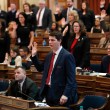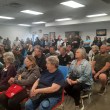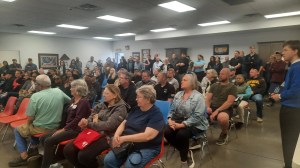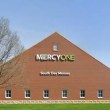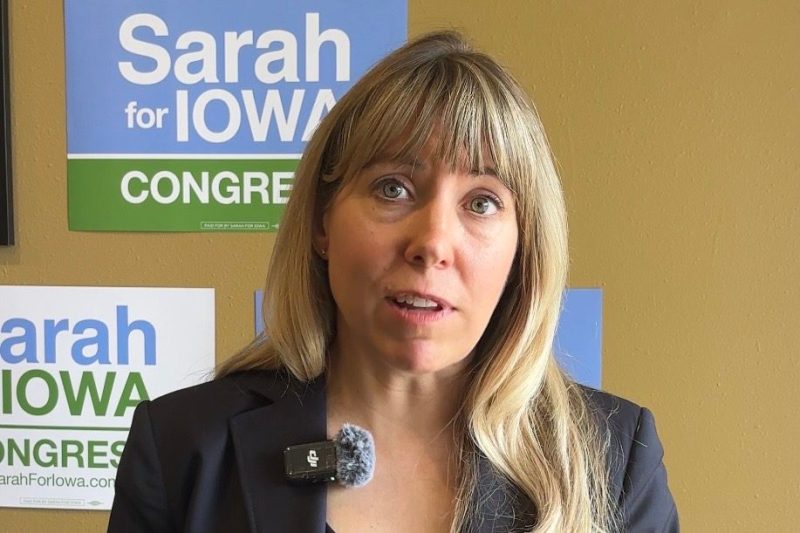
Democratic congressional candidate Sarah Trone Garriott held a roundtable in Ottumwa where local health care professionals and patients discussed the closure of MercyOne’s Ottumwa clinic and how the “One Big, Beautiful Bill” led to it.
OTTUMWA – Kerri Rupe, a retired family nurse practitioner, said working in the health care system taught her how broken it is. In 2010, she was working at River Hills Community Health Center in Ottumwa when a 36-year-old woman came in without insurance or any other resources to pay. She had three kids and no options for treating her breast cancer.
Rupe tried to work the system. She begged a surgeon friend to operate. But the mother died about a year later.
“I’ve seen them,” Rupe said of the woman’s children. “And every time I see them it breaks my heart. There is no reason that human medicine has been able to obtain care.”
Rupe went on to spend decades caring for patients in Ottumwa, training the next generation of nurses at the University of Iowa College of Nursing, and trying to make a broken system work. But decades later, that 36 year-old woman is still on her mind.
“I really think if we don’t do something, the system will crash,” she said. “It’s only a matter of time.”
Rupe was one of several Ottumwa-area health care professionals and residents who joined Democratic congressional candidate Sarah Trone Garriott at the Hotel Ottumwa on Saturday for a roundtable on the state of health care in rural Iowa. Trone Garriott is a state senator from West Des Moines and frontrunner for the Democratic nomination in the 3rd District.
‘Zach Nunn owns this’
Republican U.S. Rep. Zach Nunn told WHO13 in July 2025 that rural hospital closures were a “myth.”
“I think that the myth here is that rural hospitals are going to close down. That’s not the case,” he said.
Seven months later, the MercyOne family medicine clinic in Ottumwa closed. It joined MercyOne’s clinic in Traer, which closed in December, and Pella Regional Medical Clinic, which reduced its family practice operations in January—all of it before the Medicaid cuts have even fully taken effect.
Dr. Peter Reiter practiced medicine in Ottumwa for 40 years. He was there when the city had 45 physicians. Now, he said, the town has two board-certified family practice doctors.
“Zach Nunn owns this,” Reiter said. “This is harming Iowans. This is harming Ottumwans.”
Mike Slubowski, the CEO of Trinity Health, which owns the MercyOne system of hospitals and clinics, warned after President Donald Trump signed the One, Big, Beautiful Bill Act on July 4 that the Medicaid cuts would more than double the company’s annual losses to exceed $1 billion.
“These cuts would trigger both health and economic disruption,” he wrote. “Employers already shoulder higher premiums to offset underpayments from Medicaid and Medicare, and they won’t accept further cost shifts. Hospitals, often the largest employers in small and mid-sized towns, may be forced to reduce services, cut jobs or close entirely.”
Reiter called Ottumwa the “canary in the coal mine” when it comes to the impact of Medicaid cuts on Iowans’ health care.
“There are going to be many other health care access points in the state of Iowa and around the country that will close,” he said. “People will not be able to get care anywhere. People will not be able to take their medication and people will die prematurely.”
A community left scrambling
The closure didn’t just cost Ottumwa a clinic. It cost the community roughly 40 jobs at MercyOne, plus another 12 jobs at Pella Regional’s Ottumwa location. Rick Johnson, former mayor of Ottumwa, who also served as CEO of River Hills Community Health Center, said the economic ripple effects are already being felt.
“It has a real domino effect on the community,” Johnson said. “Back in the ‘80s, Ottumwa had about 45 physicians. We’ve went from like 45 physicians in the ‘80s down to like two now.”
For patients, the scramble is deeply personal. Julie Lawrence had been a patient at MercyOne Ottumwa and had finally found a provider she trusted.
“I thought, this is who I’m going to have, maybe for the rest of my life,” she said.
Now she’s on a waitlist. She was told her records might go to Centerville—less than an hour away on a two-lane highway she doesn’t want to drive on in the winter—or possibly to Des Moines. She isn’t sure.
“I have no idea where my medical records are right now,” Lawrence said. “It’s just not a pleasant feeling.”
Former Nunn staffer at House GOP campaign arm responds, deletes response
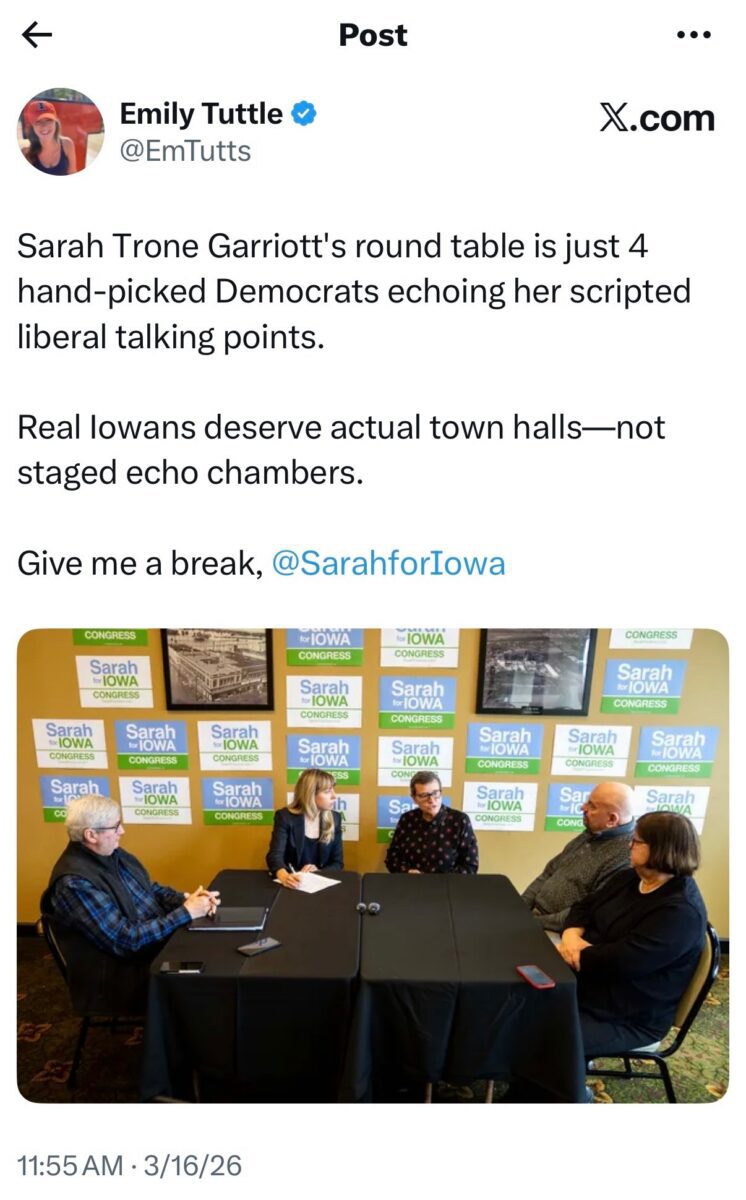
The National Republican Congressional Committee responded to Trone Garriott’s roundtable on X, the social media platform formerly known as Twitter.
“Sarah Trone Garriot’s round table is just 4 hand-picked Democrats echoing her scripted liberal talking points,” wrote the NRCC’s Emily Tuttle-Millard. “Real Iowans deserve actual town halls—not staged echo chambers.”
The tweet was deleted shortly after it was posted.
Nunn has not appeared at community meetings on the clinic closure. Attendees at the roundtable on Saturday said repeated attempts to get him to show up have gone unanswered. Nunn has said he wants to avoid what he calls “taxpayer-funded protest events,” and has steered clear of public town halls.
“We’ve tried to talk to him numerous times,” Lawrence said. “A group of us goes down and he’s never once showed up.”
“If he would ever show up and listen to his constituents, he would know that this is very much the reality that our neighbors are facing in the third district,” Trone Garriott said.
Trone Garriott: strengthen the ACA, pursue a public option
Trone Garriott said Congress needs to immediately shore up the Affordable Care Act, protect Medicaid and Medicare, and ensure reimbursement rates actually cover the cost of care.
But she went further.
“We need a public option,” she said. “We need something bigger to be able to make sure that our neighbors are covered, because when folks don’t have health care coverage, they still show up at the emergency room and the hospital, we all end up paying for that.”
She described the public option as a government-backed alternative that would coexist with private insurance.