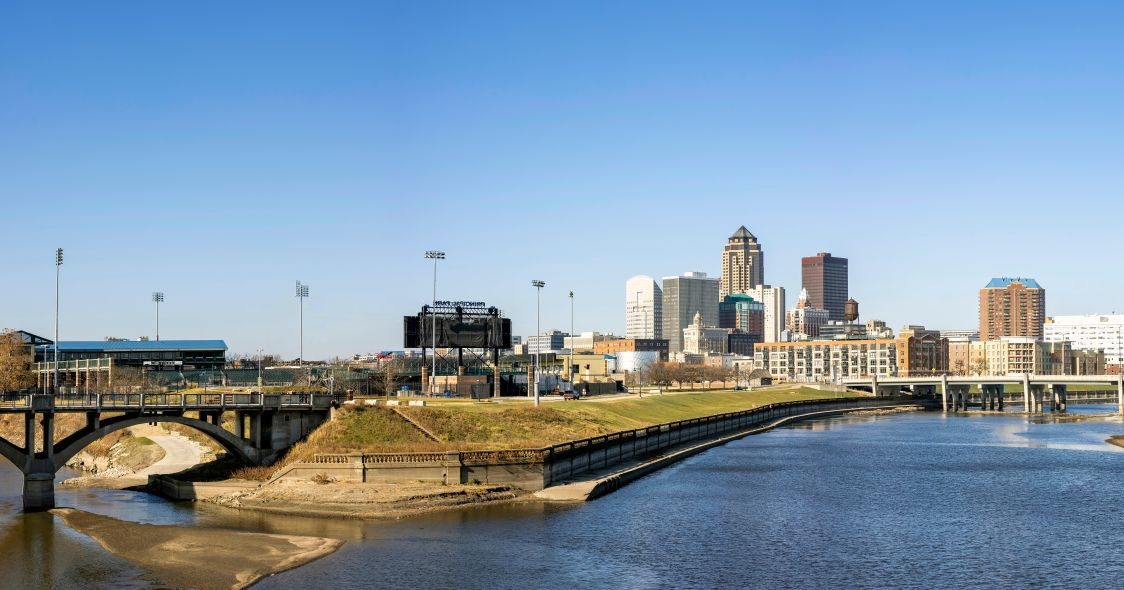
The confluence of the Des Moines and Racoon Rivers lies just outside downtown Des Moines, the state's capitol. Both provide the city's drinking water and are listed among Iowa's waterways impaired with nitrates and other toxins. (Adobe Stock)
The period for public comment on Iowa’s impaired waterways report closes this week.
The federal Clean Water Act requires the state to list potentially threatened rivers, lakes and streams every two years. Waterways in Iowa are routinely polluted with excess nitrate and phosphorous, the result of manure runoff from factory farms. The Iowa Department of Natural Resources uses the report to identify which bodies of water are meeting their designated goals for recreation, fishing and drinking water. Increased nitrate levels have prompted beach closures and lawn watering restrictions around the state because the state’s largest nitrate removal system can’t keep up with the contamination.
Progress Iowa volunteer Kim Hagemann said that in her 40 years as a resident, the water quality has definitely declined.
“And those increased nitrate levels, they used to say, ‘Oh, they’re just in the spring,’ and they would call it a ‘spring flush.’ But we are finding that those nitrate levels are high even in January this year,” she said.
The DNR assessed 61 variables in 213,000 Iowa waterways to arrive at the results in the report. Sections of the Racoon and Des Moines Rivers, both of which run through downtown Des Moines, are listed as impaired for nitrates. But the state maintains those levels meet federal safe drinking water standards.
Officials are working toward identifying sources of pollution before a waterway is included on the impaired list – knowing where animal e-coli contamination comes from, for example – which Hagemann said amounts to foot-dragging at the public’s expense.
“And we are spending a lot of money on it,” she said. “But if we don’t have the data to see what works, and we don’t have the regulations to stop the polluters, we are never going to make headway.”
The DNR says members of the public can submit their own scientific data and observations to help ensure which waterways wind up on the impaired list.
Related: Guest post: Iowa needs to stop ignoring our clean water crisis


Iowa John Deere workers recalled after layoffs
By Mark Moran John Deere has recalled 245 workers in Iowa after mass layoffs. They'll be back on the job this month and next. Prompted...

Oppose ICE? Here’s how you can take action
The moment we’re in The US Senate is currently deciding whether to approve new funding for the Department of Homeland Security (DHS), including...
Oppose ICE? Here’s how you can take action
The moment we’re in The US Senate is currently deciding whether to approve new funding for the Department of Homeland Security (DHS), including...
Clean water advocates announce demands for Iowa rivers, streams
By Mark Moran The environmental advocacy group Food & Water Watch has announced a 20-point "clean water blueprint" it says would help...
Iowa environmental researchers push back on clean water claims
By Mark Moran The Iowa Farm Bureau has released a statement claiming that the state's waterways are becoming cleaner, despite evidence that...

Iowa Guard soldier killed in Syria was Meskwaki police chief’s son
Meskwaki police chief says his son was one of the Iowa Guard members killed in Syria. by Robin Opsahl, Iowa Capital Dispatch December 14, 2025 The...