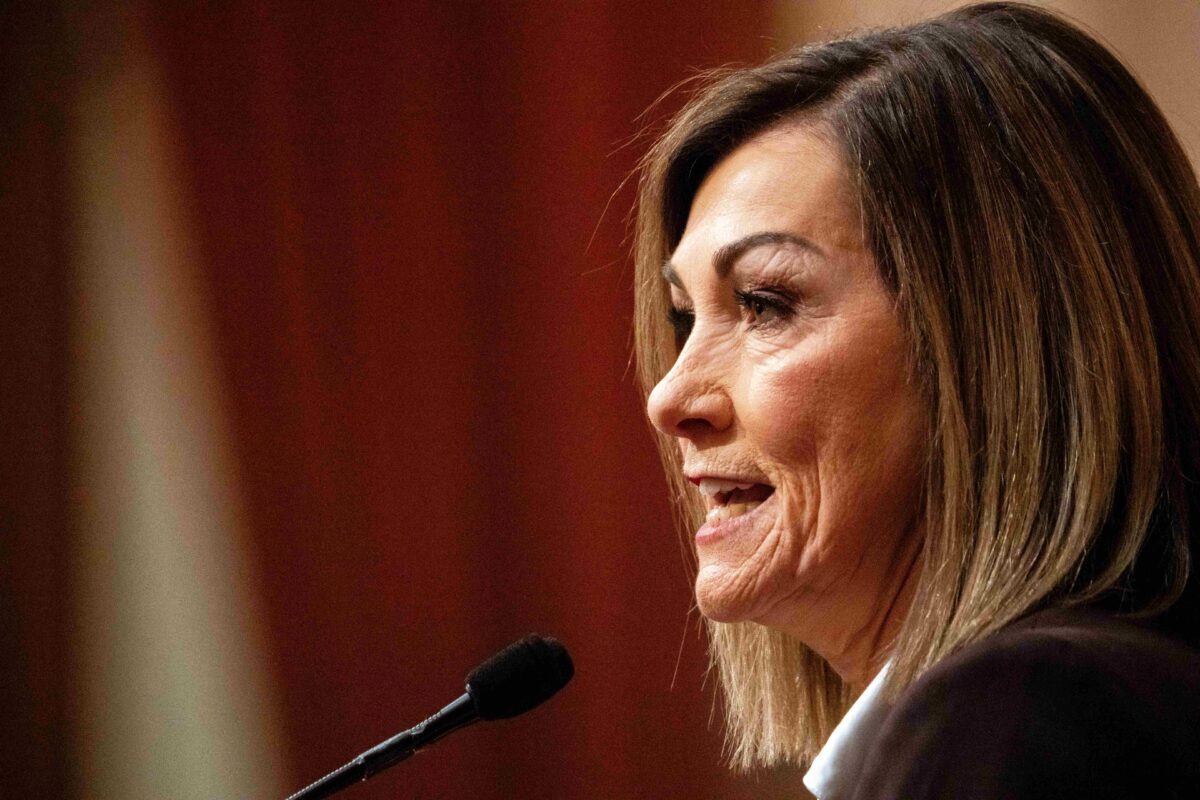
Gov. Kim Reynolds delivers her Condition of the State address on January 13, 2026 during a joint convention of the Iowa Legislature. Her speech devoted time to her plans to change Iowa's property tax rates.
Iowa lawmakers are racing to cut property taxes. One proposal would take funding powers away from your local school board.
Iowa lawmakers say they want to cut your property taxes. That part’s easy to promise. The hard part is deciding how to do it and what services they’re willing to give up.
Right now, Iowa schools get most fo their money from two places: property taxes you pay locally and funding from the state budget in Des Moines. One early proposal from Senate Republicans, SSB 3001, would shift basic school costs (foundation and special education support) to the state, while limiting local governments’ options for raising property taxes for revenue.
During gerCondition of the State address on Tuesday night, Gov. Kim Reynolds spoke about her own property tax proposal that she claimed would save $3 billion over six years. House Republicans have not released their plan, though Speaker Pat Grassley told reporters Tuesday that one would be released next week.
Before the Legislature gavels out this year, many property tax proposals will compete for support. The Senate proposal will vie for support against proposals from the House and governor. Using SSB 3001 as a starting point, here’s a look at some of the tools the Legislature could use to cut property taxes and the consequences of adopting them.
Shift who pays for a service
Instead of funding schools partially with local property taxes, Senate Republicans’ bill would require the state to pay for it out of the general fund—the state’s pot of money that comes mostly from sales and income taxes.
Under the Senate bill, the state would pay 100% of basic school costs, up from 88% now. It would also pay 100% of special education support, up from 79%. It would cut the school property tax rate from $5.40 to $4.49 per $1,000 of property value.
Shifting costs onto the state limits the size of property tax bills and schools still get their funding, at least on paper. But the downside is that state revenues fluctuate with the Iowa economy. Sales tax revenues fall with recessions, unlike property taxes that are relatively stable. On top of that, it means the most important funding decisions for districts get made in Des Moines by the Legislature and governor, not by the districts themselves. And at least under this bill, the schools would have fewer options for making up the difference.
State revenue fell by 8% in the most recent fiscal year, according to state estimates, mostly due to changes in income tax revenue. Iowa’s government is already using reserve monies to cover expenses, which isn’t sustainable long term. What happens in the next recession when Des Moines has to choose between schools, Medicaid, and public safety?
Cap percentages for local levies
Another way to limit property taxes is to tell cities, counties, and schools they can only raise their tax rate by a certain percentage in a single budgeting year.
Senate Republicans’ bill caps how fast property tax revenue can grow, generally between 2% and 5% depending on the rate of inflation. They argue this is more predictable for property owners.
Reynolds’ proposal features a flat 2% cap on revenue on property tax growth for local governments. Her cap would have exemptions for new construction, school funding, and debt services.
The challenge is a flat 2% cap becomes a de facto budget cut in years when inflation runs high. It means that local governments and school districts that have growing populations don’t necessarily benefit from additional funding past that cap to meet their needs.
For growing school districts like Ankeny or Waukee, this means they have a harder time responding when new students show up.
Groups like the Tax Foundation support this approach, but only if it’s tied to inflation and allows localities to save unused percentage increases for later. Without this, districts face a ‘use it or lose it’ pressure—max out the 2% every year or lose the ability to raise it later.
Tax breaks to specific groups
A third way to reduce property taxes is by lowering the taxable value of homes, either for everyone or specific groups like seniors or veterans.
The Senate Republicans’ bill would create a flat 50% exemption for all homeowner-occupied properties, regardless of income. This means a millionaire with a paid-off house gets the same break as a teacher stretching to make mortgage payments. The bill would also nearly eliminate property taxes for homeowners 60 and older who’ve paid off their mortgage.
Reynolds’ plan would be to freeze property taxes for all Iowans aged 65 and older whose homes are valued at no more than $350,000.
The downside is these approaches necessarily leave people out. While House Democrats are exploring ways to bring tax relief for renters, this proposal doesn’t do anything to lower high rent costs. Someone who owns a $400,000 house free and clear pays almost nothing. A renter in the apartment next door—who pays property taxes through their rent—gets zero relief.
Further, it shifts the tax burden to new homeowners and young families trying to buy property. It benefits people who bought houses decades ago at the expense of everyone else. Then there’s the issue of lost funding. Residential properties are a major source of tax revenue for services like police, fire, and schools. If the state knocks out a chunk of its taxable base in residential properties, where does that money come from?
Limit special levies
A popular way of cutting taxes in the state in recent years has been to remove special levies. A 2023 property tax bill removed special levies that once helped fund local libraries and museums.
The Senate Republican bill would decrease the levy used by schools for equipment and building improvements. It would restrict management levies if school districts have large reserves and reduce the debt levies a district can carry, even for voter-approved bonds.
The upside is this prevents special levies from ratcheting up property tax bills. The downside is it goes after tax increases that voters have already approved.
Every option has winners and losers. The question isn’t whether property taxes are too high; plenty of Iowans say they are. The question is what you’re willing to trade: Lower property taxes now, or local control over your schools? Predictable tax bills, or the ability for your district to respond to emergencies? Relief for property owners, or help for renters?
SSB 3001 makes one set of choices. The governor would make another. These are not the only options available.
It’s worth asking your legislator: Why across-the-board cuts instead of helping people who actually can’t afford their bills? Why eliminate local flexibility right when schools might need it? And what’s the backup plan when state revenues fall?

Support Our Cause
Thank you for taking the time to read our work. Before you go, we hope you'll consider supporting our values-driven journalism, which has always strived to make clear what's really at stake for Iowans and our future.
Since day one, our goal here at Iowa Starting Line has always been to empower people across the state with fact-based news and information. We believe that when people are armed with knowledge about what's happening in their local, state, and federal governments—including who is working on their behalf and who is actively trying to block efforts aimed at improving the daily lives of Iowan families—they will be inspired to become civically engaged.

Sen. Claire Celsi remembered for her passion and outspokenness
The Democratic state senator from West Des Moines died on Oct. 6 after a bout with an undisclosed illness. West Des Moines resident Al Womble will...

Iowa pumps brakes on crypto ATM transaction fees
A new law caps daily crypto ATM transactions at $1,000, limits fees to 15% of the transaction amount, and requires operators to provide full refunds...

Iowa Legislature passes budget bill, adjourns with no property tax cut
Lawmakers worked through the night Wednesday to reach a budget deal after a contentious session went into overtime. While most of us were sleeping,...

Opinion: Zach Nunn is my congressman. I had to travel to DC just to talk to him.
I recently traveled to Washington, D.C. with a group of Iowans to talk with my representative: Congressman Zach Nunn. We weren’t sightseeing. We...

Op-ed: Iowa School Chaplain Bill is a Christian Nationalist Knock Off
The School Chaplain bill is currently rushing through the Iowa legislature – it’s now heading to the Iowa Senate floor as H.F. 884, having passed...

Iowa House Democrats propose worker relief package amid Iowa economic headwinds
Iowa House Democrats unveiled a series of legislative proposals aimed at supporting working families as the state faces economic headwinds,...